


We may not have the course you’re looking for. If you enquire or give us a call on 01344203999 and speak to our training experts, we may still be able to help with your training requirements.
Home
 Resources
Project Management
What is the Project Management Triangle: Scope, Cost & Time Explained
Resources
Project Management
What is the Project Management Triangle: Scope, Cost & Time Explained
What is the Project Management Triangle: Scope, Cost & Time Explained
ByScarlett AdamsLast updated on: 22 October 2026
The project management triangle explains how scope, cost and time influence one another during project delivery. This blog explores the three constraints, their relationships, practical management strategies, key benefits and applications across different industries.

At a Glance
1. Three Constraints: Scope defines the work, cost sets financial limits and time determines the delivery schedule.2. Connected Decisions: Changing one constraint may affect the others, depending on project conditions.3. Quality Considerations: Project trade-offs must account for agreed quality requirements and fitness for purpose.4. Managing Changes: Risk management, stakeholder communication and project change control support informed decisions.5. Practical Applications: The triangle helps teams evaluate competing requirements across IT, product development and construction projects.
Client: “Can we add one more feature?”
Project Manager: “Of course. Shall we review the timeline and budget?”
Client: “Actually, those need to stay exactly the same.”
Sounds familiar?
One small request. Three project constraints. And suddenly, a simple change isn't so simple anymore.
This is where the project management triangle comes into play. It helps project teams understand how changes to scope, time and cost can influence one another, making it easier to evaluate competing project demands.
But how does this triangle work in practice? Let's explore its three constraints and how they can guide better project decisions.
What is the Project Management Triangle?
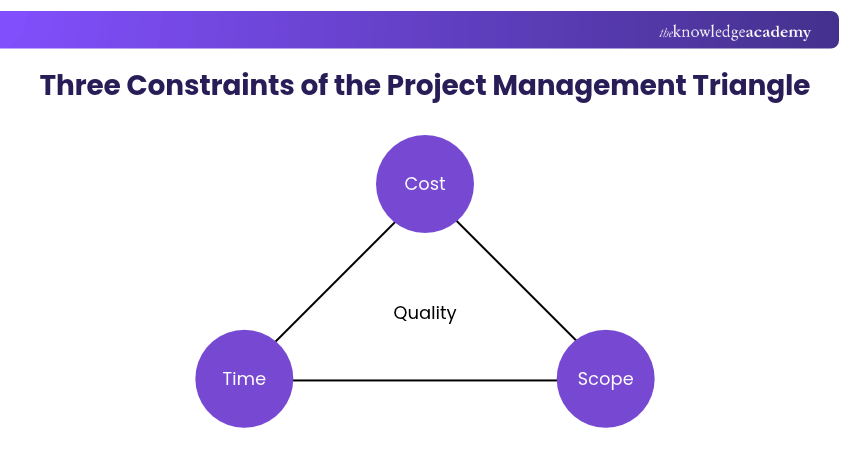
The project management triangle, also known as the triple constraint or iron triangle, illustrates the relationship between three project constraints: scope, cost and time. It helps teams understand how changes to one constraint may affect the others and assess potential trade-offs.
For example, additional deliverables may require more time or resources, while a reduced budget may require adjustments to planned work. Quality is also an important consideration and is often represented at the centre of the triangle. It helps teams understand the need to balance scope, time and cost while meeting project requirements and standards.

What are the Three Constraints of the Project Management Triangle?
The project management triangle consists of three interconnected constraints, each representing a different aspect of project delivery. They include the following:
1) Scope
Scope defines the work, deliverables, requirements and boundaries of a project. Clearly establishing what is included and excluded helps teams estimate resources and evaluate requests. Uncontrolled expansion of project scope is known as scope creep.
Example: In a website development project, the agreed scope might include a homepage, product catalogue and checkout functionality. Adding a customer loyalty programme would represent additional scope if it was not part of the original agreement.
2) Cost
Cost represents the financial resources required to complete a project, including labour, materials, equipment and external services. Managing this constraint involves estimating expenditure, setting an approved budget and monitoring costs as the project progresses.
Example: If a construction project requires additional specialist materials after a design change, the project team may need to review its cost estimate and available budget.
3) Time
Time refers to the project schedule, including activity durations, milestones, deadlines and dependencies. Effective schedule management helps teams monitor progress and identify delays that may affect later activities or the completion date.
Example: During an office renovation, electrical work may need to be completed before certain finishing activities can begin. A delay in the electrical work could therefore affect later tasks and the overall schedule.
How are Scope, Cost, and Time Interconnected?
Scope, cost and time are interconnected because scope determines the activities required, and those activities require resources and take time to complete. Increasing scope may require additional funding, a longer schedule or adjustments to quality or other constraints. Similarly, shortening a deadline may increase costs, require additional resources or lead to a reduction in planned deliverables.
However, these relationships are not always proportional. Adding more people does not necessarily shorten delivery, and reducing scope may not produce equivalent savings. Project dependencies, available skills and contractual commitments influence the actual impact.
Worked Example: A Project Scope Change
Imagine a software project with an illustrative budget of £80,000 and a planned duration of 12 weeks. During development, a stakeholder requests an additional reporting feature.
Before approving the request, the Project Manager evaluates three possible responses.
|
Option |
Possible Action |
Consideration |
|
Adjust Scope |
Defer a lower-priority feature to a later release |
Check whether the revised deliverables still meet essential business requirements |
|
Review Cost |
Assess whether additional specialist support is justified |
Extra resources may increase costs without necessarily shortening the schedule |
|
Extend Timeline |
Negotiate a later delivery date |
Consider dependencies, contractual commitments and delayed business benefits |
The team should also examine testing, security and other quality requirements before making a decision.
Keep This in Mind
The triangle illustrates possible trade-offs, not fixed mathematical relationships. Every proposed change requires an assessment of its actual impact.
How to Manage the Project Triangle?
Managing the project management triangle involves recognising competing priorities, monitoring changing conditions and making decisions based on reliable information. The following approaches help teams address constraints throughout project delivery:
1) Maintain Clear Communication with Stakeholders
Stakeholders may prioritise different project constraints, such as fixed deadlines, budgets or essential deliverables. Discuss these priorities early, clarify which commitments are flexible and explain the potential consequences of proposed changes. When decisions are required, present the available options and obtain appropriate agreement before updating project commitments.
2) Establish Effective Risk Management Processes
Project risks are uncertain events or conditions that may affect project objectives. Delayed materials, unavailable specialists, changing requirements and unexpected technical issues can all place pressure on the triangle.
Identify relevant risks, assess their likelihood and potential impact, and plan suitable responses. Review the risk register as new information becomes available and monitor important warning signs throughout the project.
Pro Tip: Track Constraint-related Risks
When recording a risk, identify which constraint it could affect and how. For example, a possible supplier delay may threaten the schedule, while an uncertain material price may create cost exposure. This makes the risk assessment more directly useful for project decisions.
3) Establish a Project Change Control Process
Project change control provides a structured way to assess requests that may affect approved commitments. It generally involves recording the request, evaluating its impact on scope, cost, time and quality, deciding whether to approve, reject or defer the change, and updating relevant project records when a change is approved.
The level of formality depends on project governance and the delivery approach. Iterative projects may manage certain adjustments through backlog prioritisation, while significant changes to agreed commitments may require formal approval.
Trainer’s Insight: Approve the Impact, Not Just the Request
Before approving a substantial project change, confirm what additional work is involved, which existing commitments may be affected and who is authorised to make the decision. A request can appear small while having significant consequences for dependencies or testing.
4) Select a Suitable Project Management Approach
The choice of project management approach depends on requirements, uncertainty, governance and team capabilities. Predictive approaches may suit projects with relatively stable requirements, while adaptive or iterative approaches can support work where requirements evolve through feedback.
Some projects use a hybrid approach that combines planned delivery stages with iterative activities. The selected approach should support the project's objectives, quality requirements and available resources rather than depend solely on scope, cost or time.
Understand how project, programme, and portfolio management work together with our Project Management Certification Training – Join now!
Why Should You Use the Project Management Triangle?
The project management triangle helps teams understand competing constraints and make informed project decisions. By providing a clear view of scope, cost and time, it supports better communication, risk awareness and management of changing requirements. Here are its key benefits:
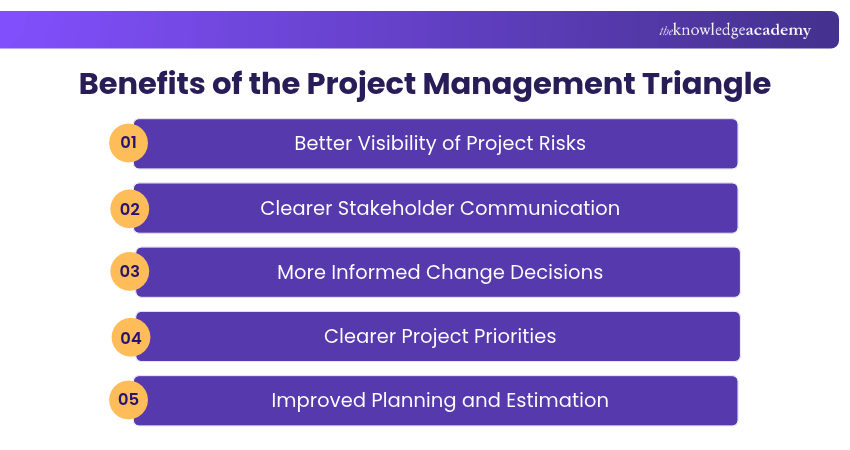
1) Better Visibility of Project Risks
The triangle helps teams recognise how problems affecting one constraint may influence other commitments. For example, a schedule delay could increase labour costs or affect planned deliverables, highlighting areas that require further risk assessment. This helps teams address potential problems before they cause significant disruption to project delivery.
2) Clearer Stakeholder Communication
Scope, cost and time provide a shared framework for discussing project commitments. This helps stakeholders understand how proposed changes may affect delivery expectations, particularly when their priorities differ.
3) More Informed Change Decisions
The triangle helps decision-makers evaluate changes by comparing their potential benefits with the effects on scope, cost and schedule. This supports more informed decisions when project commitments have limited flexibility.
4) Clearer Project Priorities
Projects may have fixed deadlines, funding limits or essential deliverables that cannot easily change. The triangle helps teams recognise these priorities, identify where flexibility exists and determine which trade-offs require stakeholder agreement.
5) Improved Planning and Estimation
The triangle encourages teams to define scope before estimating cost and time, which links planning decisions to agreed deliverables. This helps teams build more realistic budgets and schedules and allocate resources based on the work required.
How to Apply the Project Management Triangle?
The project management triangle can support decisions across industries, although the factors affecting scope, cost and time vary by project. The following examples show how teams may apply the model in different situations:
1) Application in IT Projects
IT projects may face changing requirements, integration dependencies and testing challenges. For example, a company migrating its data to a cloud platform may discover that transferring certain applications requires more time and resources than initially estimated.
The project team can use the project management triangle to evaluate the impact on scope, cost and time. If the migration takes longer than planned, the team may extend the deadline, increase the budget to accommodate additional resources or move less critical applications to a later phase. This helps the team make informed decisions while maintaining essential security and operational requirements.
2) Application in Product Development Projects
Product development projects involve design requirements, materials, prototypes and testing. For example, a company developing a household appliance may identify a design improvement that requires a different component during prototype testing.
The team should use the triangle to compare the change in scope with the component’s cost, the time needed for validation and the effect on production schedules. Decision-makers can then determine whether to introduce the change before launch or consider it for a later version, while ensuring applicable safety requirements are still met.
3) Application in Construction Projects
Construction projects involve interdependent activities, resources and site conditions. For example, an unexpected ground condition during a commercial building project may require additional foundation work.
This increases scope, so the project team should assess the effect on cost, including materials and labour, and on the construction schedule. It can then review suitable adjustments or contractual changes. Structural safety, approved specifications and regulatory compliance remain non-negotiable.
Project Constraint Review Checklist
Use this checklist to review important project constraints before approving significant changes or commitments.□ Confirm Project Scope: Are the project's scope and deliverables clearly defined and agreed upon?□ Review Cost and Time: Have the potential budget and schedule impacts of proposed changes been assessed?□ Check Dependencies: Are task dependencies and critical resource requirements understood?□ Protect Quality and Safety: Have essential quality, safety and regulatory requirements been considered?□ Obtain Stakeholder Approval: Have significant changes received approval from the appropriate stakeholders?
Understand the principles of project planning and execution with our Project Management Courses – Register now!

 If you wish to make any changes to your course, please


