




We may not have the course you’re looking for. If you enquire or give us a call on 01344203999 and speak to our training experts, we may still be able to help with your training requirements.
What is Project Initiation Phase: Importance, Steps and Key Roles
ByDavid EvansLast updated on: 19 August 2026
The Project Initiation Phase turns an idea into a defined and authorised project. This blog explores its importance, key roles, initiation steps, major deliverables, and readiness checks.

Key Takeaways
1. Project Initiation evaluates whether a proposed project is valuable, feasible and aligned with organisational objectives.2. The business case supports the investment decision, while the project charter or equivalent document supports formal authorisation.3. Early stakeholder identification helps clarify expectations, influence and responsibilities.4. Initial scope, risks, assumptions and resource needs should be understood before detailed planning.5. Initiation may result in approval, revision, deferral or rejection of the proposal.
Imagine you are discussing a promising new project with your team.
The idea sounds exciting, but one colleague pauses and asks:
"Is this project truly worth pursuing, and are we ready to begin?"
That simple question is exactly why the Project Initiation Phase matters. Before committing time, money and people, teams need to assess feasibility, clarify objectives, define the high-level scope and identify key stakeholders.
So, how can you turn an exciting idea into a well-defined and authorised project?
This blog explores What is Project Initiation Phase, why it matters, the key roles involved, essential steps, major deliverables and more. Let's begin!
What is Project Initiation Phase?
Project Initiation is the process of defining and formally authorising a new project or project phase. During initiation, the organisation examines the project's purpose, feasibility, expected business value and key stakeholders before deciding whether it should proceed.
In the Project Management Institute's traditional Process Group framework, Initiating is one of five Process Groups. It defines and authorises a project or phase through activities such as developing the project charter and identifying key stakeholders. The business case supports authorisation, while detailed planning follows in the Planning Process Group.

Why is the Project Initiation Phase Important?
The Project Initiation Phase creates a reliable foundation for informed decision-making. It allows organisations to test the value and practicality of an idea before committing significant time, money and resources. Here are the key reasons why Project Initiation is important:
1. Confirms the Business Need: The Project Initiation Phase establishes the problem, opportunity or requirement behind the project. This prevents teams from starting work without understanding what the project is expected to achieve.
2. Supports Strategic Alignment: The proposed project can be assessed against organisational objectives and priorities. Projects that do not provide sufficient value or support strategic goals can be revised, deferred or rejected.
3. Tests Feasibility: Early analysis examines whether the project can realistically be completed with the available technology, skills, funding and time. It can also identify legal, operational or environmental concerns.
4. Creates Stakeholder Alignment: Identifying stakeholders early helps the organisation understand their expectations, influence, concerns and decision-making authority. This reduces the risk of discovering important opposition or requirements later.
5. Establishes High-level Boundaries: A preliminary scope clarifies what the project is expected to cover and what falls outside it. This provides direction without attempting to create a detailed scope baseline too early.
6. Reveals Early Uncertainty: Initial risks, assumptions, constraints and dependencies can affect whether the project is achievable. Recognising them early improves the quality of estimates and approval decisions.
7. Enables Formal Authorisation: Initiation provides the information required for the sponsor or governing authority to decide whether the project should proceed. Formal approval also clarifies accountability and authority.
Build a strong foundation for project success with the Introduction to Project Management Course – Join now!
Key Roles Involved in Project Initiation Phase
Project Initiation Phase requires contributions from people who understand the business need, expected benefits, delivery environment and governance requirements. The exact roles vary depending on the organisation and project. Some of the key ones include:
1. Project Sponsor: Champions the project, owns or supports the business case, secures senior support and helps obtain approval and resources.
2. Project Manager: Helps define the project, coordinates initiation activities and provides delivery estimates and advice.
3. Business Analyst: Investigates requirements, problems, processes and stakeholder needs.
4. Subject Matter Experts (SMEs): Provide specialist information for scope, feasibility, risk and estimation.
5. Key Stakeholders: Contribute requirements, constraints, concerns and acceptance expectations.
6. Project Management Office (PMO): Provides governance guidance, templates and review requirements where a PMO exists.
7. Financial or Commercial Representative: Reviews costs, affordability, procurement needs and financial assumptions.
Trainer's Insight
An effective Project Sponsor provides more than approval. They champion the business need, support key decisions and help remove organisational barriers that could prevent the project from progressing.
Steps in Project Initiation
The following steps provide a practical approach to Project Initiation. Their order, depth and documentation may vary depending on the organisation, methodology, project size and level of risk. Some activities may overlap or begin before formal initiation. Let's look at them below:
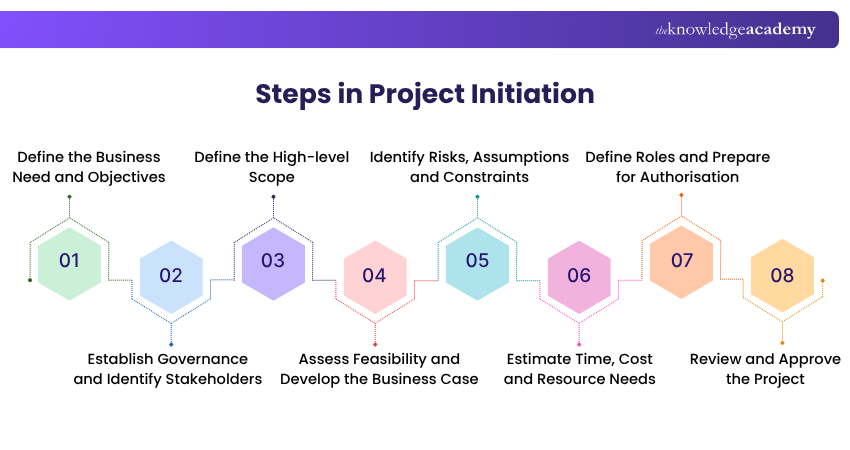
1) Define the Business Need and Objectives
Identify the problem, opportunity or requirement the project will address. Explain why it is needed, what outcome is expected and how it supports organisational priorities. Set high-level objectives and initial success criteria, leaving detailed requirements for planning.
Pro Tip
Link every project objective to a clear business need and expected outcome. If that connection cannot be explained, the proposal may require further analysis.
2) Establish Governance and Identify Key Stakeholders
Confirm the Project Sponsor, key decision-makers and initial governance arrangements. Identify stakeholders who may influence the project, provide resources, use its outputs or be affected by its outcomes. Assess their interests, influence and expectations to support early engagement and decision-making.
3) Define the High-level Scope
Outline the project's expected deliverables and main boundaries. Clarify what is included, excluded and still requires further investigation. Keep the scope high-level, as detailed requirements and the scope baseline are normally developed during planning.
4) Assess Feasibility and Develop the Business Case
Assess whether the proposal appears achievable and worthwhile by considering relevant technical, financial, operational, legal and resource factors. Develop or review the business case by comparing realistic options and considering expected benefits, costs and risks.
Trainer's Insight
A strong business case does not simply promote one solution. It compares realistic options and explains why the preferred option offers suitable value within an acceptable level of risk.
5) Identify Initial Risks, Assumptions and Constraints
Record the major risks, assumptions, constraints and dependencies that could affect the project or approval decision. These may include fixed deadlines, funding limits, supplier availability and external dependencies. More detailed risk analysis can follow during planning.
6) Estimate Time, Cost and Resource Needs
Prepare preliminary estimates for the project's duration, cost, skills, technology and resource requirements. Clearly document the assumptions and uncertainty behind these figures, as they support the approval decision but are not yet approved baselines.
Pro Tip
Treat early cost and time figures as estimates rather than fixed commitments. Record the assumptions behind them and refine the figures when more reliable information becomes available.
7) Define Roles and Prepare for Authorisation
Identify the Project Manager, business owner and other key contributors and clarify their initial responsibilities and authority. Prepare the project charter or equivalent authorisation documents required by the organisation to support formal project approval.
8) Review and Approve the Project
Submit the proposal to the sponsor, project board or relevant authority for review. Based on its expected value, feasibility, risks and resource requirements, the project may be approved, conditionally approved, revised, deferred or rejected. Detailed planning should begin once the project is formally authorised.
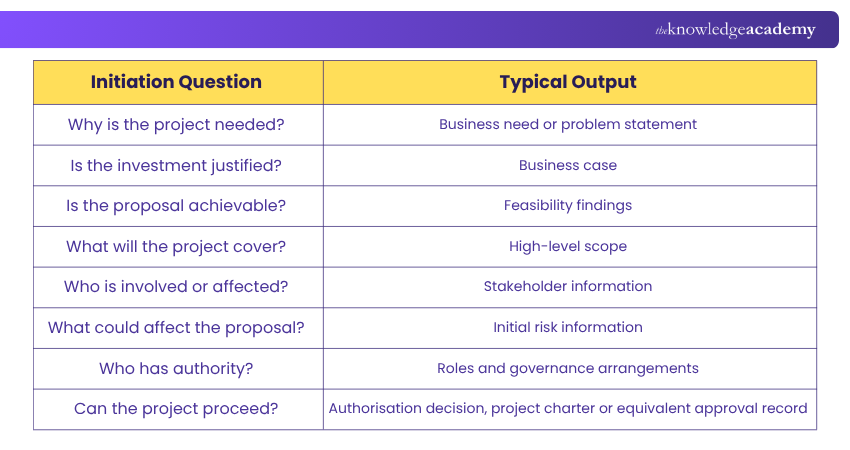
From Initiation Question to Project Output
Key Deliverables of the Project Initiation Phase
The Project Initiation Phase develops, reviews or brings together the information required to assess, define and authorise a proposed project. The exact deliverables vary according to the organisation's methodology, governance requirements and project complexity. Let's look at the core ones below:
1. Business Case: The business case explains why the project should proceed by comparing its expected benefits, costs and risks. It recommends a preferred option and should be reviewed as project conditions change.
2. Project Charter or Authorisation Document: In PMI-based environments, the project charter formally authorises the project and summarises high-level information such as its objectives, scope, risks and stakeholders. Other approaches may use different documents or governance mechanisms to support project authorisation.
3. High-level Scope: The high-level scope outlines the project's expected outputs and boundaries. It clarifies what is included, excluded and still requires investigation, while detailed scope planning follows approval.
4. Initial Stakeholder Information: Initial stakeholder information identifies those who may influence or be affected by the project and records their interests, expectations and influence to support future engagement planning.
5. Feasibility Findings: Feasibility findings indicate whether the project appears achievable and worthwhile. They may cover technical, financial, operational, legal and resource factors and can be included within the business case.
6. Initial Risk Information: An initial risk record captures major risks, assumptions, constraints and dependencies. It helps decision-makers understand uncertainty before approval, while more detailed risk management follows later.
7. Preliminary Estimates: Preliminary estimates indicate the expected time, cost, skills and resources required. Their assumptions and uncertainty should be clearly stated because they are not approved baselines.
8. Roles and Governance Arrangements: This deliverable identifies the sponsor, Project Manager and key decision-makers. It clarifies responsibilities for funding, approvals and escalation, with governance proportionate to the project's risk and complexity.
9. Approval Record: The approval record confirms whether the project has been approved, conditionally approved, revised, deferred or rejected. It identifies the decision-maker and records any conditions attached to the decision.
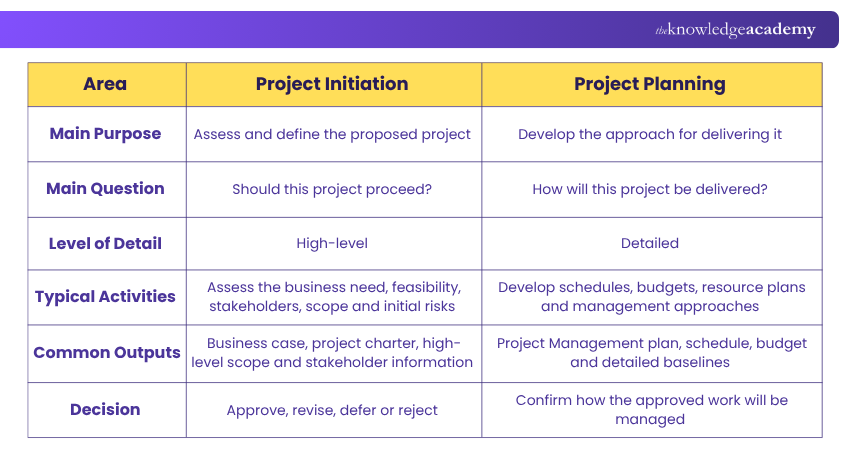
Project Initiation vs Project Planning
Understanding the distinction between Project Initiation and Project Planning is crucial for effective Project Management. Below is a comparison of Project Initiation vs Project Planning:
Project Initiation Readiness Checklist
Before moving into detailed planning, use this checklist to confirm that the project has a sufficient foundation and the required authorisation:
The business need is clearly defined
□ The project supports relevant organisational objectives□ The expected outcomes and benefits are understood□ Suitable options have been considered□ The preferred option appears feasible□ The high-level scope and exclusions are clear□ Key stakeholders have been identified□ Major risks, assumptions, constraints and dependencies are recorded□ Preliminary time, cost and resource needs are understood□ The sponsor, Project Manager and decision-makers are identified□ The required business case and authorisation documents are complete□ The appropriate authority has formally authorised the project
Conclusion
Every successful project begins with clear direction. Understanding What is Project Initiation Phase helps teams assess value, define goals, identify stakeholders and recognise potential risks before detailed planning begins. With the right foundation and formal approval, organisations can reduce uncertainty, use resources wisely and move forward with greater confidence.
Learn how to create stronger systems for project delivery by signing up for the Project Management Office Fundamentals Certification Course today!

David Evans creates accessible resources that help professionals understand different approaches to planning and delivering projects. His content addresses changing requirements, collaborative working and the practical demands of contemporary project environments.
View Detail

 If you wish to make any changes to your course, please


