




We may not have the course you’re looking for. If you enquire or give us a call on + 1-866 272 8822 and speak to our training experts, we may still be able to help with your training requirements.
What is Microeconomics: Definition and Key Concepts
ByThe Knowledge AcademyLast updated on: 18 September 2026
Microeconomics is the branch of economics that studies individual and business decisions regarding the allocation of resources, goods and service pricing.

Quick Preview
1. Microeconomics studies the choices of individuals, households, firms and specific markets.2. Limited resources make choice and resource allocation central to microeconomic analysis.3. Supply and demand help explain changes in prices and quantities within markets.4. Consumer behaviour, production costs and market structures influence economic decisions.5. Microeconomics helps explain everyday choices, from purchasing products to businesses setting prices.
You walk into your favourite cafe and your go-to latte just got pricier. Why? Welcome to the world of microeconomics, the behind-the-scenes force guiding everyday decisions, from coffee prices to your weekend splurges. It’s not just textbook theory, but economics that explains how people spend, how businesses price, and how markets react.
It is the study of you, your choices, your budget, your habits and how they connect to a bigger economic picture. It’s what drives business decisions, pricing, and market shifts. In this blog, we'll unpack what microeconomics is, its key concepts, and why it shapes far more of your everyday decisions than you might expect.
What is Microeconomics?
Microeconomics is a branch of economics that focuses on the behaviour and decision-making processes of individuals, households, and businesses. It studies how these entities allocate limited resources to satisfy their needs and wants. The main aim is to examine the key concepts such as supply and demand, pricing mechanisms, consumer choice, production and costs, and market structures.

Key Concepts of Microeconomics
Here are the key concepts that make up microeconomics:
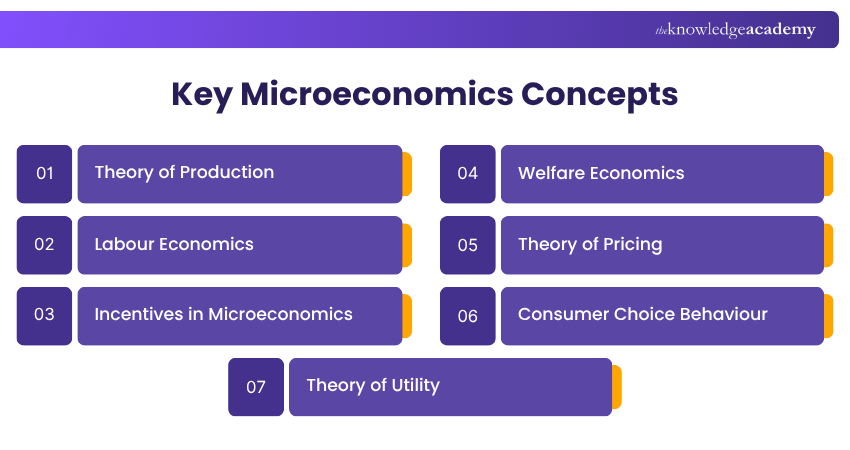
1) Theory of Production
This theory explores how businesses transform inputs like labour, capital, and raw materials into outputs (goods and services). It examines production functions, efficiency, costs, and how firms decide the optimal combination of inputs to maximise profit.
2) Labour Economics
Labour economics studies the supply and demand for labour. It investigates wage determination, employment levels, and how workers and employers interact in labour markets. It also considers the impact of education, skills, and unions on employment.
3) Incentives in Microeconomics
Incentives are central to decision-making. Microeconomics analyses how individuals and firms respond to rewards or penalties. Examples include lower prices, higher wages, or taxes, to influence behaviour and drive efficient outcomes.
4) Welfare Economics
Welfare economics focuses on how economic policies and market conditions affect social welfare. It examines resource allocation efficiency and fairness, often using tools like cost-benefit analysis and Pareto efficiency.
5) Theory of Pricing
This theory explains how prices are determined through supply and demand interactions. It includes understanding how producers set prices, how consumers react to prices, and how equilibrium is achieved in different types of markets.
Trainer Insight
Market equilibrium should not be viewed as a permanently fixed price. Changes in supply or demand can alter the market outcome and establish a different equilibrium.
6) Consumer Choice Behaviour
This concept analyses how individuals make decisions to maximise satisfaction (utility) within budget constraints. It considers preferences, income, prices, and trade-offs involved in choosing between different goods and services.
7) Theory of Utility
Utility theory explains how consumers derive satisfaction from goods and services. It forms the basis of demand; people buy more of what gives them greater utility. It includes concepts like marginal utility and the law of diminishing returns.
Quick Check
Scenario: A product suddenly becomes more desirable while its supply remains unchanged. What would you generally expect?A) Demand decreasesB) Price faces upward pressureC) Supply automatically doublesD) Price must fallAnswer: B, because more consumers are competing for the available supply.
Demand in Microeconomics
In microeconomics, demand refers to the willingness and ability of consumers to purchase a specific quantity of a good or service at various price levels within a certain timeframe. It focuses on individual consumer behaviour and how price changes influence buying decisions in a particular market.
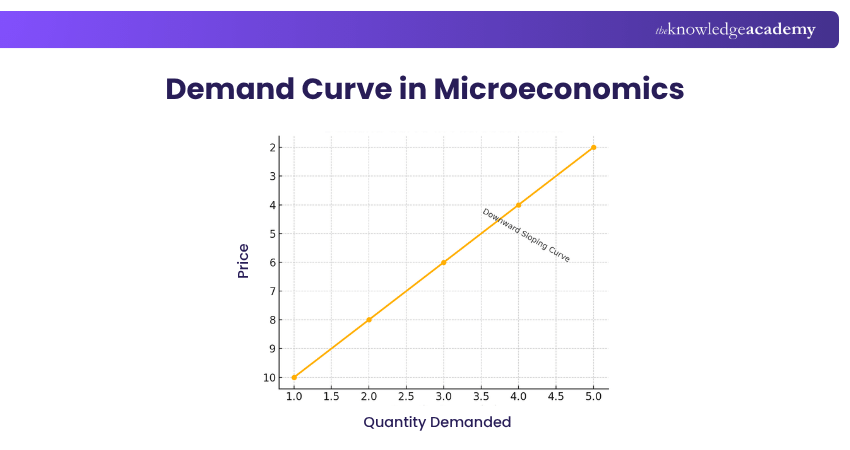
Here are some of the main aspects of demand:
1) Law of Demand: In microeconomics, this law shows that when the price of a good falls, the quantity demanded increases, assuming other factors remain unchanged (ceteris paribus).
2) Demand Curve: A key microeconomic tool, it shows the inverse relationship between price and quantity demanded.
3) Determinants: Microeconomics analyses how factors like consumer income, preferences, and prices of substitutes or complements affect demand at the individual or firm level.
Master the principles behind markets, pricing, and business strategy with the CIMA’s CGMA® Fundamentals of Business Economics (BA1) Course – Sign up now!
Supply in Microeconomics
In microeconomics, supply refers to the quantity of a good or service that producers are willing and able to offer for sale at various prices over a specific period. It focuses on the behaviour of individual firms and sellers within a market and how they respond to price changes and other economic factors.
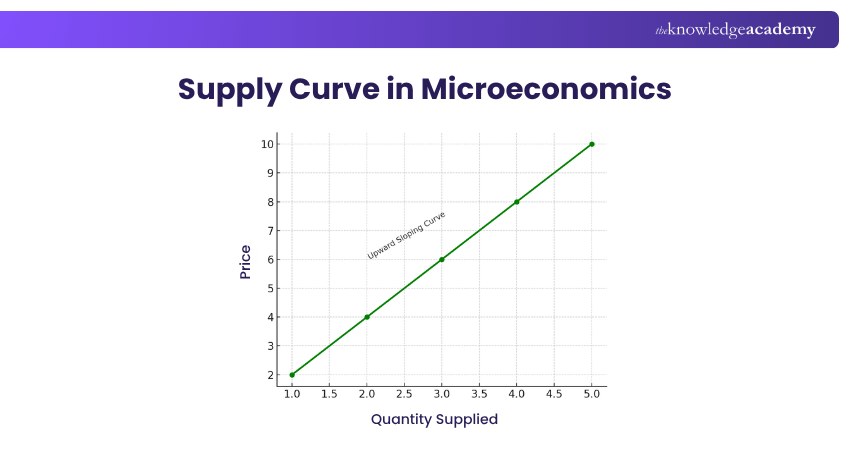
Here are some of the main aspects of Supply:
1) Law of Supply: As price increases, quantity supplied also increases, assuming other factors remain constant.
2) Supply Curve: Typically, upward-sloping, showing a direct relationship between price and quantity supplied.
3) Determinants of Supply: Includes production costs, technology, taxes, subsidies, and future expectations.
4) Individual vs Market Supply: Individual supply refers to one firm; market supply is the total of all producers.
The Price Mechanism in Microeconomics
The price mechanism is the fundamental process through which supply and demand interact to determine the prices of goods and services in a free-market economy. It plays a central role in resource allocation, helping balance what consumers want with what producers provide. All of this happens without direct government control.
How the Price Mechanism Works:
1) When Demand Rises: Prices tend to increase, signalling producers to increase output
2) When Supply Rises: Prices usually fall, encouraging consumers to buy more
3) When There's Scarcity: Prices go up, helping ration the limited supply
Why the Price Mechanism Matters:
1) Promotes economic efficiency by distributing goods to those who value them
2) Reduces the need for central planning or government intervention
3) Enables self-regulation of the market through voluntary exchanges
4) Reacts dynamically to changing market conditions in real-time
A strong understanding of finance is the fuel behind successful business decision. Learn about it all in the Finance Courses – Sign up now!
Difference Between Microeconomics and Macroeconomics
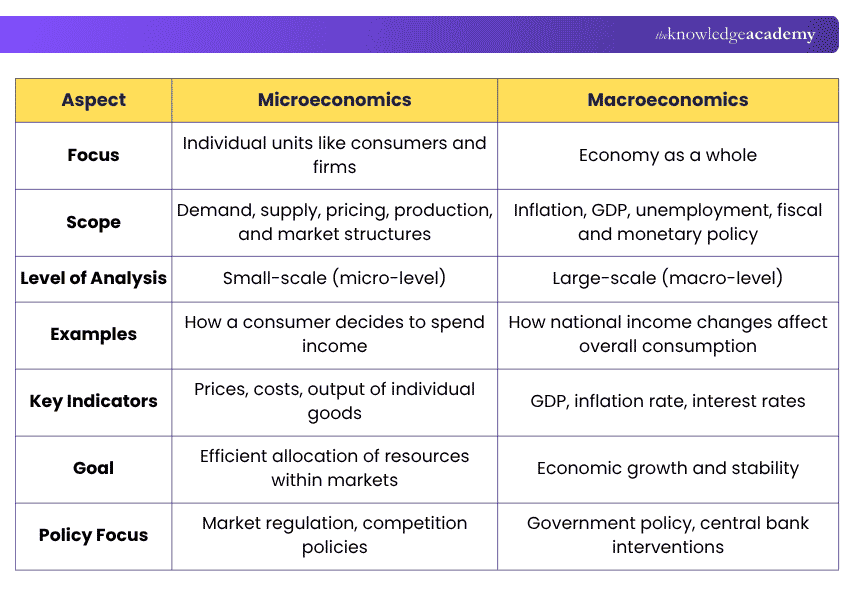
In Economics, understanding the distinction between microeconomics and macroeconomics is essential. While both branches study how economies function, they do so at different levels. Microeconomics zooms in on individual consumers, firms, and specific markets, whereas macroeconomics takes a broader view of national-level trends.
Here are the key distinctions:
Method of Microeconomics
Microeconomics uses two primary methods to study economic behaviour: deductive and inductive methods. These help economists develop theories, test hypotheses, and explain real-world phenomena at the individual and firm level.
1) Deductive Method
The deductive method begins with general economic principles or assumptions and logically deduces conclusions about specific situations. It’s a top-down approach.
a) Economists start with basic assumptions like consumers aim to maximise utility
b) From these, they build economic models and theories like demand and supply laws
c) These models are then used to predict real-world behaviour
d) Theories are tested against actual outcomes for validation
2) Inductive Method
The inductive method is a bottom-up approach, where conclusions are drawn from observations and real data.
a) Economists collect and analyse real-world economic data
b) Patterns or trends are identified
c) General principles or theories are formed based on these patterns
Examples of Microeconomics in Everyday Life
Microeconomics appears in many everyday situations where individuals and businesses make choices about prices, resources and spending. For example, a family may choose between eating out and saving for a holiday based on its available budget. Other situations include:
1) Consumer Spending: A student weighing up whether to buy a new laptop now or save the money for an upcoming trip is making a classic microeconomic trade-off between immediate wants and future needs.
2) Business Production: A bakery deciding to bake 200 loaves instead of 300 because it expects quieter footfall that day is directly applying supply decisions to anticipated demand.
3) Pricing Decisions: A cinema dropping ticket prices for Tuesday afternoon screenings, when seats would otherwise sit empty, is using price to shift demand into a slower period.
4) Employment Decisions: A retail store bringing on extra seasonal staff every December, then scaling back in January, shows how businesses adjust labour based on expected customer demand.
5) Market Competition: Two gyms in the same neighbourhood offering different membership tiers, one cheaper with fewer perks, one pricier with added extras, illustrates how competitors position themselves to attract different customer segments.

The Knowledge Academy develops accessible learning content across Project Management, IT, Cybersecurity, Data Science, Business Analysis, HR, Accounting and Finance, Leadership and Health and Safety. Its resources combine subject research with clear explanations to help professionals build practical knowledge across a wide range of disciplines.
View Detail

 If you wish to make any changes to your course, please


