


We may not have the course you’re looking for. If you enquire or give us a call on 01344203999 and speak to our training experts, we may still be able to help with your training requirements.
What is a Linear Data Structure: Types, Operations and Benefits
ByVishnu SankarLast updated on: 12 October 2026
Learn what a linear data structure is, how it organises elements sequentially, and how arrays, linked lists, stacks, and queues work. This blog also explores common operations, advantages, disadvantages, and practical uses in programming.
Quick Look
1. Choosing the right data structure can significantly affect program efficiency and scalability.2. Access patterns, memory requirements, and expected data changes should guide structure selection.3. Understanding time complexity helps developers anticipate how performance changes as datasets grow.4. Combining different data structures is often more effective than relying on a single structure throughout an application.
A linear data structure organises elements in a sequential arrangement, where elements are typically processed or traversed in a defined order. Common examples include arrays, linked lists, stacks, and queues. Linear data structures serve as the fundamental building blocks for data organisation. They provide a systematic way to store, manage, and manipulate data in a linear fashion.
This blog will discuss what is linear data structure, exploring its various types, advantages and disadvantages, and use cases. Read more to learn more.
What is a Linear Data Structure?
A Linear Data Structure is a method of organising and storing data elements in a sequential order, where each element is logically connected to the next. This structure allows data to be accessed and processed in a systematic manner, making it easier to perform operations such as insertion, deletion, searching, and traversal.

Key Characteristics of Linear Data Structures
Linear Data Structures exhibit several essential characteristics that set them apart from other Data Structures. These characteristics are crucial for understanding their behaviour and applications:
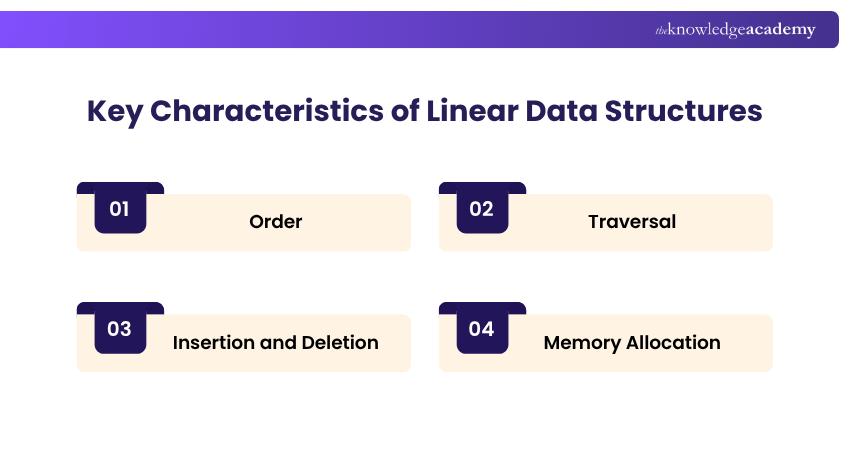
1) Order: Elements are organised in a linear sequence, with their positions determined by the structure and its operations. The values themselves do not need to be sorted.
2) Traversal: One of the fundamental operations with linear data structures is sequential traversal. Traversal involves visiting elements in a defined sequence. The method depends on the structure; for example, linked lists are typically traversed node by node, while arrays also support indexed access.
3) Insertion and Deletion: Linear data structures allow for the insertion and deletion of elements at specific positions. The cost of insertion and deletion depends on the data structure and position involved. Some structures support these operations efficiently at specific locations, while others may require shifting or traversing elements.
4) Memory Allocation: In linear data structures like Arrays, memory allocation is typically contiguous. This means that elements are stored in adjacent memory locations. Arrays typically store elements in contiguous memory, which supports efficient indexed access and good memory locality. Linked structures, by contrast, commonly store nodes separately and connect them through references or pointers.
Common Operations on Linear Data Structures
Linear Data Structures support various operations, and understanding how these operations work is crucial for effectively utilising them in software development. Some of the most common operations on linear data structures include:
1) Access: Access involves retrieving an element from the structure. Arrays support direct indexed access, while linked lists generally require traversal to reach a particular position.
2) Insertion: Inserting an element entails adding a new data element at a specific position within the structure. Depending on the type of linear data structure, this operation can be performed at the beginning, end, or anywhere in between.
3) Deletion: Deletion involves removing an element from a specified position within the linear structure. This operation can free up memory or simply reorganise the elements to maintain the linear order.
4) Traversal: Traversal is the process of iterating through all the elements in the linear data structure sequentially. This operation is fundamental for examining or processing the data in a systematic manner.
Pro Tip
When selecting a Linear Data Structure, think beyond the amount of data you have today. Consider how frequently the data will grow, change, or need to be accessed as the application scales.
Types of Linear Data Structures
Linear Data Structures are fundamental components in programming, each offering unique features and use cases often discussed. In this section, we will delve deeper into the four primary types of linear data structures:
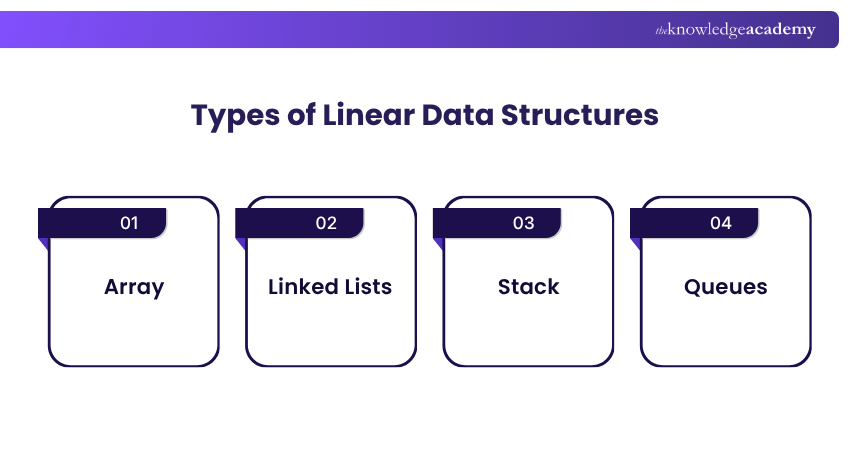
Array
Arrays are a fundamental and versatile linear data structure widely used in programming. An array typically stores a sequence of elements of the same or compatible type, with each element accessed by an index. These Data Structures provide efficient access to elements through indexing, and they are crucial for various applications in software development.
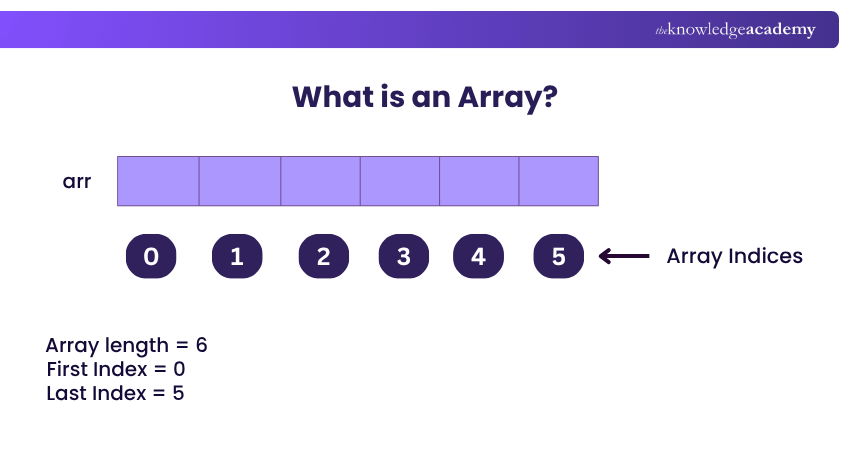
Key Components of an Array
An Array consists of several key components:
1) Elements: These are the actual data values stored in the Array. The elements can be of any data type, such as integers, characters, or custom objects.
2) Index: The index is a numeric value that specifies the position of an element within the Array. Indices typically start from 0 (in many programming languages) and increment sequentially.
3) Size: The size of an Array is set. It represents the total number of elements that the Array can hold. Traditional arrays have a fixed length once created. Some programming languages also provide dynamic array structures that can resize by allocating additional storage when required.
Advantages and Disadvantages of Arrays
Arrays offer several advantages and disadvantages, which determine their suitability for various programming scenarios:
Advantages:
1) Fast Access: Arrays typically provide O(1) indexed access because an element's position can be calculated directly from its index.
2) Memory Efficiency: Arrays are memory-efficient, as they use contiguous memory allocation. This means elements are stored in adjacent memory locations, reducing memory overhead.
3) Predictable Indexed Access: Arrays typically provide O(1) access when an index is known, while insertion and deletion can require O(n) time when elements need to be shifted.
Disadvantages:
1) Fixed Size: The size of an Array is fixed upon creation, which can be a limitation if the number of elements is not known in advance. A fixed-size array cannot hold additional elements beyond its allocated capacity without creating or allocating a larger structure.
2) Inefficient Insertions and Deletions: Inserting or deleting elements in an Array can be ineffective because it requires shifting elements to maintain order, which can be a time-consuming process for large Arrays.
3) Wasted Memory: Arrays may allocate memory for the maximum size even if you do not use all the available slots. This can result in wasted memory in cases where the Array size is significantly larger than the actual number of elements stored.
Information technology leads the world, and programming skills are more important than ever. Get equipped with us Programming Training Course to learn major programming languages.
Linked Lists
Linked Lists offer a dynamic and flexible way to store and organize collections of data elements. Unlike Arrays, which use contiguous memory allocation, Linked Lists use a structure where each element, known as a "node," is connected to the next one through a reference or a pointer.
Key Components of a Linked List
A Linked List consists of nodes, and each node contains two primary components:
1) Data: The data can be of any type and represents the actual information stored in the Linked List. For example, in a list of names, the data could be the name itself.
2) Pointer: A reference or pointer that points to the next node in the list. This connection between nodes is what allows the traversal of the Linked List.
Types of Linked Lists
There are several types of Linked Lists, each with its unique characteristics and use cases:
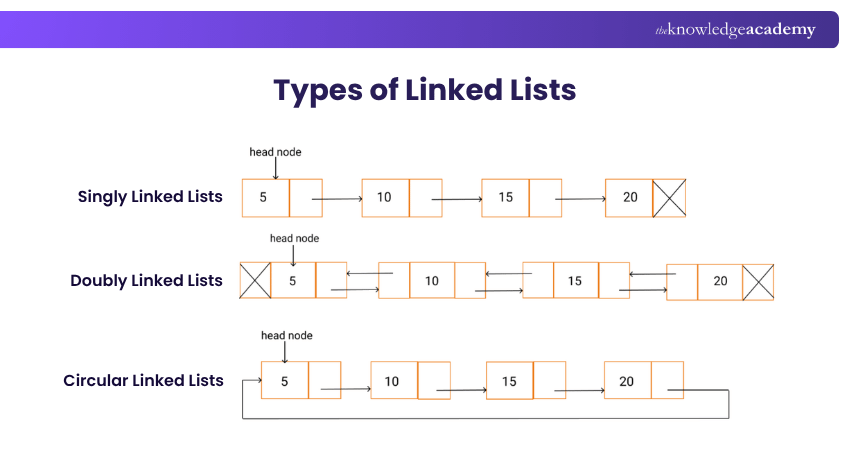
1) Singly Linked Lists: In a Singly Linked List, each node has a data component and a reference to the next node. Insertion or deletion can be efficient when the relevant node or reference is already known. For example, inserting at the beginning of a singly linked list is typically O(1).
2) Doubly Linked Lists: In a Doubly Linked List, each node has two references—one pointing to the next node and the other to the previous node. This bidirectional connectivity allows for efficient traversal in both directions but requires more memory than Singly Linked Lists.
3) Circular Linked Lists: It is a variation where the last node points back to the first node, forming a closed loop. This circular structure is used in situations where data needs to be continuously cycled.
Advantages and Disadvantages of Linked Lists
Linked Lists offer several advantages and disadvantages, which determine their suitability for various programming scenarios:
Advantages:
1) Dynamic Sizing: Linked Lists can grow or shrink as needed, making them useful for managing data whose size is uncertain or can change over time.
2) Efficient Insertions and Deletions: Adding or removing elements from a Linked List can be done efficiently, especially when the location of insertion or deletion is known.
3) Dynamic Memory Allocation: Linked Lists allow for dynamic memory allocation as each node can be allocated and deallocated separately.
Disadvantages:
1) Slower Access Time: Linked lists generally do not provide constant-time indexed access, so reaching a particular position often requires traversing nodes sequentially.
2) Increased Memory Usage: The use of pointers or references in Linked Lists requires additional memory, making them less memory-efficient than Arrays in terms of overhead.
3) Complexity: Managing Pointers in C and references can introduce complexity and make Linked Lists more error-prone compared to Arrays.
Stack
A Stack is a fundamental linear data structure that follows the Last-In, First-Out (LIFO) principle. It is a collection of elements in which new elements are added to the top and removed from the top, much like a Stack of plates where the last plate you put on the Stack is the first one you can take off. Stacks are used in a wide range of applications and are an essential tool for managing data and controlling program flow.
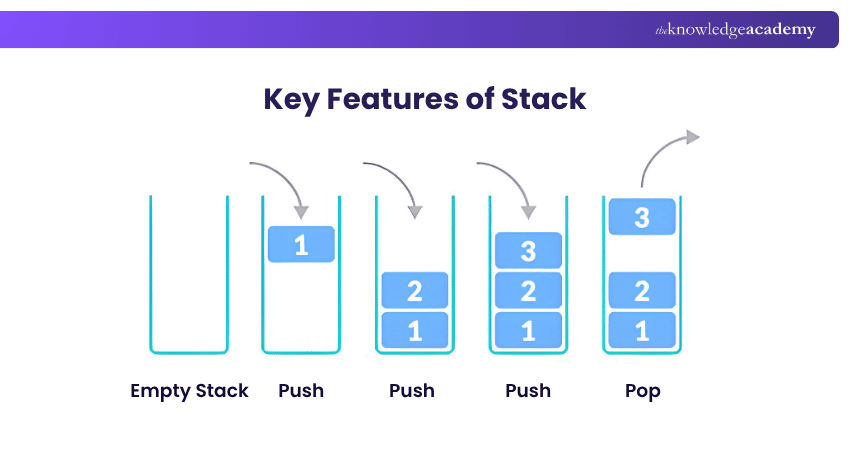
1) Push Operation: The operation of adding an element to the top of the Stack is known as "push." This element becomes the new top of the Stack.
2) Pop Operation: The operation of removing and returning the element from the top of the Stack is called "pop." After a pop operation, the element below the removed element becomes the new top.
3) Peek Operation: The "peek" operation allows you to view the element at the top of the Stack without removing it. This is useful for examining the top element without altering the Stack's structure.
Advantages and Disadvantages of Stacks
Stacks are a versatile and important Data Structure that provides specific benefits but also comes with certain limitations. Understanding the advantages and disadvantages of Stacks is essential for making informed decisions when implementing them in your software solutions.
Advantages
1) Last-In, First-Out (LIFO) principle: The LIFO ordering in Stacks is a natural fit for many applications. Stacks are useful when the most recently added item needs to be processed first, such as function calls, undo operations, parsing, and backtracking.
2) Efficient Push and Pop Operations: The push and pop operations for Stacks are typically performed in O(1) time. This efficiency is crucial for managing data efficiently, especially in scenarios where elements are frequently added or removed from the top of the Stack.
3) Simple Implementation: Stacks have a straightforward and intuitive structure. They can be implemented using arrays or linked lists.
Disadvantages
1) Limited Access: Stacks are designed for efficient access to the top element. Accessing elements deeper within the Stack requires popping elements until the desired one is reached, which can be inefficient for large Stacks.
2) Fixed Size: A stack backed by a fixed-size array has limited capacity unless resizing is supported. Linked-list or dynamic-array implementations can grow as needed within available memory.
3) Memory Management: A stack can consume unnecessary memory if items are retained longer than required. Memory-management behaviour also depends on the programming language and implementation.
Queues
A Queue is a fundamental linear data structure that adheres to the First-In, First-Out (FIFO) principle. In a Queue, elements are added at one end, known as the "rear" or "tail," and removed from the other end, known as the "front" or "head." Queues are commonly used for tasks that require the orderly processing of data, such as scheduling, managing tasks, or handling requests.
Key Features of a Queue
These are the key features of a Queue:
1) Enqueue Operation: It is the process of adding an element to the rear of the Queue. The newly added element becomes the last one to be processed.
2) Dequeue Operation: The operation of removing and returning the element from the front of the Queue is called "deQueue." After a deQueue operation, the element behind it becomes the next one to be processed.
3) Front and Rear: Elements in a Queue are organised linearly, with the front representing the first element to be processed and the rear representing the last.
4) FIFO Principle: The FIFO principle means that the first element added is normally the first element removed.
Advantages and Disadvantages of Queues
Queues are a fundamental Data Structure with specific advantages and disadvantages that make them suitable for particular use cases. Understanding these aspects is crucial for determining when to use Queues in software development.
Advantages
1) Orderly Data Processing: Queues follow the First-In, First-Out (FIFO) principle, ensuring that elements are processed in the order they were added. This feature is essential for managing tasks or requests in a systematic and orderly manner.
2) Effective Task Management: Queues are highly effective for managing tasks or processes that need to be executed one after the other, such as print jobs, task scheduling, or requests waiting to be processed by a server. This ensures that each task is processed fairly and sequentially.
3) Buffering and Flow Control: Queues can buffer data when production and consumption rates differ, helping regulate data flow. If capacity is limited, however, overflow or backpressure still needs to be managed.
Disadvantages
1) Inefficient for Random Access: Queues are not suitable for scenarios that require random access to elements. Accessing elements beyond the front (head) of the Queue is inefficient because it requires dequeuing multiple items.
2) Memory Usage: Queues may consume significant memory when used to buffer data, especially in cases of long Queues. This can become a concern if memory is limited.
3) Blocking: In bounded queue implementations, producers may be blocked or rejected when the queue reaches capacity until space becomes available. This blocking behaviour can be problematic in scenarios where continuous data flow is critical.
Learn about essential concepts of Data Structures with Data Structure And Algorithm Training Course- Join now!

Vishnu Sankar is a Senior Content Writer with 5+ years of experience across content development, software development, web development and system administration. His technical background and professional training support his expertise in IT and Tech, while his extensive research and writing experience covers Project Management and Health and Safety.
View Detail

 If you wish to make any changes to your course, please


