


 Top Rated Course

We may not have the course you’re looking for. If you enquire or give us a call on 01344203999 and speak to our training experts, we may still be able to help with your training requirements.
What is Game Development: All You Need to Know
Scarlett Adams 18 August 2026This blog explains what Game Development is, key components, development stages, essential skills, and how beginners can start creating games.

Training Outcomes Within Your Budget!
We ensure quality, budget-alignment, and timely delivery by our expert instructors.
Table of Contents
KEY TAKEAWAYS
1. Game Development combines technical, creative, and production disciplines to create interactive experiences.2. Games can be developed for PC, mobile, consoles, and other target platforms.3. Design, programming, visuals, audio, and UI/UX work together to shape the player experience.4. Game Development moves through several stages, from initial concepts to testing, release, and ongoing improvement.5. Beginners can start by choosing an area of interest and building small, practical projects.
Think about the last time you pressed “Play” on a game. Within seconds, a character moved, music started, a world appeared, and every action you took produced a response.
Behind those few seconds are thousands of decisions involving code, artwork, sound, storytelling, testing, interfaces, and gameplay. Game Development is the process that brings all these pieces together and transforms an idea into something people can actually play.
So, what happens between the first idea and the moment someone finally presses Play? Let’s enter the development process.
What is Game Development?
Game Development is the process of creating interactive video games by combining design, programming, art, audio, and technology. It involves turning an initial idea into a playable experience across platforms such as PC, mobile, and consoles.
From developing gameplay mechanics to creating characters, environments, and interfaces, Game Development brings different creative and technical elements together. The process can also extend beyond entertainment into areas such as education and training.

Key Components of Game Development
A playable game emerges when several creative and technical components work together. These typically include game design, programming and technology, graphics and animation, audio, and UI/UX design, each shaping a different part of how the game looks, feels, and plays.
Did You Know?
The UK video game market reached a record £8.76 billion in 2025, a 7.4% rise on the previous year, with the UK games industry now supporting over 73,000 jobs.Source: UKIE, 2025
1) Game Design
Game design determines how the game works. It covers gameplay mechanics, rules, progression, challenges, rewards, characters, narrative elements, and the overall experience intended for players.
2) Programming and Technology
Programming turns designs into functioning systems. Developers write code for mechanics, player interactions, game logic, physics, Artificial Intelligence (AI), and other interactive elements.
3) Graphics and Animation
Visual assets establish how the game world looks and feels. These can include characters, environments, objects, textures, animations, lighting, and visual effects.
4) Audio
Music, dialogue, ambient sound, and sound effects help establish atmosphere and provide feedback to players. Effective audio can make actions and environments feel considerably more immersive.
5) UI and UX Design
User Interface (UI) Design covers visible elements such as menus, buttons, inventories, and Heads-up Displays (HUDs). User Experience (UX) considers how easily players can navigate, understand, and interact with the game.
Build practical skills in 2D game design, development, and interactive mechanics with our 2D Game Development Training- Join now!
Game Development Phases
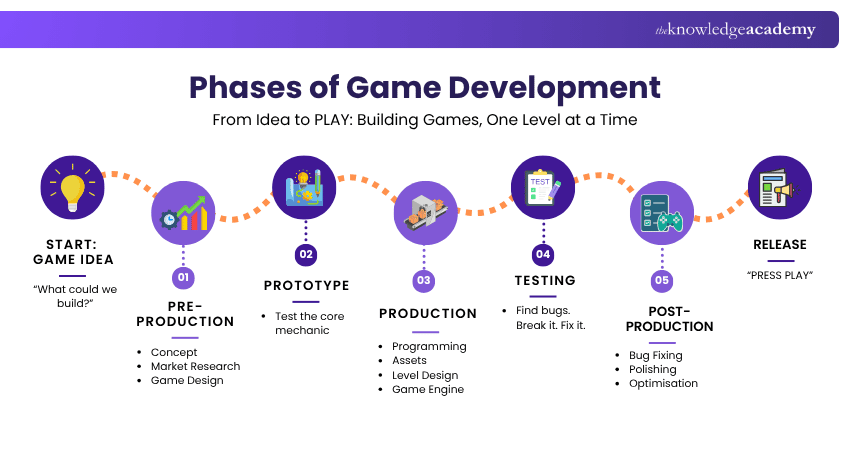
Game Development generally moves through interconnected stages rather than appearing fully formed. The existing blog groups this lifecycle into pre-production, production, and post-production.
For greater clarity, we can follow that journey from the initial idea through release.
1) Pre-production Phase
Before development begins, the team turns an initial idea into a clear direction for the game. Here are the key activities involved:
a) Conceptualisation: Game Designers develop the game's concept, exploring themes, mechanics, storylines, and its overall identity.
b) Market Research: Teams research the target audience, market trends, and competitors to inform the game's design and marketing strategy.
c) Game Design: Designers define the mechanics, gameplay flow, visual style, audio direction, and structure in a detailed design document that guides development.
2) Production Phase
The planned concept now moves into active development, where the different elements of the game are created and brought together. The main activities include:
a) Asset Creation: Artists and animators create characters, environments, objects, and visual effects.
b) Programming: Programmers develop game mechanics, gameplay systems, Artificial Intelligence, and interactive elements using programming languages and game engines.
c) Level Design: Level Designers create environments, challenges, puzzles, object placement, and gameplay progression while balancing difficulty and player enjoyment.
d) Testing: QA testers check the game for bugs, glitches, and performance issues through functional testing and playtesting.
e) Game Engine: The game engine provides core functions such as rendering, physics, sound, input, networking, and scripting, reducing the need to build these systems from scratch.
Developer's Pro Tip:
Don't wait until the game is finished to test it. Test core mechanics early, fix problems as they appear, and refine the experience before adding more complexity.
3) Post-production Phase
The game is now refined for its final release, with the team focusing on quality, performance, and the overall player experience. This includes:
a) Bug Fixing: Developers resolve crashes, gameplay glitches, and other issues identified during testing.
b) Polishing: Teams refine visuals, audio, UI, and UX to improve the game's quality and player experience.
c) Optimisation: Developers improve frame rates, load times, memory usage, and responsiveness for the target platforms.
Who is Involved in Game Development?
A game can require specialists from several disciplines. On smaller projects, one person may perform several roles, while larger productions can divide responsibilities across specialised teams.
Can you match the task to the person most likely responsible?
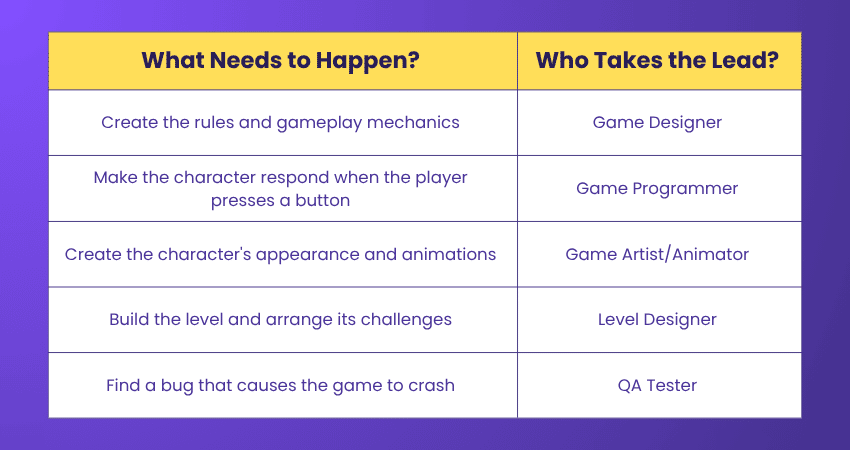
Got them all right? If not, let's check what each role actually does:
1) Game Designer: Defines mechanics, rules, progression, challenges, and other elements that shape gameplay.
2) Game Programmer: Writes and maintains the code responsible for game systems, mechanics, interactions, and technical functionality.
3) Game Artist and Animator: Creates characters, objects, environments, animations, textures, and other visual assets.
4) Level Designer: Builds playable environments and determines how challenges, objects, enemies, and progression are arranged.
5) UI/UX Designer: Designs interfaces and interactions that help players understand and navigate the game.
6) Audio Designer: Creates or integrates sound effects, music, dialogue, and other audio elements.
7) QA Tester: Tests gameplay and technical functionality to identify bugs, inconsistencies, and other issues.
Game Engines Used in Development
Choosing the right engine shapes how a game is built, from what platforms it can support to how quickly a team can move from prototype to finished product. Here are four widely used options, each suited to different kinds of projects.
a) Unity: A flexible engine ideal for 2D, 3D, and mobile cross-platform creation. Its large asset store and active community make it a popular starting point for beginners and indie developers alike. Unity supports deployment across most major platforms, including PC, mobile, and consoles, from a single codebase.
b) Unreal Engine: Developed by Epic Games, it is built for high-end cinematic graphics and AAA titles. Its Blueprint visual scripting system allows developers to build gameplay logic without writing extensive code, which speeds up prototyping. Unreal is widely used in large-scale productions where visual fidelity and performance are top priorities.
c) Godot: A lightweight, open-source 2D and 3D game engine. It's fully free with no royalty fees or revenue-sharing requirements, making it an appealing choice for independent developers on a budget. Godot's smaller footprint and simpler interface make it easier to pick up compared to some larger commercial engines.
d) Cocos2d-x: A cross-platform framework suited for lightweight mobile games. It's known for producing fast, efficient builds that perform well even on lower-end mobile devices. Cocos2d-x is commonly used for casual and hyper-casual mobile games where performance and file size matter most.
Your First Game Quest
Ready to move from learning to creating? Start small and turn one simple idea into a playable experience.
Choose one mechanic↓Build a basic prototype↓Play and test it↓Find one thing to improve↓Make the next version
Quest Complete: Don't aim to build a blockbuster first. Aim to finish one small, playable game.
Conclusion
Understanding What is Game Development comes down to recognising it as the process of turning an idea into an interactive experience through design, technology, creativity, testing, and teamwork. Every game begins with something players cannot see: a concept, a mechanic, a sketch, or a line of code. Game Development is what brings those individual pieces together into something people can actually play.
Develop practical Roblox Game Development skills with our Game Development with Roblox Training - Join now!
Frequently Asked Questions
How Do I Start Learning Game Development as a Beginner?

Start with a small project and learn the skills needed to build it rather than trying to master everything at once. Choose a suitable game engine, follow beginner resources, experiment with simple mechanics, and gradually take on more complex projects.
Is It Better to Learn Unity or Unreal Engine First?
Neither is universally better for beginners. The right choice depends on your goals, preferred learning approach, target platform, and the type of games you want to create. Starting with one engine and completing a small project is often more valuable than trying to learn several at once.
What Skills are Important for Game Development?
Important skills include programming, problem-solving, creativity, game design, collaboration, and testing. The skills you need most will depend on the area of Game Development you want to pursue, such as programming, design, art, UI/UX, or QA.

 If you wish to make any changes to your course, please


