




We may not have the course you’re looking for. If you enquire or give us a call on +55 8000201623 and speak to our training experts, we may still be able to help with your training requirements.
What is Economics: A Complete Overview
ByThe Knowledge AcademyLast updated on: 02 October 2026
Economics is the study of how societies use limited resources, exploring choices, incentives, and outcomes like growth, inflation and unemployment. Understanding what is Economics helps individuals, businesses and governments make informed decisions regarding resource allocation, market dynamics and policy implementation.
What You Should Know
1. Scarcity means individuals and societies must make choices about limited resources.2. Opportunity cost helps explain what is given up when one option is chosen over another.3. Microeconomics focuses on individuals, businesses and specific markets.4. Macroeconomics examines economy-wide issues such as inflation, unemployment and economic growth.5. Economic indicators provide different perspectives on how an economy is performing.
Ever wonder why prices skyrocket, jobs go through seismic shifts and markets boom or bust? The answer lies in understanding what is Economics. Economics helps us understand how governments, businesses and people make choices about using limited resources. Essentially, it’s the story behind every financial decision, from your morning sip at your favourite coffee shop to government budgets.
This blog explores what is Economics in detail. It breaks down the basics, explains key indicators like inflation and GDP, and explores what Economists do to help guide decisions and shape the world. So read on, strengthen your grasp on Economics and learn how Economics function as the heartbeat of how we earn, spend, save, and invest!
What is Economics?
Economics is the study of how people, businesses, and governments use limited resources to produce and share goods and services. It looks at our choices and how we respond to different situations. Economics includes both small topics like family spending (Microeconomics) and big ones like national debt (Macroeconomics). It helps us understand the past, make sense of today’s news and plan for the future.
The roots of Economics go back centuries. One of the earliest known economic thinkers was the Greek Farmer and Poet Hesiod in the eighth century B.C. He wrote about allocating labour, materials and time efficiently to overcome scarcity. Modern Economic thought took shape with Adam Smith’s landmark 1776 work, “An Inquiry Into the Nature and Causes of the Wealth of Nations,” which laid the foundations of contemporary Western economic theory.
Trainer's Insight
Economic decisions often involve trade-offs rather than perfect solutions. Comparing the costs, benefits and alternatives can help explain why different people make different choices in similar situations.
The Basics of Microeconomics
Microeconomics examines the choices individuals and businesses make every day. It’s the study of how we decide where to spend our time, money, and resources. Consider these questions:
1) Should I lease or buy a car?
2) Should I invest in stocks or bonds?
3) How can I use my time or money more efficiently?
If you've ever wondered about these, you’ve already stepped into microeconomic thinking. This area of Economics helps you understand your options clearly and make smarter financial and practical decisions in both life and work.
The Basics of Macroeconomics
Macroeconomics steps back to look at the economy as a whole. It explores numerous issues like inflation, unemployment, national income, stagflation and overall growth. It helps us understand major questions such as:
1) Why do some nations prosper more than others?
2) What triggers economic recessions?
3) How do government decisions shape economic outcomes?
A solid grasp of Macroeconomics is essential for anyone aiming to lead, influence policy or navigate today’s interconnected global economy.
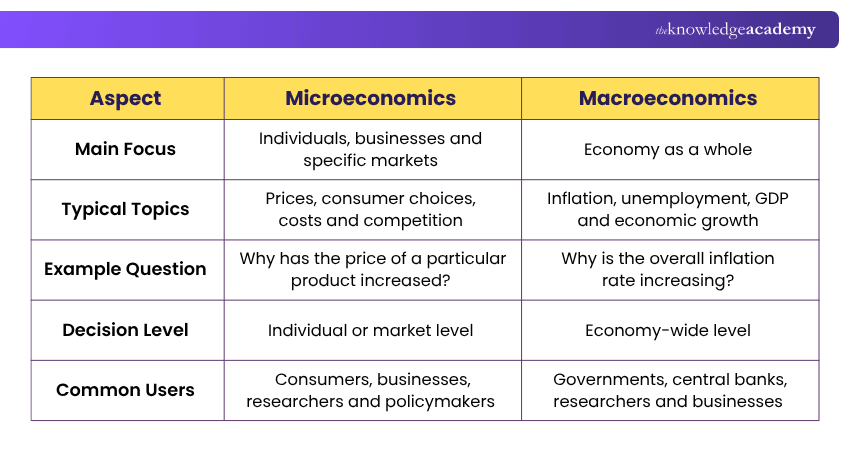
Here's a quick glimpse into the differences between microeconomics and macroeconomics:
What do Economists do?
An Economist examines how a society uses its resources and how those choices influence production, growth, and overall well-being. Their insights guide important decisions in governments, businesses, and global markets. The key roles of an Economist include:
1) Studying how resources are allocated and how they affect output and productivity.
2) Advising on policies related to interest rates, taxes, employment, and trade.
3) Supporting organisations in shaping long-term corporate and financial strategies.
4) Analysing major economic indicators like GDP and CPI to spot trends.
5) Making forecasts to predict economic conditions and guide future planning.
How Economics Affects Everyday Life
You encounter Economics when you:
1. Decide how to spend limited income2. Compare the prices of different products3. Choose how to use your available time4. Respond to rising or falling prices5. Decide whether an incentive changes your behaviour6. Consider different work or education opportunities7. Choose between competing alternatives
Key Economic Indicators Explained
Economic indicators outline a country's economic performance. Published periodically by governmental agencies or private organisations, these indicators often significantly impact employment, stocks, and international markets. They may also predict future economic conditions that drive markets and guide investment decisions. Let’s explore the key economic indicators:
1) Gross Domestic Product (GDP)
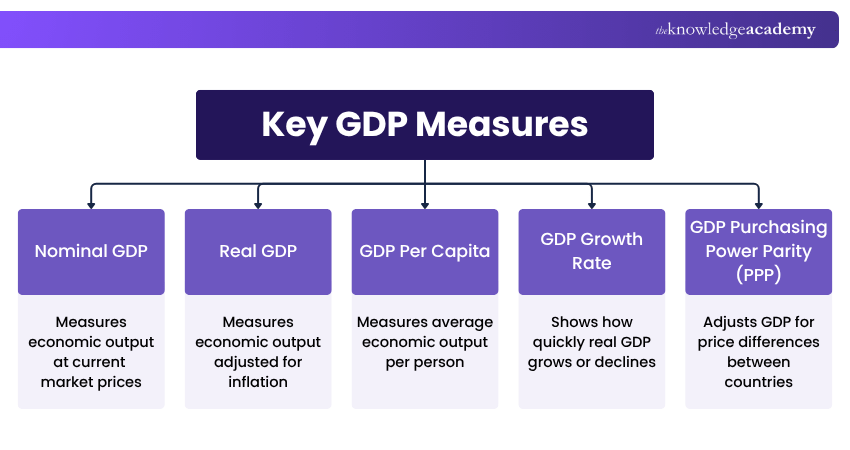
Gross Domestic Product (GDP) is the most detailed measure of a country's economic performance. It calculates the total market value of a country's finished goods and services in a given year. Many analysts, investors and traders focus on the advance GDP report and preliminary report, issued before the final GDP figures. However, GDP is considered a lagging indicator, implying that it can confirm a trend but can't predict it.
2) Retail Sales
The retail sales report (generated during the middle of each month) measures the total receipts of all merchandise sold in stores. Sampling retailers across the country serve as the proxy of consumer spending levels. Consumer spending represents over two-thirds of the GDP which is useful for gauging the economy's general direction.
Build the financial blueprint for a fulfilling tomorrow with our Financial Modelling and Forecasting Training - Sign up now!
3) Industrial Production
The industrial production report is released monthly by the Federal Reserve and reports changes in the production of mines, factories, and utilities. The capacity utilisation rate, which is included in this report, estimates the portion of productive capacity being used rather than standing idle in the economy. If its level is below 80%, the likelihood of a recession may increase, signalling the need to prepare for a recession through strategic planning and risk mitigation.
4) Employment Data
The UK Data Service holds a full range of labour market and employment data from key government surveys. A sharp increase in employment is indicative of prosperous economic growth, and contractions may be imminent if a significant decrease occurs. However, these are generalisations, and it is important to consider the economy's current position.
5) Consumer Price Index (CPI)
Consumer Price Index (CPI) is the benchmark for measuring inflation as it determines the level of changes in retail prices and the costs consumers pay. The CPI compares monthly price changes year after year. The release of this report may increase volatility in fixed income, equity, and forex markets. Greater-than-expected price increases are a sign of inflation, which'll likely cause the underlying currency to depreciate.
Pro Tip
Avoid judging an economy using a single indicator. GDP, inflation, employment and other measures reveal different aspects of economic conditions.
Want to master the language of money? Improve your fluency with our Finance Courses - Register now!
What is the Future of Economics?
Here are the main points to remember pertaining to the future of Economics:
1) The future of Economics is being shaped by digitalisation and sustainability. These are transforming how societies produce, consume and allocate resources.
2) The digital economy will lead growth through AI, data analytics, automation, smart systems and advanced connectivity.
3) The green economy will expand through renewable energy, sustainable mobility, smart agriculture and environmentally responsible development.
4) Global disruptions have accelerated the transition. This highlights the need for resilient and adaptable economic systems capable of responding to rapid change.
5) Traditional industries may slow down, while sectors such as clean energy, digital services, sustainable cities and advanced agriculture continue to rise.
6) The shift is closely tied to the Fourth Industrial Revolution, driven by big data, Machine Learning and the Internet of Things. These enable smarter and more efficient decision-making.
So overall, the future economy will focus on innovation, sustainability, long-term resilience and technological integration, aiming to shape a cleaner and more interconnected world.
Great leaders aren’t born; they’re trained. Bring out your potential with our expert-led Management Training - Sign up now!
What are the Four Pillars of Economics?
Every economy relies on four main pillars: earning, spending, saving, and investing. Understanding how they work together is essential for both individuals and businesses.
1) Earning: This is the money people and businesses make through jobs, profits, or other income sources. A strong economy depends on people earning enough to spend and grow.
2) Spending: People use their income to buy goods and services. This keeps businesses running and helps the economy stay active.
3) Saving: Money not spent is saved for future needs. It provides security and can be used for future investments.
4) Investing: Saved money is used to grow wealth through stocks, property or businesses. Investments help create jobs and grow the economy.
Everyday Economics Checklist
When examining an economic decision, consider:
□ What resources are limited?□ What alternatives are available?□ What am I giving up by choosing one option?□ Are any incentives influencing the decision?□ How might changing prices affect the choice?□ Who else could be affected by the decision?□ Is this an individual or market issue?□ Or does it involve the wider economy?

The Knowledge Academy develops accessible learning content across Project Management, IT, Cybersecurity, Data Science, Business Analysis, HR, Accounting and Finance, Leadership and Health and Safety. Its resources combine subject research with clear explanations to help professionals build practical knowledge across a wide range of disciplines.
View Detail

 If you wish to make any changes to your course, please


