




We may not have the course you’re looking for. If you enquire or give us a call on 01344203999 and speak to our training experts, we may still be able to help with your training requirements.
Home
 Resources
IT Security & Data Protection
What is a Cyber Attack: Definition, Types and Prevention
Resources
IT Security & Data Protection
What is a Cyber Attack: Definition, Types and Prevention
Resources
IT Security & Data Protection
What is a Cyber Attack: Definition, Types and Prevention
What is a Cyber Attack: Definition, Types and Prevention
BySienna RobertsLast updated on: 20 August 2026
A Cyber Attack is a deliberate attempt to gain unauthorised access to systems, networks or data to steal information. Attackers may use methods such as phishing, malware, ransomware and vulnerability exploitation.
Key Takeaways
1. Cyber Attacks can target systems, networks, applications, data and people to steal information, disrupt services or cause other harm.2. Common Cyber Attack categories include malware, Social Engineering, credential, network, application, vulnerability and supply chain attacks.3. Cyber Attacks can progress through several stages, from reconnaissance and delivery to exploitation and actions on objectives.4. Layered security combining access controls, patching, monitoring, backups and employee awareness can reduce cyber risk.5. Fast detection and a tested incident response plan can help limit damage and support recovery.
Consider this sequence of events:
1) An employee receives what looks like a routine supplier email
2) They open an attachment
3) Malware executes or credentials are stolen, giving the attacker initial access
4) Unusual activity begins appearing across the network
5) Critical files become inaccessible
This is how one seemingly ordinary action can develop into a serious security incident. But how does an attacker move from initial access to wider disruption, and where can defenders intervene?
Understanding Cyber Attacks helps organisations recognise how threats develop, detect suspicious activity earlier and respond more effectively.
What is a Cyber Attack?
A Cyber Attack refers to an attempt to gain unauthorised access to computers or networks, often to disrupt operations or steal sensitive data. It's often the first step attackers take before carrying out larger incidents, such as data breaches affecting individuals or organisations.
The primary objective of a Cyber Attack may be to shut down systems, disrupt services or gain access to valuable information as it spreads through connected networks. Cybercriminals commonly use techniques such as denial-of-service attacks, malware, phishing and ransomware to carry out these intrusions.
DID YOU KNOW?
The WannaCry ransomware attack in 2017 spread rapidly across organisations worldwide and caused significant disruption, including to parts of the UK's National Health Service (NHS).Lesson: Keeping systems patched and maintaining resilient backups can significantly reduce ransomware exposure.

Types of Cyber Attacks
Cyber Attacks take many forms, and each targets different weaknesses in people, applications, networks or infrastructure. Here are some of the most common types:
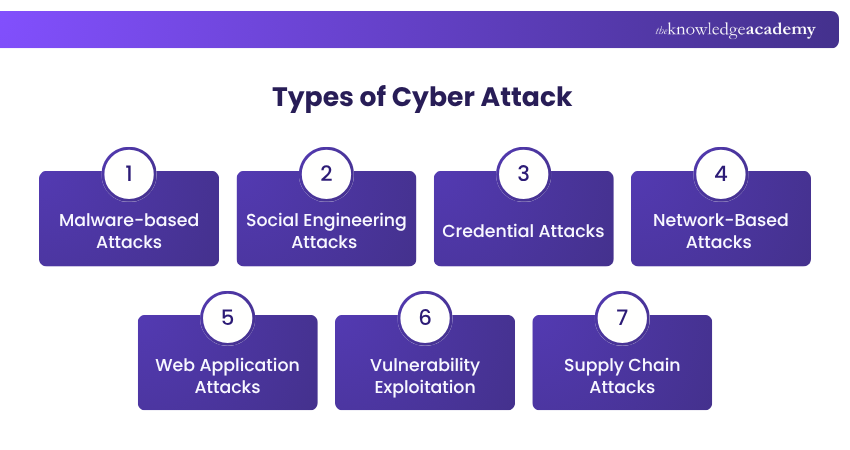
1) Malware-based Attacks
Malware is malicious software designed to damage, disrupt, or gain unauthorised access to systems. Common forms include viruses, worms, Trojans, spyware, and ransomware. Malware or malicious scripts may also be used for cryptojacking, where attackers secretly use a device's computing resources to mine cryptocurrency.
Become a malware Detective and outsmart the unseen threats before they strike. Sign up for our Malware Analysis Training now!
2) Social Engineering Attacks
These attacks manipulate people into revealing sensitive information or performing unsafe actions. Phishing is a common example, using deceptive emails, messages, or websites to steal credentials, distribute malware, or obtain confidential information.
3) Credential Attacks
Credential attacks attempt to obtain or misuse login credentials to gain unauthorised access. Common methods include brute-force attacks, password spraying, credential stuffing, and the use of stolen credentials.
4) Network-Based Attacks
These attacks target network services or communications. Examples include Denial-of-Service (DoS) and Distributed Denial-of-Service (DDoS) attacks, Man-in-the-Middle (MitM) attacks, and DNS tunnelling.
5) Web Application Attacks
These attacks exploit weaknesses in websites and web applications. Common examples include SQL Injection (SQLi), which uses malicious SQL commands to access or manipulate database information, and Cross-Site Scripting (XSS), which injects malicious scripts into web pages viewed by users.
6) Vulnerability Exploitation
Attackers exploit security weaknesses in software, hardware, or system configurations to gain access or cause harm. Zero-day attacks exploit vulnerabilities before developers can release or apply a security patch.
7) Supply Chain Attacks
Supply chain attacks compromise a trusted supplier, software provider, or service to reach other organisations. Malicious software updates, compromised third-party components, or unauthorised vendor access can provide attackers with a pathway into multiple targets.
Did You Know?
In 2020, attackers compromised the SolarWinds Orion software supply chain, allowing malicious code to reach government agencies and private organisations through software updates.
How do Cyber Attacks Work?
Cyber Attacks can follow different paths depending on the attacker, target and objective. Intrusion-based attacks can often be understood through the following seven stages:
1) Reconnaissance: Attackers gather information about the target, including employees, systems, networks and exposed services.
2) Weaponisation: Attackers prepare malicious content or tools designed to exploit the target.
3) Delivery: The malicious content reaches the target through methods such as phishing, malicious websites, infected devices or compromised software.
4) Exploitation: The attack exploits a vulnerability or tricks a user into triggering malicious content.
5) Installation: Attackers may install malware, backdoors or other mechanisms to maintain access to the compromised environment.
6) Command and Control (C2): The compromised system may communicate with attacker-controlled infrastructure, allowing attackers to issue commands and manage their access.
7) Actions on Objectives: Attackers pursue their goal, which may involve moving through the network, stealing data, deploying ransomware, committing fraud or disrupting operations.
Use this quick decision path to determine if something is a Cyber Attack:
Who is Behind Cyber Attacks?
Cyber Attacks can be carried out by different threat actors, each with their own motivations, capabilities and objectives. Common groups include:
1) Cybercriminals:
Cybercriminals commonly carry out attacks for financial gain through ransomware, fraud, data theft and extortion. Some operate organised criminal services, including Ransomware-as-a-Service (RaaS).
2) State-linked Actors:
State-linked actors may conduct Cyber Attacks for espionage, intelligence gathering or strategic disruption, often using significant resources and maintaining long-term access.
3) Hacktivists:
Hacktivists are motivated by political, social or ideological causes. Their activities may include DDoS attacks, website disruption or unauthorised disclosure of information.
4) Malicious Insiders:
Employees, contractors or trusted partners may intentionally misuse legitimate access to steal information, disrupt systems or assist external attackers. Accidental employee actions can cause security incidents but should not be classified as Cyber Attacks without malicious intent.
5) Opportunistic Attackers:
These attackers often use readily available tools, known vulnerabilities or automated techniques to target poorly secured systems. Although they may have limited technical expertise, their attacks can still cause significant disruption.
Be the shield in a world full of cyber threats. Sign up for our range of Cyber Security Training today!
How Can a Cyber Attack Be Prevented?
No single measure can prevent every Cyber Attack, but a layered security approach can reduce the likelihood of an attack and limit its impact. Key preventive measures include:
1) Strong Access Controls: Use Multi-factor Authentication (MFA), apply the principle of least privilege and promptly remove unused or default accounts and credentials.
2) Regular Patching and Updates: Keep operating systems, applications and security tools updated to address known vulnerabilities before they can be exploited.
3) Employee Awareness Training: Regular training helps employees recognise phishing emails, suspicious links and Social Engineering attempts and respond to them appropriately.
4) Network Segmentation: Divide networks into separate security zones to restrict unauthorised movement and limit the spread of an attack if one area is compromised.
5) Endpoint Protection and Monitoring: Use endpoint security tools, Endpoint Detection and Response (EDR) and security monitoring to identify suspicious behaviour and potential threats early.
6) Data Backup and Recovery: Maintain regular, tested backups that are protected from unauthorised modification or deletion. Offline or appropriately secured backup copies can support recovery from ransomware and other destructive attacks.
7) Incident Response Planning: Maintain and regularly test an Incident Response Plan so teams understand how to identify, contain, investigate and recover from security incidents.
8) Third-party and Supply Chain Security: Assess the security risks associated with suppliers, software providers and third-party access, and apply appropriate controls throughout the supplier relationship.
Embrace the human side of Cyber Security with our Social Engineering Training. Sign up now and outsmart the manipulators!
How to Detect a Cyber Attack?
Since no security defence is completely foolproof, organisations must maintain continuous visibility across their networks and information systems to detect potential threats quickly. Here are some ways to detect Cyber Security Attacks:
1) Security Information and Event Management (SIEM): SIEM systems collect and analyse alerts from multiple security tools to identify suspicious activity. This includes intrusion detection systems and endpoint detection and response (EDR) platforms.
2) Threat Intelligence: Threat Intelligence boosts security alerts by providing information about known attackers, tactics and Indicators of Compromise (IOCs). This helps security teams respond more efficiently.
3) Advanced Analytics and AI: Modern detection tools use Machine Learning and advanced analytics to point out unusual behaviour patterns. This helps them detect potential cyber incidents that might otherwise go unnoticed.
4) Proactive Threat Hunting: Cyber Security Analysts actively search for hidden threats, such as Advanced Persistent Threats (APTs), that automated security tools may fail to detect.
Pro Tip
Don't rely on one security control to stop every attack. Combine identity protection, patching, endpoint security, network monitoring, secure backups and employee awareness. If one layer fails, another may still detect or contain the threat.
How to Respond to a Cyber Attack?
Once an incident is detected, coordinated action can help contain the threat, protect evidence and restore operations.
1) Activate the Incident Response Plan: Follow established incident procedures and involve the appropriate technical, management, legal and communication teams according to the nature of the incident.
2) Contain the Incident: Limit the attack's ability to spread while considering the potential impact of containment actions. Depending on the incident, this may involve isolating affected systems or restricting compromised accounts.
3) Preserve and Investigate Evidence: Preserve relevant logs and forensic evidence while determining how the attack occurred, which assets were affected and whether attackers retain access.
4) Eradicate the Threat: Remove malicious software, close exploited vulnerabilities, reset compromised credentials and address persistence mechanisms identified during the investigation.
5) Recover Operations: Restore systems carefully and monitor them for signs that the attacker has returned. Recovery may involve validated backups, security testing and phased restoration.
6) Conduct a Post-incident Review: Review what happened, identify root causes and determine which security controls or procedures need improvement.
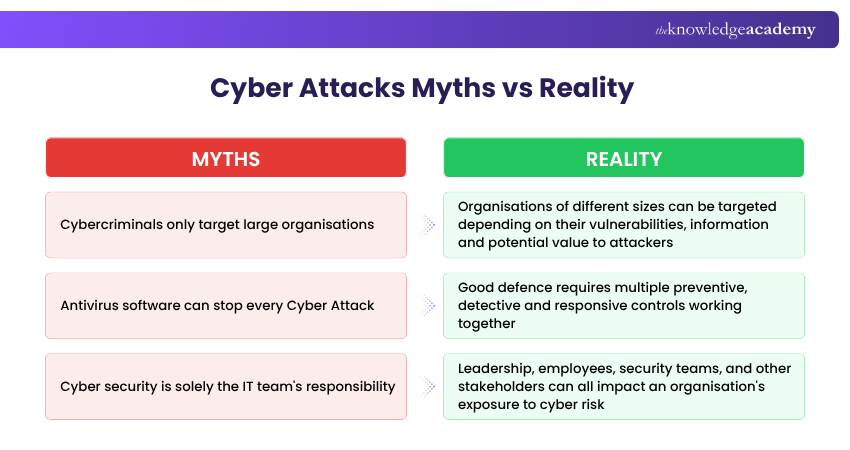
Here are some myths surrounding Cyber Attacks that you need to consider:
Emerging Cyber Attack Trends
Attackers continue to adapt their methods as technology changes. Two areas receiving particular attention are AI-enabled attacks and threats targeting Cloud and container environments.
1) AI-enabled Cyber Attacks
Generative AI can help attackers create convincing phishing messages, synthetic audio or video and support reconnaissance at scale. AI systems themselves may also be targeted through techniques such as prompt injection and data poisoning, which can influence how systems process information or behave.
2) Cloud and Container Attacks
Misconfigured Cloud services, exposed APIs, compromised credentials and vulnerable workloads can create opportunities for attackers to access Cloud and container environments. Strong access controls, secure configurations and continuous monitoring can help reduce these risks.
Cyber Attack Readiness Checklist
Use this checklist to assess whether your organisation is prepared for a Cyber Attack:
☐ Critical Assets Identified: Do you know which systems and data require the highest protection level?☐ Access Controls Reviewed: Are least-privilege access and Multi-factor Authentication (MFA) applied?☐ Systems Patched: Are operating systems, applications and security tools updated?☐ Backups Tested: Are important backups maintained and regularly tested for recovery?☐ Employees Prepared: Can employees recognise phishing and Social Engineering attempts?☐ Networks Monitored: Are suspicious login attempts and abnormal system behaviour monitored?☐ Vulnerabilities Managed: Are vulnerabilities prioritised and remediated as per the risk?☐ Incident Response Plan Tested: Does your organisation have a documented response plan?☐ Responsibilities Defined: Does everyone know who should investigate and communicate during an incident?☐ Recovery Procedures Ready: Can critical systems be restored safely after an attack?
Conclusion
Cyber Attacks can disrupt operations, expose sensitive information and create serious financial and operational consequences. Understanding how attacks work, who carries them out and how to prevent, detect and respond to them helps organisations reduce risk. Strong access controls, timely patching, monitoring, secure backups and tested response plans all support stronger cyber resilience.
Spot the patterns and stop the fraud. Become the Analyst every system needs with our Fraud Analytics Training - Sign up now!

 If you wish to make any changes to your course, please


