


 Top Rated Course

We may not have the course you’re looking for. If you enquire or give us a call on 01344203999 and speak to our training experts, we may still be able to help with your training requirements.
What is Bookkeeping: A Complete Guide to Process and Types
Olivia Taylor 15 July 2026Bookkeeping is the systematic process of recording, organising, and maintaining a business’s daily financial transactions to ensure accurate financial records. It helps monitor cash flow, support financial reporting, and make informed and strategic decisions. Ultimately, it provides reliable data for budgeting and financial planning.

Training Outcomes Within Your Budget!
We ensure quality, budget-alignment, and timely delivery by our expert instructors.
Table of Contents
Have you ever wondered how companies keep their finances in perfect shape without losing track of a single transaction? Bookkeeping is the foundation that keeps every business financially organised and transparent. It is a vital practice that companies of all sizes and industries rely on to maintain stability, make smart decisions, follow tax laws, and analyse their financial health in detail.
Wondering how you can avoid costly mistakes, stay legally compliant, and clearly understand your business profits? Continue reading this blog to find out What is Bookkeeping, how it works, and why it remains essential for all businesses!
Table of Contents
1) What is Bookkeeping?
2) Types of Bookkeeping Methods
3) How Bookkeeping Works?
4) What Does a Bookkeeper do?
5) Bookkeeper vs Accountant: What’s the Difference?
6) Why Choose Bookkeeping Software?
7) Steps to Become a Bookkeeper
8) Conclusion
What is Bookkeeping?
Bookkeeping is the process of recording, organising, and maintaining a business's financial transactions in a systematic manner. It involves tracking income, expenses, purchases, sales, receipts, and payments to ensure financial records remain accurate and up to date.
Effective Bookkeeping provides the foundation for accounting, financial reporting, budgeting, and tax compliance. By maintaining accurate records, businesses can monitor cash flow, make informed financial decisions, meet legal obligations, and support long-term financial planning.

Types of Bookkeeping Methods
Bookkeeping can be done using different methods as per specific business needs and complexities. Let’s check those types of Bookkeeping methods:
1) Single-entry Bookkeeping
Single-entry Bookkeeping is a simple method. It is typically used by small businesses and sole proprietors. In this system, only one entry is made for each financial transaction, usually in a simple ledger or spreadsheet.
It records the basic information of your income and expenses. Moreover, it is easy to maintain with its single-entry system. The key features of Single-entry Bookkeeping include:
1) Records each transaction only once
2) Commonly tracks cash inflow and outflow
3) Often uses a basic cash book or spreadsheet
4) Doesn’t track assets or liabilities in detail
5) Suited for small businesses or sole traders
6) Focuses mainly on income and expenses
2) Double-entry Bookkeeping
Double-entry Bookkeeping is a more advanced and widely used method. It is the standard for most businesses, especially those with multiple transactions and complex financial structures. This method maintains a balance between assets, liabilities, equity, income, and expenses.
In the Double-entry Bookkeeping system, every financial transaction is recorded as both a debit in one account and a corresponding credit in another. This ensures that the accounting equation remains balanced and improves the accuracy of financial records. Its key features include:
1) Tracks income, expenses, assets, and liabilities
2) Suitable for medium to large businesses
3) Helps detect errors through the trial balance
4) Provides a complete and accurate financial picture
5) Supports detailed financial reporting and analysis
6) Complies with Accounting standards and tax laws
Estimate the inventory for better Financial Management with our Inventory Accounting and Costing Course – Sign up now!
How Bookkeeping Works?
Bookkeeping is more than writing down numbers. It follows a clear process to keep everything accurate and organised. There are four common steps in the process of recording transactions. Here are those steps:
1) Determining the Accounting Method
Before Bookkeeping begins, businesses select an accounting method, such as cash or accrual accounting. Bookkeepers then record financial transactions consistently using the chosen method.
Following the same approach throughout each accounting period improves the reliability of financial information, simplifies reporting, and enables businesses to compare financial performance over time.
2) Monitoring Goal Progress
Accurate Bookkeeping allows businesses to track income, expenses, and overall financial performance against their objectives. Regularly reviewing financial records helps identify trends, measure progress, and make informed business decisions.
Moreover, by comparing actual financial results with budgets and targets, businesses can quickly identify areas that require improvement. This enables business owners to adjust their strategies, control costs, and stay focused on achieving their financial goals.
3) Managing Financial Records
Bookkeeping ensures all financial documents and transactions are organised, accurate, and up to date. Well-maintained records support tax compliance, simplify audits, and provide valuable information for budgeting and financial planning.
Keeping records well-maintained also makes it easier to retrieve important information whenever required. Whether applying for loans, preparing financial statements, or responding to regulatory requests, businesses can quickly access reliable financial data and demonstrate financial transparency.
Learn how Letters of Credit work with our Letters of Credit Training – Join soon!
What Does a Bookkeeper do?
Bookkeepers have several tasks to handle. Now that you know What is Bookkeeping, here are some common tasks a Bookkeeper does:
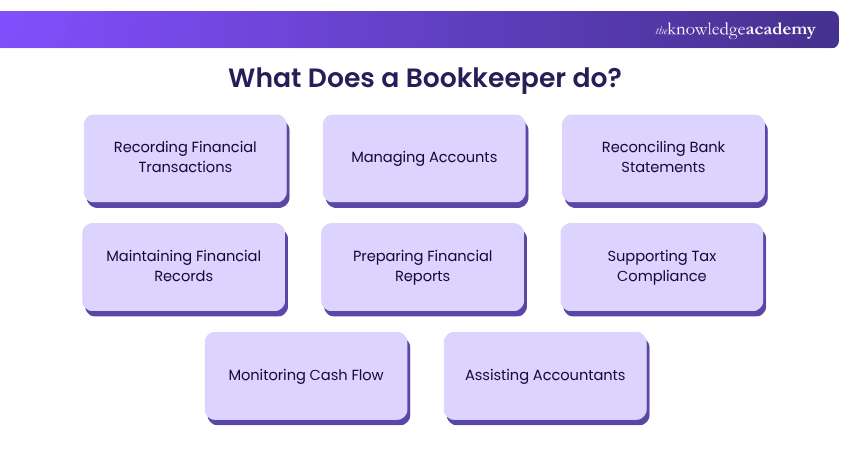
1) Recording Financial Transactions: Maintain accurate records of sales, purchases, payments, receipts, and other financial activities.
2) Managing Accounts: Update accounts payable and receivable to ensure timely payments and collections.
3) Reconciling Bank Statements: Compare financial records with bank statements to identify and resolve discrepancies.
4) Maintaining Financial Records: Organise invoices, receipts, and supporting documents for accurate record-keeping.
5) Preparing Financial Reports: Generate reports that help businesses monitor income, expenses, and cash flow.
6) Supporting Tax Compliance: Keep accurate financial records to assist with tax returns and regulatory obligations.
7) Monitoring Cash Flow: Track incoming and outgoing funds to help businesses manage their finances effectively.
8) Assisting Accountants: Provide organised financial data and documentation for accounting, auditing, and financial analysis.
Bookkeeper vs Accountant: What’s the Difference?
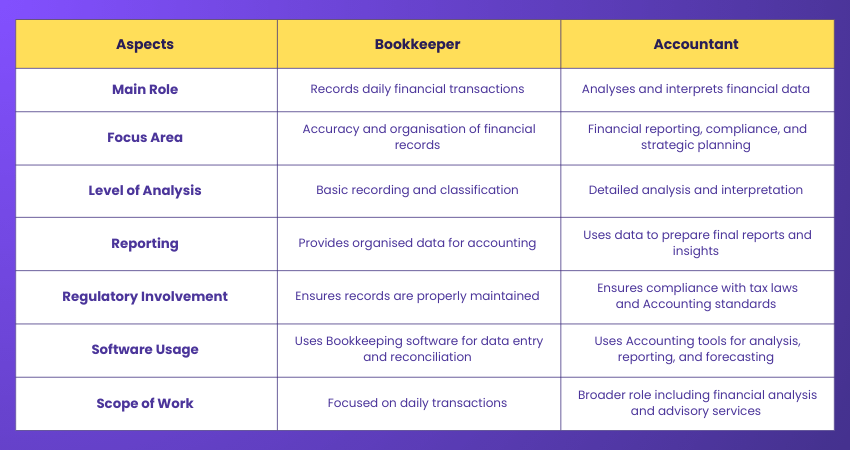
Although Bookkeepers and Accountants both work with financial data, their roles are different in scope and responsibility. A Bookkeeper focuses on recording and organising daily financial transactions, while an Accountant analyses, interprets, and reports on that financial information to support strategic decisions.
A Bookkeeper records daily financial transactions and ensures that the records are accurate and up to date. An Accountant uses this data to prepare financial statements, calculate taxes, ensure compliance, and provide strategic financial advice. In simple terms, Bookkeeping focuses on recording data, while Accounting focuses on analysing and interpreting it.
Here are the detailed differences between Bookkeeper and Accountant:
Why Choose Bookkeeping Software?
Bookkeeping software is effective for businesses of all sizes. It replaces manual record-keeping with smarter, accurate, and efficient systems. Some important reasons for adopting Bookkeeping software include:
1) Cost-effective: Bookkeeping software automates repetitive tasks, helps reduce the cost of labour and maintains accuracy in financial records.
2) Focus on Running Business: By integrating automation, you can dedicate more time towards growing your business instead of fixating on paper and admin work.
3) Centralised Financial Records: All financial data is stored in a centralised place. This makes it simple to find receipts, track expenses, review income, and prepare reports.
4) Real-time Financial Insights: Bookkeeping software's update figures in an instant. This gives an updated view of cash flow, expenses, and profits. This makes room for faster data driven decision-making.
5) Collaboration: In cases where you require to share financial data with team members or Accountants, Bookkeeping software makes it secure. This makes collaboration seamless and efficient.
Promote resilience in dynamic financial environments with our Asset and Liability Management Training – Register today!
Steps to Become a Bookkeeper
Becoming a Bookkeeper involves a combination of education, training, and practical experience. Here are the steps to pursue a career in Bookkeeping:
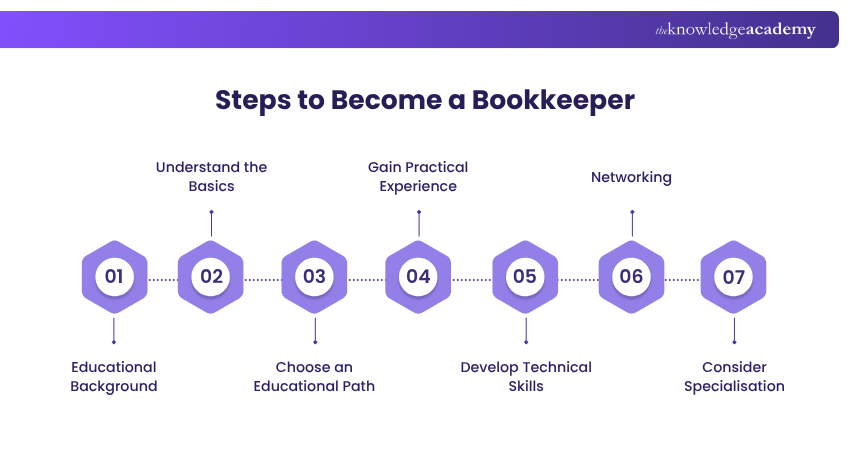
1) Educational Background: Start by completing your secondary education, as it provides the foundation for further studies and skills needed in Bookkeeping. You can go for a High School Diploma.
2) Understand the Basics: Develop a strong understanding of basic arithmetic, mathematics, and numerical skills. Bookkeeping is heavily reliant on accuracy in calculations.
3) Choose an Educational Path: While a college degree is not always required, many Bookkeepers pursue relevant education to enhance their skills. You can go for an Associate Degree or certifications in Accounting or Bookkeeping. Also, joining various online Bookkeeping courses can help you develop Bookkeeping skills.
4) Gain Practical Experience: Practical experience is crucial in Bookkeeping. Consider internships or part-time positions that allow you to apply your knowledge and get real-world experience. You can work for small businesses, Accounting firms, or as a freelance Bookkeeper.
5) Develop Technical Skills: Familiarise yourself with Bookkeeping Software and Accounting Tools. Proficiency in software like QuickBooks, Xero, or Sage can be an invaluable asset for your career.
6) Networking: Join professional organisations and networks related to Bookkeeping and Accounting. Building a professional network can create better job opportunities and industry insights.
7) Consider Specialisation: Bookkeeping can cover a broad range of industries and areas. You may choose to specialise in areas such as payroll, tax preparation, or Forensic Accounting, depending on your interests and career goals.
Conclusion
Bookkeeping lies at the core of every business’s financial health. It may appear simple, but it has a major impact on business growth, legal compliance tasks, and decision-making processes. If you are a freelancer, business owner or someone starting their finance career, knowing What is Bookkeeping is crucial for effective money management and sustaining long-term success.
Become an expert in auditing, tax preparation, and Financial Analysis with our Accounting Courses – Explore today!
Frequently Asked Questions
Do I Have to Keep Bookkeeping Records for My Business?

Yes, if you run a business, HMRC requires you to keep accurate Bookkeeping records, whether you're a sole trader, limited company, freelancer, or VAT-registered business. These records help with tax returns, avoid fines, manage cash flow, track debts, and claim tax relief on allowable business expenses.
What is the Formula for Bookkeeping?
The formula for Bookkeeping is known as the Accounting equation. The basic formula is:
Assets = Liabilities + Equity
The above formula balances the balance sheet. Also, Bookkeeping links to the Income Statement through revenue and expenses. The expanded equation is:
Assets = Liabilities + (Capital + Revenue - Expenses)

Olivia Taylor


Chartered Accountant and Financial Training Specialist
Olivia Taylor is a qualified chartered accountant with over a decade of experience in financial management, auditing and corporate reporting. Having worked with leading firms in both the public and private sectors, Olivia brings clarity to complex financial topics. Her writing focuses on helping professionals build confidence in key areas of accounting, compliance and financial planning.
View Detail

 If you wish to make any changes to your course, please


