


 Top Rated Course

We may not have the course you’re looking for. If you enquire or give us a call on 01344203999 and speak to our training experts, we may still be able to help with your training requirements.
Forensic Accounting: Meaning, Process and Applications
Olivia Taylor 15 July 2026Forensic Accounting analyses financial data to detect fraud, trace assets, calculate damages, and support legal cases with reliable evidence. It combines accounting, auditing, and investigative techniques to resolve disputes, strengthen compliance, and protect organisations from financial misconduct and risk.

Training Outcomes Within Your Budget!
We ensure quality, budget-alignment, and timely delivery by our expert instructors.
Table of Contents
Have you ever wondered how financial experts uncover hidden financial secrets, expose fraud or solve complex money mysteries? That is the world of Forensic Accounting, a meticulous process of examining financial records, transactions and data to reveal the truth. Unlike traditional Bookkeeping, it goes far beyond balancing ledgers, combining Accounting expertise with investigative and legal skills to dig deep into the details of financial activities.
With its market size is expected to reach £7.6 billion by 2031, its growing importance in the business world is undeniable. In this blog, we will explore what is Forensic Accounting, how it works, its process and why it matters, along with its key applications. Read more to find out!
Table of Contents
1) What is Forensic Accounting?
2) History of Forensic Accounting
3) Importance of Forensic Accounting
4) Applications of Forensic Accounting
5) How Forensic Accounting Works?
6) What is the Role of a Forensic Accountant?
7) Forensic Accounting vs Traditional Accounting: Key Differences
8) Skills Required to Become a Forensic Accountant
9) What are the Tools and Software for Forensic Accounting?
10) Conclusion
What is Forensic Accounting?
Forensic Accounting is a specialised area of accounting that focuses on investigating financial information to detect fraud, financial disputes, and misconduct. It combines accounting expertise with auditing techniques and investigative skills to examine financial records in detail.
Unlike traditional accounting, which mainly tracks and reports financial data, Forensic Accounting is used when legal action may be involved. The findings are often presented as evidence in court, to explain the nature of financial crimes. In general, Forensic Accountants analyse complex financial data, prepare clear reports, and may present findings as expert witnesses in court.

History of Forensic Accounting
Here’s a brief history of Forensic Accounting:
1) Ancient Origins: The principles of Forensic Accounting date back to ancient civilisations, where financial records were examined to detect fraud and resolve disputes. Over time, these practices evolved alongside accounting and legal systems.
2) Early 20th Century: As businesses and financial transactions became more complex, Forensic Accounting emerged as a specialised field. Governments, organisations and courts increasingly relied on accounting professionals to investigate fraud, financial crimes and commercial disputes.
3) Early 2000s: The Enron and WorldCom scandals exposed large-scale accounting fraud, including the misuse of Special Purpose Entities (SPEs) to conceal debt. These corporate failures also resulted in the collapse of the auditing firm Arthur Andersen, highlighting the need for stronger financial oversight.
4) 2002: In response to these scandals, the Sarbanes-Oxley Act (SOX) was implemented in the United States. The legislation strengthened corporate governance, financial reporting, and auditing standards, significantly increasing the demand for Forensic Accountants in fraud detection and regulatory compliance.
5) Present Day: Today, Forensic Accounting is an essential profession worldwide. Modern Forensic Accountants use Data Analytics, Digital Forensics and advanced investigative techniques to detect fraud, support legal proceedings, investigate cybercrime, and ensure financial transparency.
Importance of Forensic Accounting
Forensic Accounting plays an important role in protecting organisations and building trust in financial systems. Some of their importance are listed below:
1) Prevents Financial Crimes
It helps to identify frauds or money laundering activities before they turn into large-scale issues. Forensic Accountants help to trace suspicious activities and prevent financial crimes from escalation in a proactive manner.
2) Minimises Financial Loss
Since it helps to identify fraudulent activities proactively, it aids in reducing monetary damage for an organisation. This saves organisations from extra budgeting and prevents misuse of funds.
3) Recovery of Stolen Assets
Financial Accounting helps organisations to track financial transactions. This is done to locate and recover stolen or hidden funds, that might otherwise remain lost.
4) Internal Controls Strengthening
It helps to identify vulnerabilities in financial systems. After discovering such weaknesses, it recommends improvements to mitigate future fraud or misconduct of funds.
5) Supports Legal Proceedings
It provides evidence and expert testimony in court. It helps law enforcement and legal teams to prove crimes related to finance and make sure justice is served.
Learn Accounting standards and compliance requirements with our Accounting Courses – Join today!
Applications of Forensic Accounting
Forensic Accounting focuses on detecting financial discrepancies and fraud. As a specialised area of Accounting, its role extends beyond basic financial analysis- acting as an essential tool for identifying fraud, resolving disputes and more. Some of its key applications include:
1) Fraud and Financial Crime Investigation
a) Embezzlement and Employee Misconduct: Identifying theft or misuse of company assets, including cash and inventory.
b) Financial Statement Manipulation: Detecting falsified or altered records intended to deceive investors and stakeholders.
c) Money Laundering Activities: Tracking illicit funds and uncovering sophisticated laundering operations across borders.
d) Cyber-related Financial Crimes: Investigating online fraud, identity theft, and digital payment scams.
2) Business and Financial Conflict Resolution
a) Mergers and Acquisitions Review: Performing financial due diligence and validating financial accuracy during corporate transactions.
b) Shareholder and Partnership Conflicts: Conducting valuations and analysing financial disagreements between business parties.
c) Asset Identification and Recovery: Locating concealed or improperly transferred assets in corporate or personal disputes.
d) Insolvency and Bankruptcy Examination: Investigating financial distress, fraudulent transfers, and underlying causes of collapse.
3) Litigation Support and Court Assistance
a) Expert Witness Services: Explaining financial evidence clearly in court and assisting judges and juries in understanding complex data.
b) Loss and Damage Assessment: Calculating financial compensation for cases involving contractual breaches, lost income, or operational disruption.
c) Settlement and Dispute Analysis: Preparing detailed financial reports to support negotiations and legal resolutions.
4) Insurance and Claims Examination
a) Claim Verification: Assessing the authenticity and accuracy of submitted insurance claims.
b) Financial Loss Evaluation: Determining the extent of monetary damage due to fraud, accidents, or business interruption.
c) Detection of False Claims: Identifying inflated or fabricated claims to prevent unjustified payouts.
5) Regulatory Compliance and Prevention
a) Regulatory Investigations: Supporting organisations during regulatory reviews and making sure of compliance with financial standards and laws.
b) Anti-Bribery and Corruption (ABC) Reviews: Investigating bribery risks, improper payments, and corruption practices, while assessing compliance with anti-corruption regulations.
c) Fraud Risk Assessment: Identifying potential weaknesses and recommending strategies to minimise fraud exposure.
Design and implement effective financial frameworks with the Accounting and Finance Policies Course – Register today!
How Forensic Accounting Works?
The Forensic Accounting process is a meticulously orchestrated series of steps designed to uncover hidden financial truths, detect fraud, and provide an unbiased assessment of financial situations. In this article, we dive into the stages that comprise the Accounting process and explore how each step contributes to unravelling complex financial mysteries.

1) Investigation Planning
The journey of Forensic Accounting begins with careful planning. This phase involves understanding the context of the investigation, defining the scope, and identifying the key objectives. It includes selecting the right methods suitable for examination and maintaining clear communication with stakeholders to align goals and expectations.
2) Data Collection and Analysis
Once the investigation plan is in place, Forensic Accountants move on to collecting the necessary data. This involves gathering financial records, transaction data, bank statements, invoices, and any other relevant documents. Afterwards, they carefully examine it for detecting patterns, anomalies, or inconsistencies for finding financial irregularities.
3) Quantifying Economic Damages
In disputes or litigation cases, quantifying economic damages becomes a critical task. Forensic Accountants apply their expertise to calculate financial losses, business valuations, and other relevant monetary aspects. This involves analysing financial data, market trends, and economic conditions to provide an accurate assessment of the financial impact.
Register for our Quantitative Finance Training, and upskill your financial knowledge!
4) Reporting and Communication
The Accounting report outlines the methodologies employed, the collection of evidence, running analysis, and drawing conclusions. It is essential for the report to be clear, objective, and free of bias, as it may be presented as evidence in legal proceedings. The report should be structured in a manner that is easily understandable to stakeholders who may not possess a financial background.
5) Ethical Considerations
Throughout the process, adherence to ethical standards is paramount. Forensic Accountants must maintain objectivity, independence, and confidentiality. Their findings and conclusions should be based on facts and evidence, devoid of personal bias. Additionally, they must ensure that the methods employed align with legal and professional standards.
What is the Role of a Forensic Accountant?
A Forensic Accountant investigates financial records to detect fraud, misconduct, or legal disputes. They analyse transactions, trace assets, and prepare reports for use in court or arbitration. Their role often includes supporting criminal investigations, corporate audits, or insurance claims, blending Accounting expertise with legal and investigative skills.
Improve financial reporting accuracy with our Fixed Assets Accounting and Management Course – Sign up soon!
Forensic Accounting vs Traditional Accounting: Key Differences
Traditional Accounting focuses on recording and reporting financial information, while Forensic Accounting investigates fraud, financial irregularities, and disputes that may involve legal proceedings.
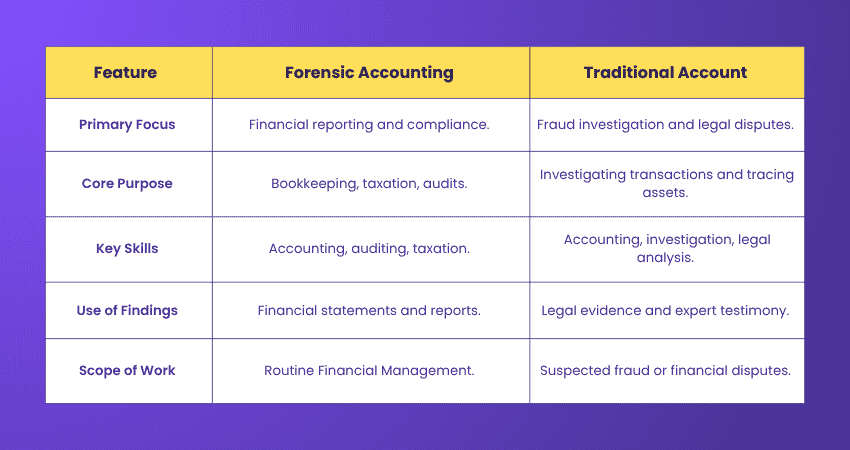
Let’s explore the distinctions in detail:
1) Primary Focus: Traditional Accounting manages financial records and prepares financial statements, whereas Forensic Accounting investigates suspected fraud, financial crimes, and disputes.
2) Purpose: Traditional Accounting supports financial reporting, compliance, and business decision-making. Forensic Accounting analyses financial evidence for investigations, litigation, and dispute resolution.
3) Scope of Work: Traditional Accountants handle routine bookkeeping, reporting, taxation, and audits. Forensic Accountants examine complex financial transactions, trace hidden assets, and reconstruct records when necessary.
4) Skills Required: Traditional Accounting requires expertise in financial reporting, taxation, and auditing, while Forensic Accounting combines accounting knowledge with investigative, analytical, and legal skills.
5) Use of Findings: Traditional Accounting produces financial reports for stakeholders and regulatory compliance. Forensic Accounting findings may be presented as evidence in court or during legal proceedings.
6) When It Is Used: Traditional Accounting is performed regularly throughout the financial year, whereas Forensic Accounting is typically conducted when fraud, misconduct, or financial disputes are suspected.
Skills Required to Become a Forensic Accountant
A Forensic Accountant needs a diverse set of skills and expertise to effectively investigate financial matters and detect irregularities. Key skills include:
1) Investigative Abilities: Forensic Accountants examine financial records of individuals or organisations to identify inconsistencies and uncover evidence of fraud or misconduct. Strong investigative skills are essential for gathering and analysing relevant information.
2) Analytical and Critical Thinking: They must be able to evaluate large volumes of financial data, distinguish significant details from irrelevant information, and make sound judgments based on their findings.
3) Communication and Collaboration Skills: Effective communication is crucial, as Forensic Accountants frequently work alongside attorneys, law enforcement officials, auditors, and other specialists. They must also be able to present complex financial information to different audiences clearly.
4) Strong Accounting Expertise: A thorough understanding of accounting principles, financial reporting standards, taxation and regulatory requirements is vital for accurately assessing financial records and identifying discrepancies.
What are the Tools and Software for Forensic Accounting?
Forensic Accounting often involves analysing large volumes of financial data and digital records. To manage this, you can use tools and software that help organise information, detect irregularities, and present findings clearly. Such tools and software include the following:
1) Microsoft Excel: Widely used for organising data, performing calculations, financial modelling, and trend analysis.
2) ACL Analytics: Audit and Data Analytics software that helps identify fraud risks and financial irregularities.
3) Interactive Data Extraction and Analysis (IDEA): Used to test, analyse, and validate financial information during investigations.
4) Tableau: A data visualisation tool that converts complex financial data into interactive dashboards and visual reports for easier interpretation.
5) QuickBooks: Accounting software used to review transaction records, invoices, and financial statements of small to medium-sized businesses.
6) SAP: Enterprise Resource Planning (ERP) software that provides access to detailed financial and operational data within large organisations.
7) IBM i2 iBase: Investigation software used to organise, link, and analyse complex financial data, helping identify relationships in fraud and financial crime cases.
Conclusion
Forensic Accountants play a vital role in uncovering financial fraud and ensuring transparency within organisations. By blending investigative skills with Accounting expertise, it supports legal processes and protects business integrity. When pursued as a career, understanding Forensic Accounting demonstrates its growing importance in the financial world.
Learn to interpret complex financial statement with our Accounting and Financial Statement Analysis Training – Join today!
Frequently Asked Questions
Will AI Replace Forensic Accounting?

No Artificial Intelligence (AI) will not replace Forensic Accounting but will enhance it. While AI can automate Data Analysis and detect unusual patterns, Forensic Accountants remain essential for investigating fraud, applying professional judgement, interviewing stakeholders and presenting findings in legal proceedings.
Why Would Someone Want to be a Forensic Accountant?
Someone may pick the Forensic Accounting profession to combine financial skills with investigative work. It offers a variety of high-impact cases, and the opportunity to support justice. It’s ideal for those who enjoy solving puzzles, uncovering fraud and making a tangible difference in legal or corporate outcomes.

Olivia Taylor


Chartered Accountant and Financial Training Specialist
Olivia Taylor is a qualified chartered accountant with over a decade of experience in financial management, auditing and corporate reporting. Having worked with leading firms in both the public and private sectors, Olivia brings clarity to complex financial topics. Her writing focuses on helping professionals build confidence in key areas of accounting, compliance and financial planning.
View Detail

 If you wish to make any changes to your course, please


