




We may not have the course you’re looking for. If you enquire or give us a call on 01344203999 and speak to our training experts, we may still be able to help with your training requirements.
What is a Resilient Distributed Dataset (RDD): A Complete Guide
ByScarlett AdamsLast updated on: 19 August 2026
RDDs are a foundational, lower-level abstraction in Apache Spark, although higher-level abstractions such as DataFrames are generally preferred for structured data processing. RDDs remain useful when applications require greater control over distributed data and transformations.
Key Takeaways
1. RDDs are immutable, distributed collections designed for parallel data processing in Apache Spark.2. Data in an RDD is divided into partitions, which can be processed across different nodes in a cluster.3. Transformations create new RDDs, while actions trigger computation to return results or write output.4. RDDs use lazy evaluation, meaning transformations are not computed until an action requires a result.5. RDDs provide fault tolerance through lineage, which helps Spark recompute lost partitions.
Imagine this scenario:
A large dataset is being processed across four computers:
Node 1 → Partition A
Node 2 → Partition B
Node 3 → Partition C
Node 4 → Partition D
Suddenly, Node 3 fails.
Does that mean the entire computation has to start again?
Not necessarily. Apache Spark can use information about how the data was created to recompute a lost RDD partition. This ability to distribute processing across a cluster while recovering from certain failures helps explain the name Resilient Distributed Dataset.
In this blog, we’ll explore What is a Resilient Distributed Dataset, its key characteristics, how it works, its common operations and use cases, and its main pros and cons.
What is a Resilient Distributed Dataset?
A Resilient Distributed Dataset (RDD) is a fundamental data structure in Apache Spark used to process large amounts of data across multiple computers in a cluster. It divides data into smaller partitions, allowing different parts of the dataset to be processed in parallel.
RDDs are immutable, meaning existing data cannot be changed directly. Instead, transformations create new RDDs. They also support lazy evaluation and fault tolerance through lineage, which allows Spark to recompute lost partitions if a failure occurs.

Why is it Called a Resilient Distributed Dataset?
Breaking down the name makes the concept easier to remember:
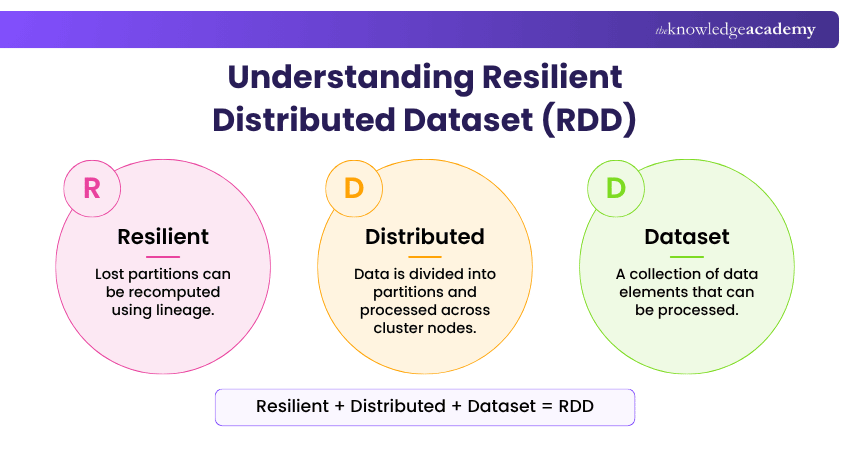
Resilient
→ Lost partitions can be recomputed using lineage information.
Distributed
→ Data is divided into partitions that can be processed across a cluster.
Dataset
→ It represents a collection of data elements that can be processed using Spark operations.
Together, these characteristics make RDDs suitable for distributed data-processing workloads where parallelism and fault recovery are important.
Key Characteristics of RDDs
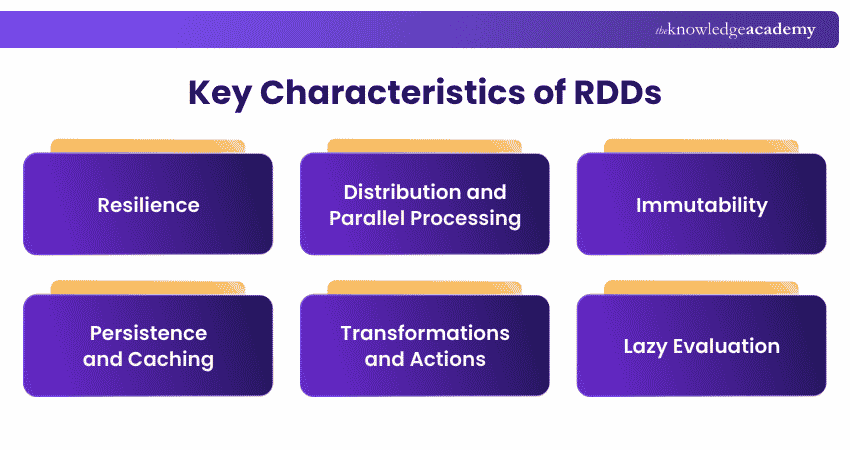
RDDs have several characteristics that determine how they store and process data.
1) Resilience
RDDs provide fault tolerance by maintaining information about the operations used to create them. If a partition becomes unavailable, Spark can use this lineage to recompute the lost partition.
2) Distribution and Parallel Processing
An RDD can be divided into multiple partitions that can be processed across different nodes in a cluster. This partitioning enables different portions of a dataset to be processed in parallel.
3) Immutability
Once an RDD is created, its contents cannot be directly changed. Applying a transformation to an existing RDD creates a new RDD rather than altering the original.
4) Persistence and Caching
RDDs can be cached or persisted so that data can be reused across operations without always being recomputed from its original source. Depending on the selected storage level and available resources, persisted data may be stored in memory, on disk, or using a combination of both.
5) Transformations and Actions
RDD operations broadly fall into two categories.
Transformations create new RDDs from existing ones, while actions trigger computation to return results or write output.
6) Lazy Evaluation
Transformations are evaluated lazily. Rather than immediately executing each transformation, Spark waits until an action requires the computation to be performed.
Gain expertise in managing large data sets using our Hadoop Big Data Certification – Register now!
How Does an RDD Work?
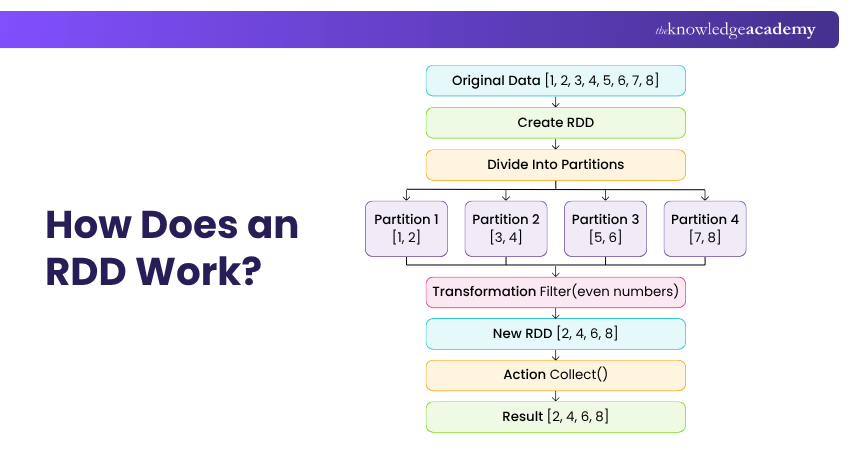
An RDD works by dividing data into partitions that can be processed across different nodes in a cluster. Operations can then be applied to these partitions in parallel. RDDs also keep track of how they were created, which helps Spark recover lost data when certain failures occur.
To understand the process, consider a simple dataset:
[1, 2, 3, 4, 5, 6, 7, 8]
Follow the RDD
What Each Stage Means
|
Stage
|
What Happens?
|
|
Original Data
|
The process starts with the data that needs to be processed.
|
|
Create RDD
|
The data is represented as an RDD for distributed processing.
|
|
Partition
|
The RDD is divided into smaller partitions that can be processed in parallel across the cluster.
|
|
Transformation
|
An operation such as filter() defines a new RDD without changing the original RDD. Transformations are evaluated lazily.
|
|
New RDD
|
The transformation defines a new RDD representing the even values [2, 4, 6, 8]; the required computation occurs when an action is triggered.
|
|
Action
|
An action such as collect() triggers the required computation and returns the RDD elements to the driver program.
|
|
Result
|
The requested output, [2, 4, 6, 8], is produced.
|
This simple workflow demonstrates several RDD concepts at once: partitioning, transformations, immutability, lazy evaluation and actions.
Transformations vs Actions
Understanding the distinction between transformations and actions is important when working with RDDs.
|
Operation
|
Type
|
Purpose
|
|
map()
|
Transformation
|
Applies an operation to elements and creates a new RDD
|
|
filter()
|
Transformation
|
Selects elements that meet a condition
|
|
flatMap()
|
Transformation
|
Transforms elements and can produce multiple output elements
|
|
collect()
|
Action
|
Returns RDD elements to the driver
|
|
count()
|
Action
|
Returns the number of elements
|
|
saveAsTextFile()
|
Action
|
Writes RDD output
|
Pro Tip
Avoid using collect() on very large RDDs unless necessary, as it brings all elements to the driver and can consume significant memory. Use actions such as take() when you only need a small sample.
Use Cases of RDDs
RDDs can be useful when developers require distributed processing with relatively low-level control over data transformations.
Some common workload types include:
1) Processing Unstructured or Custom Data
RDDs can support unstructured, specialised or custom data-processing workloads where developers need lower-level transformations, custom algorithms or direct control over partitions that do not fit naturally into a structured tabular model.
2) Text Processing
RDDs can be used to transform and analyse large collections of text in parallel, particularly when workloads require customised text-processing logic.
3) Scientific and Research Workloads
RDDs may support specialised scientific or research workloads where custom distributed algorithms require direct control over data partitions and transformations.
4) DDs can be useful where applications require low-level transformations or control that may not fit naturally into a structured tabular model.
Gain practical skills in Machine Learning and Big Data technologies with our Advanced Data Analytics Course – Join today!
Pros and Cons of RDDs
RDDs offer several advantages for distributed processing, but they also have limitations that developers should consider.
Pros of RDDs
Below are some of the key advantages of using RDDs in Apache Spark:
1) Recovery From Lost Partitions
RDD lineage allows Spark to recompute lost partitions, supporting recovery from certain failures without requiring all intermediate results to be permanently stored.
2) Flexible Data Processing
RDDs provide developers with relatively low-level control over transformations, making them suitable for specialised processing requirements.
3) Efficient Data Reuse
Frequently reused RDDs can be cached or persisted, helping reduce repeated computation across multiple operations.
4) Support for Custom Processing
RDDs can support specialised processing logic that may not fit naturally into structured, tabular data models.
5) Distributed Scalability
RDD partitions can be processed across cluster resources, allowing workloads to use distributed computing resources as data-processing requirements grow.
Cons of RDDs
Below are some of the key limitations and challenges of using RDDs in Apache Spark:
1) Lower-level Programming
RDD operations can require a deeper understanding of distributed data-processing concepts, which can increase complexity for beginners.
2) Resource Consumption
Persisting large RDDs can consume significant memory or disk resources depending on the selected storage level, so persistence strategies need to be considered carefully.
3) Serialisation Overhead
Moving data between cluster nodes may require serialisation and deserialisation, which can add processing overhead.
4) Expensive Shuffles
Some operations require data to move between partitions. These wide transformations can result in shuffling, which may consume network and computational resources.
5) Limited Automatic Optimisation
RDDs do not receive the same type of higher-level query optimisation available to structured Spark abstractions such as DataFrames.
RDD vs DataFrame: What's the Difference?
For most structured data workloads, DataFrames are generally preferred because Spark can apply higher-level optimisations using information about the data structure and operations. RDDs remain useful when developers need lower-level control or specialised transformations that do not fit naturally into a structured model.
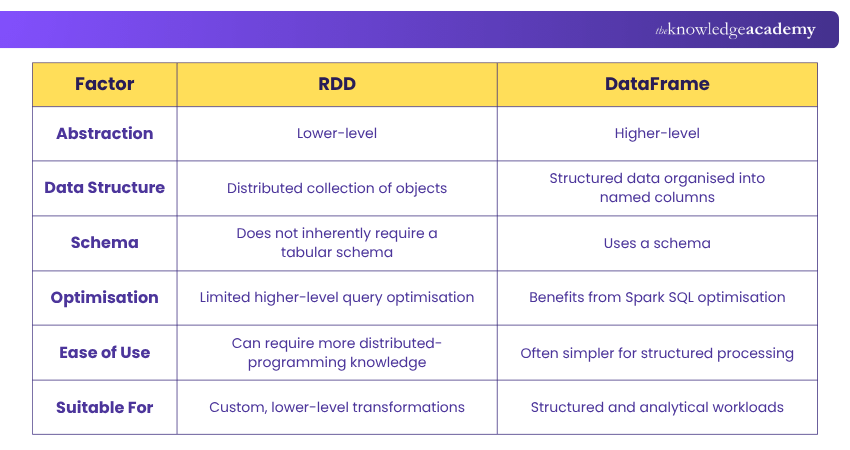
Which Should You Choose?
Is your data structured and suited to tabular operations?
→ A DataFrame is generally the more suitable approach.
Do you need lower-level control over distributed data and transformations?
→ An RDD may be appropriate.
Trainer Insight
RDDs are important for understanding how distributed processing works in Spark, but that does not mean they should automatically be selected for every Spark workload. Consider the structure of the data and the transformations required before choosing an abstraction.
Conclusion
Resilient Distributed Datasets remain an important Apache Spark abstraction for distributed processing, particularly when developers need flexibility and lower-level control over data operations. Understanding What is a Resilient Distributed Dataset can help you recognise where RDDs fit within Spark and when higher-level abstractions such as DataFrames may be more suitable.
Gain expertise in handling massive datasets efficiently with our Big Data and Analytics Training – Join now!

 If you wish to make any changes to your course, please


