


 Top Rated Course

We may not have the course you’re looking for. If you enquire or give us a call on 01344203999 and speak to our training experts, we may still be able to help with your training requirements.
What are Accruals in Accounting: Meaning and Examples
The Knowledge Academy 16 July 2026Accruals are revenues earned or expenses incurred but not yet paid in cash, recorded to reflect transactions when they occur, such as wages. This approach ensures financial statements present a more accurate view of a business’s performance, helping organisations track income and costs in the specific accounting period.

Training Outcomes Within Your Budget!
We ensure quality, budget-alignment, and timely delivery by our expert instructors.
Table of Contents

Have you ever completed work or earned income but received the payment later? This is where understanding What are Accruals becomes important. In everyday business, money does not always move at the same time as the activity, and relying only on cash transactions can give an incomplete picture of performance.
To solve this, businesses use Accrual Accounting to record income and expenses when they happen, not when cash is exchanged. This helps you understand how companies track real financial activity, make financial decisions, and present accurate financial statements. In this blog, you will learn What are Accruals, how they work, their types, examples, and more.
Table of Contents
1) What are Accruals?
2) How Do Accruals Work?
3) Accrual Accounting vs Cash Accounting
4) Different Types of Accruals
5) How to Record Accruals?
6) Example of Accruals
7) Benefits of Accruals
8) Role of Accruals in Financial Statements
9) What is the Difference Between Accruals and Payables?
10) Conclusion
What are Accruals?
Accruals are accounting entries used to record revenues earned or expenses incurred before any cash is received or paid. It recognises income when it is earned and expenses when they are incurred. This helps to present a more accurate view of a business’s financial performance.
To put it simply, Accruals ensure that financial transactions are recorded in the correct accounting period, even if payment happens later. This can be applied to various areas, such as unpaid wages, outstanding bills, accounts receivable, and accounts payable.

How Do Accruals Work?
Accruals record the income and expenses when they are earned or incurred, rather than when cash is received or paid. This ensures that the financial activity is reflected in the correct accounting period. Here's how it really works:
1) Sales are recorded when invoices are issued, even if payment is received later.
2) Expenses are recognised when supplier invoices are received, regardless of payment time.
3) Accounts show both when a transaction occurred and when cash moved.
4) This approach helps identify busy periods and delayed customer payments.
5) Accruals improve financial forecasting and support informed business decisions.
6) They also provide lenders and investors with a clearer view of financial performance and stability.
Accrual Accounting vs Cash Accounting
Here are the key distinctions between Accrual Accounting and Cash Accounting:
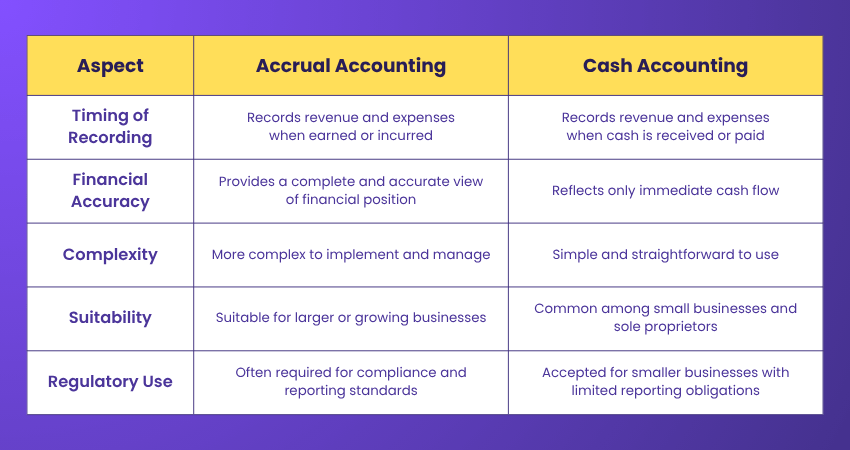
1) Timing of Recording
a) Accrual Accounting records revenue and expenses when they are earned or incurred, offering a long-term view.
b) Cash Accounting, however, only records transactions when money changes hands, reflecting short-term financial activity.
2) Financial Accuracy
a) Accrual Accounting delivers a more accurate representation of a company’s financial position by including receivables and payables.
b) Cash Accounting may overlook future obligations or expected income, limiting its accuracy.
3) Complexity
a) Accrual Accounting is more complex due to the need for tracking transactions over time.
b) Cash Accounting is easier to manage, making it a simpler choice for businesses with straightforward finances.
4) Suitability
a) Larger or expanding businesses often prefer Accrual Accounting to better monitor performance and obligations.
b) Cash Accounting is usually more suitable for smaller businesses that prioritise simplicity and short-term Cash Management.
5) Regulatory Use
a) Accrual Accounting is often mandated by regulatory bodies for compliance and Financial Reporting.
b) Cash Accounting is typically acceptable for smaller entities that are not subject to extensive reporting requirements.
Turn numbers into clarity with practical financial expertise with the Bookkeeping Course now!
Different Types of Accruals
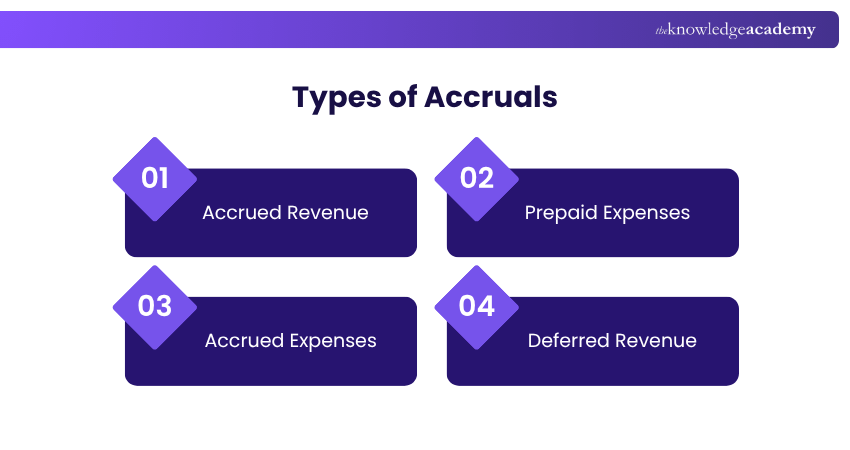
Now you know What are Accruals, but do you know that accounting accruals are considered to be of four main types that reflect the income and expenses in a certain period. They are as follows:
1) Accrued Revenue
Accrued Revenue occurs when goods or services are offered by a business, but the business has not yet been paid. As an example, when goods are sold on credit, the accrued revenue is credited, and the amount to be paid is periodically recognised as a receivable asset.
2) Prepaid Expenses
Prepaid expenses are those costs that have been paid in advance; this is in the form of goods or services that will be consumed in the course of time. These are classified as an asset in the form of payment of fees paid beforehand to a Lawyer or consultant on a retention basis.
3) Accrued Expenses
These are also referred to as accrued liabilities and are the expenses incurred but not paid yet in the accounting period. The example is when the electricity consumed in October will not be reflected in each and every bill until December but has to be noted as an expense in October.
4) Deferred Revenue
When a business receives the money and the delivery of a good or service has not yet been made, then this leads to revenue deferring. Usual examples are in the form of advance payments made towards subscription or online purchases that are treated as liabilities until the delivery of the service or product is made.
Build strong policies for confident financial control with the Accounting and Finance Policies Course today!
How to Record Accruals?
After knowing What are Accruals, you can follow these steps to record Accruals accurately:
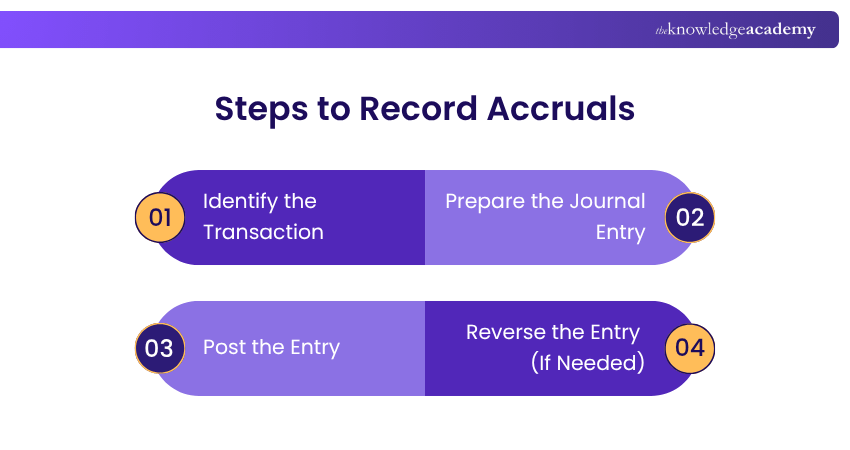
1) Identify the Transaction
Determine if revenue has been earned or an expense incurred that hasn’t yet been recorded due to no cash exchange. This step ensures that financial activities are recognised in the correct accounting period for accurate reporting.
2) Prepare the Journal Entry
1) For Accrued Expenses:
a) Debit: Relevant Expense Account (e.g., Electricity Expense)
b) Credit: Accrued Liabilities or Accounts Payable
2) For Accrued Revenues:
a) Debit: Accounts Receivable
b) Credit: Relevant Revenue Account
3) Post the Entry
Record the journal entry in the accounting system for the appropriate period. This updates the financial statements, ensuring they reflect the true financial position of the business.
4) Reverse the Entry (If Needed)
In the next period, reverse the Accrual entry when the actual cash transaction occurs, to avoid double recording. This keeps the accounts accurate and prevents duplication of income or expenses in future records.
These steps ensure your financial statements reflect the true financial position of the business within the correct reporting period.

Example of Accruals
A common example of Accruals is when a business incurs an expense but pays for it later. For instance, imagine manufacturing equipment requires maintenance at the end of the accounting period, but the bill is received and paid in the next period. Even though no cash has been paid yet, the expense has already occurred.
To reflect this accurately, the business records the maintenance cost in the current period’s income statement and recognises a liability on the balance sheet. This is conducted through an adjusting journal entry by debiting the maintenance expense and crediting accrued expenses payable. This ensures the financial records remain complete and accurate.
Step into accounting with confidence and job-ready knowledge with the Accounting Course – Join now!
Benefits of Accruals
Accruals may sound like an Accountant’s best friend (or worst nightmare), but they serve a crucial role in Financial Management. Without them, businesses would be flying blind, unsure of their true financial position.
1) Improved Forecasting Accuracy
a) Seeing the Full Picture: Imagine running a business where you only count money when it physically arrives or leaves. You’d have no clue about pending sales or upcoming expenses. Accruals ensure businesses can predict future revenue and costs accurately.
b) Better Planning, Fewer Surprises: A company that tracks income and expenses as they occur (rather than when cash changes hands) can budget more effectively, avoid cash flow shocks, and make informed strategic decisions.
2) Clear Picture of Financial Health
a) Avoiding the "False Profit" Trap: When a company waits until payment before reporting revenue it could temporarily show an unreliable financial position that differs from actual sales activity. Through Accrual Accounting, financial statements represent actual business performance instead of relying on cash position.
b) Transparency for Stakeholders: The true performance of a business needs to be known by investors along with lenders and workplace members. A financial image produced by Accrual Accounting enables businesses to establish credibility which supports their ability to attract funding at critical times.
Role of Accruals in Financial Statements
Accruals play a key role in ensuring financial statements accurately reflect a company’s economic activities within a specific accounting period. Let’s look at its key roles in financial statements as mentioned below:
1) Income Statement: Accruals help match revenues with the expenses incurred to generate them. This gives an accurate picture of profitability for the period, regardless of when cash is received or paid.
2) Balance Sheet: Accruals recognise items, such as receivables and payables, offering a clear view of a company’s assets and liabilities at a specific point in time.
3) Cash Flow Statement: This statement uses Accrual-based figures to reconcile net income with actual cash flow from operations. This is useful for highlighting the differences between profit and cash.
What is the Difference Between Accruals and Payables?
Accruals record revenues earned or expenses incurred before cash is exchanged. Accounts payable are a type of Accrual, representing short-term debts for goods or services received but not yet paid. While all payables are Accruals, not all Accruals are payables since some are related to income or other obligations.
Conclusion
Understanding What are Accruals is key to accurate financial reporting. By recording income and expenses when they occur, Accruals provide a clearer view of a company’s true financial position. This helps businesses make informed decisions and maintain transparency in their financial statements.
Unlock career-ready accounting skills with real-world insights with Accounting Courses now!
Frequently Asked Questions
Can Anyone Use the Accrual Method for Accounting?

The Accrual method can be used by the majority of businesses, although it is compulsory for limited companies and where the annual turnover of a business is more than 150,000. The technique is particularly helpful in bigger or more intricate organisations, especially those with control over high quantities of stock.
How to Keep Track of Accruals?
To keep track of Accruals, do the following:
1) Use accounting software
2) Maintain detailed records of invoices and expenses
3) Regularly update financial statements with adjusting entries.

The Knowledge Academy


Global Training Provider
The Knowledge Academy is a world-leading provider of professional training courses, offering globally recognised qualifications across a wide range of subjects. With expert trainers, up-to-date course material, and flexible learning options, we aim to empower professionals and organisations to achieve their goals through continuous learning.


 If you wish to make any changes to your course, please


