




We may not have the course you’re looking for. If you enquire or give us a call on 01344203999 and speak to our training experts, we may still be able to help with your training requirements.
Water Jug Problem in AI: An In-Depth Guide
ByNilotpal SarmahLast updated on: 22 September 2026
Curious about the Water Jug Problem in AI? This classic puzzle involves measuring exact amounts of water using two jugs of different capacities. This blog will explore the Water Jug Problem in AI, its algorithmic solutions, practical examples, and how it's used to teach concepts in Artificial Intelligence. Let's dive in!
Ever pondered the seemingly simple task of measuring exact quantities of water using just two jugs? This classic puzzle has been a staple in computer science, challenging minds for decades. Welcome to the intriguing world of the Water Jug Problem in AI. Beyond being a mere brain teaser, it’s a fundamental problem that has shaped the development of Artificial Intelligence algorithms.
Imagine teaching a computer to solve puzzles, make decisions, and find optimal solutions – that’s where the Water Jug Problem comes in. In this blog, we’ll delve into the intricacies of this problem, exploring various solution approaches and understanding its significance in the broader context of AI. Get ready to quench your thirst for knowledge as we unravel the secrets of this classic puzzle!
What is the Water Jug Problem in AI?
The Water Jug Problem in AI is a classic puzzle often used to illustrate problem-solving and search algorithms. It involves two jugs with known capacities and an unlimited water supply. The challenge is to measure a specific amount of water using these jugs. For example, given a 3-litre and a 5-litre jug, the goal might be to measure exactly 4 litres.
The problem requires figuring out a sequence of actions (filling, emptying, and transferring water between jugs) to achieve the desired measurement. It's a practical example of how AI systems can be designed to explore possible states and actions to reach a solution, demonstrating concepts like state space, goal state, and operators. This problem helps understand the importance of planning and decision-making in AI.

Solving the Water Jug Problem
After understanding the basics of the Water Jug Problem in AI, it's time to explore the methods used to solve it. These methods include various search algorithms and optimisation techniques, each offering unique approaches to finding the solution.
1) Breadth-First Search (BFS)
Breadth-First Search (BFS) is a fundamental algorithm in computer science, particularly useful in solving the Water Jug Problem. BFS explores all possible moves level by level, starting from the initial state. In the context of the Water Jug Problem, this means systematically filling, emptying, and transferring water between jugs, considering every possible state that can be reached from the current state.
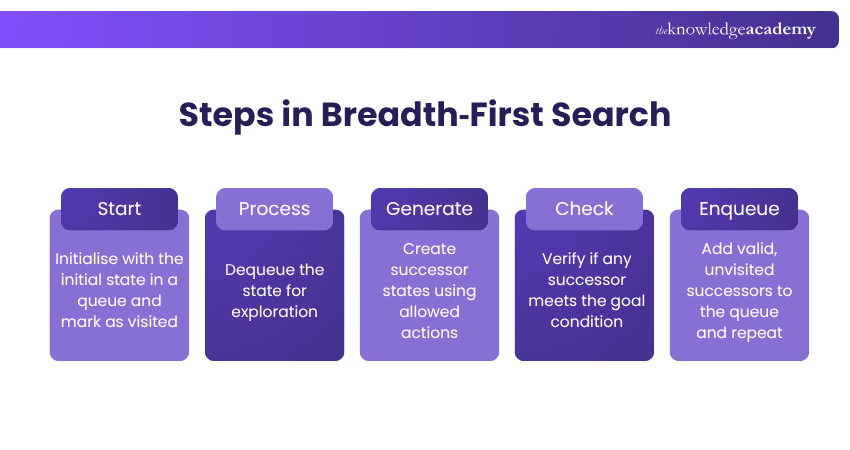
To implement BFS, you use a queue to keep track of the current state and all potential subsequent states. The algorithm begins by enqueueing the initial state, then iteratively dequeues states to explore their neighbouring states. For example, if you have a 3-litre jug and a 5-litre jug, BFS would first consider the states where each jug is either filled to its capacity or emptied. It then explores transferring water between the jugs in various configurations.
The main advantage of BFS is its ability to find the shortest path to the goal state, ensuring the minimum number of moves. However, BFS can be memory-intensive, as it needs to store all possible states. Despite this, BFS is particularly effective when the solution requires exploring all possibilities or when the search space is relatively small, making it a good fit for problems like the Water Jug Problem.
Want to be an AI Project Manager? Get assistance with our Artificial Intelligence (AI) for Project Managers today!
2) Depth-First Search (DFS)
Depth-First Search (DFS) takes a different approach by exploring one potential path to its end before backtracking and trying alternative paths. In the Water Jug Problem, DFS starts from the initial state and continues to explore the deepest level of the state space before moving back to explore other branches. This is implemented using a stack, which helps in maintaining the sequence of states being explored.
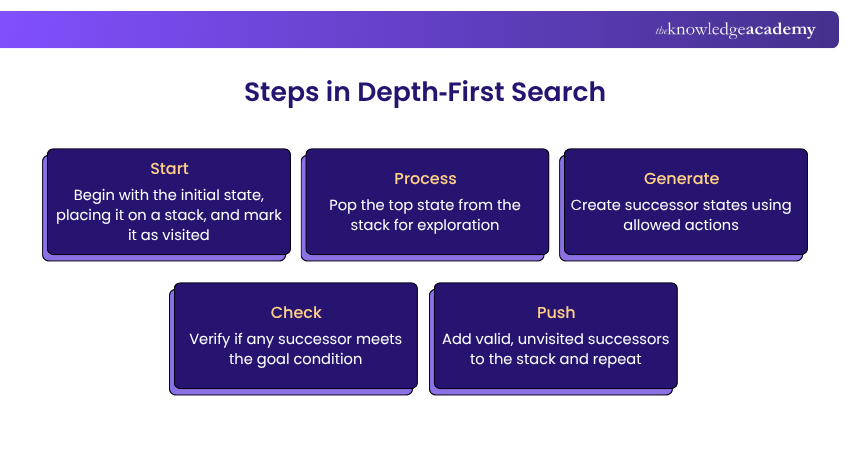
DFS is often more memory-efficient than BFS, as it only needs to store the current path and backtrack when necessary. However, one downside is that DFS does not guarantee finding the shortest path to the solution. In some cases, it may even explore paths that are far longer than necessary, particularly if the solution lies closer to the root of the search tree.
In the water jug problem, DFS might fill one jug completely and then attempt to pour water into the other jug until it is full or empty before moving to another operation. This method can be advantageous when you need to explore deep solutions or when the search space is large, and the solution lies deep within it. However, care must be taken to avoid infinite loops or repeatedly visiting the same states, which can be mitigated by keeping track of visited states.

3) Pruning
Pruning is a technique used in search algorithms to eliminate paths that are unlikely to lead to a solution, thereby improving efficiency. In the context of the Water Jug Problem, pruning can significantly reduce the number of states that need to be explored, speeding up the search process.
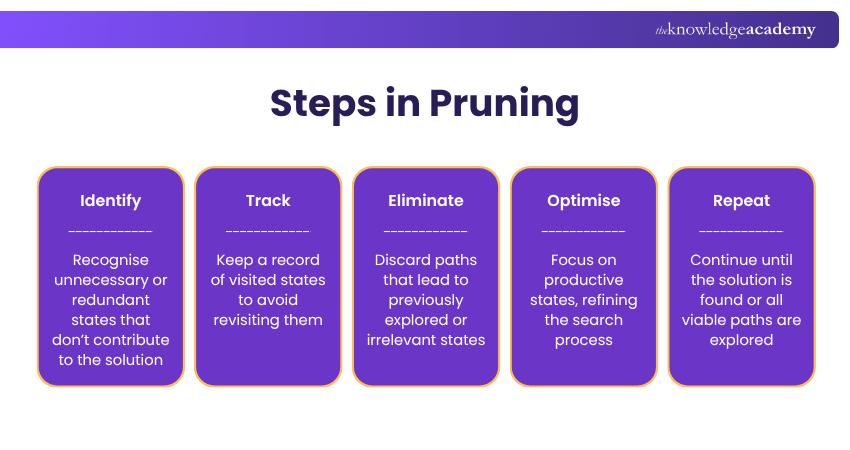
One common pruning method involves keeping track of visited states to prevent re-exploration. For instance, if you have already explored the state where the 3-litre jug is full, and the 5-litre jug is empty, there is no need to revisit this state. This prevents redundant calculations and helps the algorithm focus on new, unexplored paths, thereby improving Time Complexity.
Another pruning strategy involves identifying and ignoring moves that do not contribute to reaching the goal. For example, if the goal is to measure 4 litres and you find yourself repeatedly filling and emptying the same jug without making progress, these actions can be pruned from consideration. Pruning is particularly useful in the water jug problem when combined with BFS or DFS, as it helps manage the search space more effectively. It can also be combined with heuristics to further refine the search process, making it faster and more efficient. By reducing the number of unnecessary or unproductive states, pruning helps in achieving the solution more quickly and with less computational effort.
Get practical knowledge on Machine Learning with our Machine Learning Course- sign up now!

Nilotpal Sarmah is a Senior Content Writer with 11+ years of overall experience spanning engineering, operations and content development. His technical knowledge and extensive writing experience enable him to simplify specialised topics across IT and Tech, Business Skills, Project Management, Health and Safety, and ISO and Compliance.
View Detail

 If you wish to make any changes to your course, please


