




We may not have the course you’re looking for. If you enquire or give us a call on 01344203999 and speak to our training experts, we may still be able to help with your training requirements.
Types of Trees in Data Structures: A Comprehensive Overview
ByVishnu SankarLast updated on: 18 September 2026
In this blog, we will explore the types of trees in data structures, which are widely used to represent hierarchical and non-linear data. We will learn about basic tree properties and terminology, such as nodes, edges, roots, leaves, height, depth, degree, etc.
What This Blog Covers
1. The fundamentals of trees, including their structure, properties and core terminology.2. Key binary tree structures, including full, complete, perfect and balanced trees.3. Search and balancing approaches used in BSTs, AVL Trees, and Red-Black Trees.4. Range-query applications of Segment Trees and hierarchical structures supported by N-ary Trees.5. The importance of B-Trees for managing large datasets in databases and file systems.
Exploring types of trees in data structures unveils a fundamental landscape crucial for efficient information management. Trees, with their hierarchical arrangement of nodes, play a pivotal role in organising data and supporting efficient algorithms.
From search-focused structures to balanced and multiway trees, each structure is designed to meet different computational needs. Understanding these distinctions provides a strong foundation for choosing and applying suitable tree structures in different scenarios.
Did You Know?
Different tree structures are designed for different tasks. AVL and Red-Black Trees focus on maintaining balance, Segment Trees handle range-based queries, while B-Trees are well suited to database and file-system storage.
Different Types of Trees in Data Structure
Binary Trees provide a simple branching structure, while specialised forms such as AVL and Red-Black Trees maintain balance according to specific rules. Multiway trees like B-Trees and B+ Trees handle large datasets effectively.
Trees can be classified in different ways based on their branching structure, ordering rules, balancing properties and intended applications. Below are some widely used tree structures explained in detail:
1) Binary Tree
A Binary Tree is a fundamental ordered data structure which is composed of nodes, where each node has two children, referred to as the left and right subtrees. The topmost node is the root, and nodes without children are leaves.
More importantly, Binary Trees provide a structured way to organise hierarchical data and support various traversal and processing operations. Search efficiency depends on how the tree is organised and balanced. Their simplicity and versatility make them a cornerstone in various algorithms and applications in Computer Science.
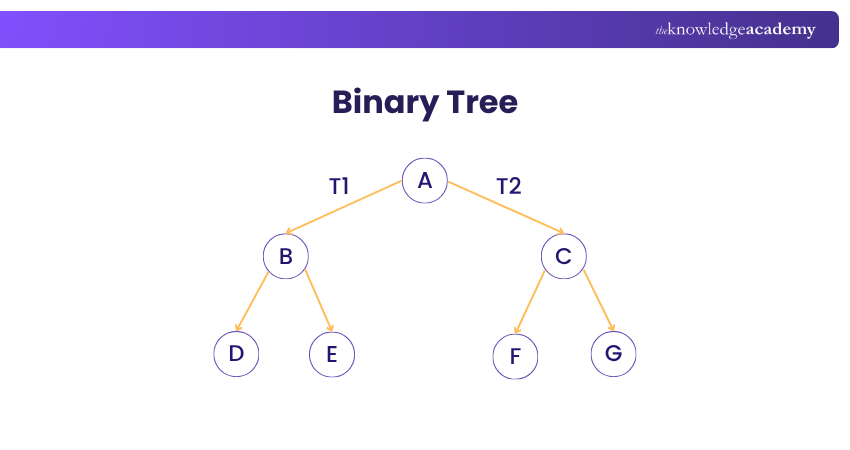
Now, Binary Trees can be classified into different types based on their structure and arrangement of nodes:
a) Full Binary Tree: A Full Binary Tree is a binary tree in which each node has either 0 or 2 children. This structure is useful in applications where internal nodes naturally require exactly two children.
b) Degenerate Binary Tree: A Degenerate Binary Tree, also known as a pathological or skewed tree, is a binary tree in which a parent node has only one associated child, resulting in a structure akin to a linked list. Degenerate Binary Trees lack balance and can behave like linked lists, which may result in O(n) search time when used as Binary Search Trees.
Furthermore, Binary Trees can also be segregated into the following types based on their completion of levels:
a) Complete Binary Tree: A Complete Binary Tree is a binary tree where all levels, except the last one, are fully filled, and all nodes are as far left as possible. This unique structure is maintained by filling levels from left to right, allowing efficient array-based representation and making Complete Binary Trees particularly useful for binary heaps.
b) Perfect Binary Tree: A Perfect Binary Tree is a specialised binary tree where all internal nodes have exactly two children, and all leaf nodes are at the same level. As a result, every level is completely filled, giving the tree a regular and symmetrical structure.
c) Balanced Binary Tree: A Balanced Binary Tree keeps its height controlled by preventing its subtrees from becoming excessively uneven according to a defined balancing condition. Self-balancing Binary Search Trees, such as AVL and Red-Black Trees, use different balancing rules to maintain logarithmic height and support efficient search, insertion and deletion operations.
2) Binary Search Tree
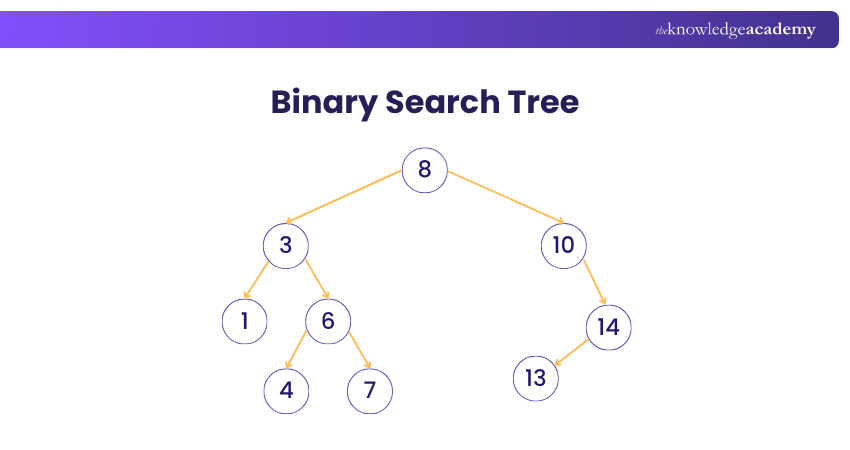
A Binary Search Tree (BST) is a specialised Binary Tree where all keys in the left subtree are smaller than the node's key, while all keys in the right subtree are greater, with duplicate-key handling depending on the implementation. This ordering property enables efficient searching, insertion, and deletion operations, making BSTs valuable in data structures.
When the tree remains reasonably balanced, search, insertion and deletion can typically be performed in O(log n) time. However, an unbalanced BST can degrade to O(n) in the worst case.
3) Ternary Tree
A Ternary Tree is a hierarchical data structure where each node can have up to three children, distinguishing it from binary trees. This unique characteristic allows nodes to branch into three subtrees, providing additional flexibility in organising and representing hierarchical relationships.
A related structure, the Ternary Search Tree, is commonly used for string-searching applications such as autocomplete and spell-checking. While less common than binary trees, ternary structures accommodate richer relationships between nodes, expanding the scope of potential use cases.

Understanding and implementing Ternary Trees offers a nuanced approach to hierarchical data representation, catering to scenarios where a triadic relationship is more fitting than the binary alternative.
4) AVL Tree
An AVL Tree is a self-balancing binary search tree, ensuring that the height difference between every node's left and right subtrees is at most one. Named after its inventors, Adelson-Velsky and Landis, an AVL Tree automatically adjusts its structure through rotations during insertion and deletion operations, maintaining logarithmic height and efficient search, insertion, and deletion times.
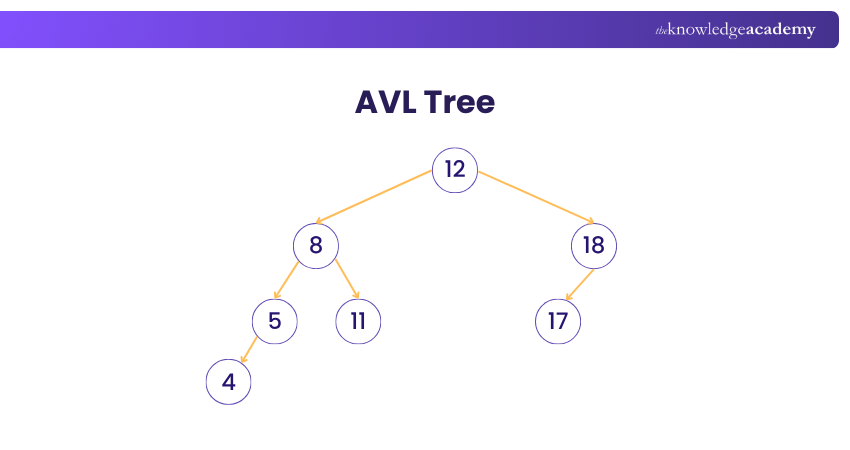
More importantly, this balancing property enhances the performance of operations, making AVL Trees valuable in scenarios where predictable and efficient lookup performance is important.
While the maintenance of balance introduces additional overhead, the benefits of predictable performance make AVL Trees a powerful and widely used data structure in computer science for scenarios requiring fast and reliable search operations.
Quick Insight
AVL Trees maintain stricter balance, which can result in shorter tree heights and efficient lookups. Red-Black Trees allow looser balance and generally require fewer rotations, making them well suited to workloads involving frequent insertions and deletions.
Get equipped with the necessary programming knowledge by signing up for our Programming Training now!
5) Red-Black Tree
A Red-Black Tree is a self-balancing binary search tree with the key innovation of assigning colours (red or black) to its nodes. This colour-coding scheme ensures the tree remains approximately balanced, limiting the maximum path length from the root to any leaf.
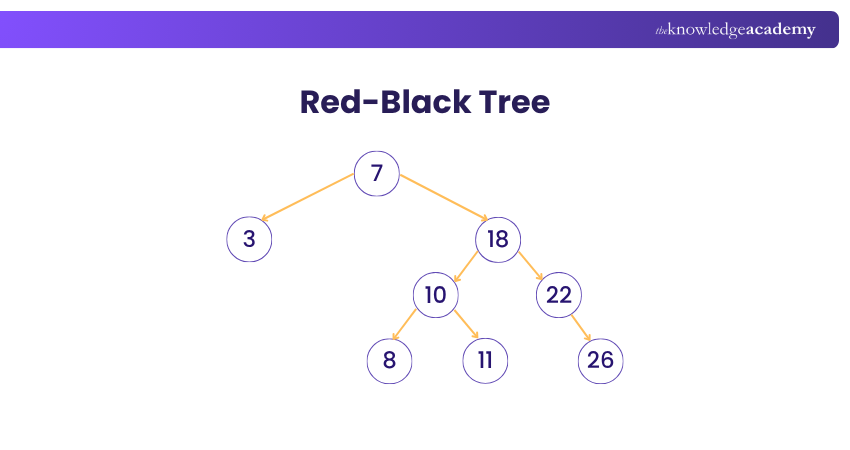
Additionally, the Red-Black Tree maintains five essential properties:
a) The root is black.
b) No two consecutive red nodes exist along a path.
c) Every path from a node to its descendant NIL/null leaves contains the same number of black nodes.
d) Every node is either red or black.
e) Every NIL/null leaf is black.
These properties ensure logarithmic height, guaranteeing efficient search, insertion, and deletion operations with a predictable time complexity.
Red-black trees balance the simplicity of binary trees and the strict balancing of AVL Trees. The colour-coding mechanism allows less strict balancing than AVL Trees, which can reduce rebalancing overhead during insertion and deletion operations.
This makes Red-Black Trees particularly suitable for scenarios where a balance between structural integrity and operational efficiency is crucial, such as in implementing data structures like sets and maps in various programming languages.
6) Segment Tree
A Segment Tree is a versatile and efficient data structure for solving range query problems on an array or a list. It recursively divides the input array into segments or intervals, represented by nodes in the tree.
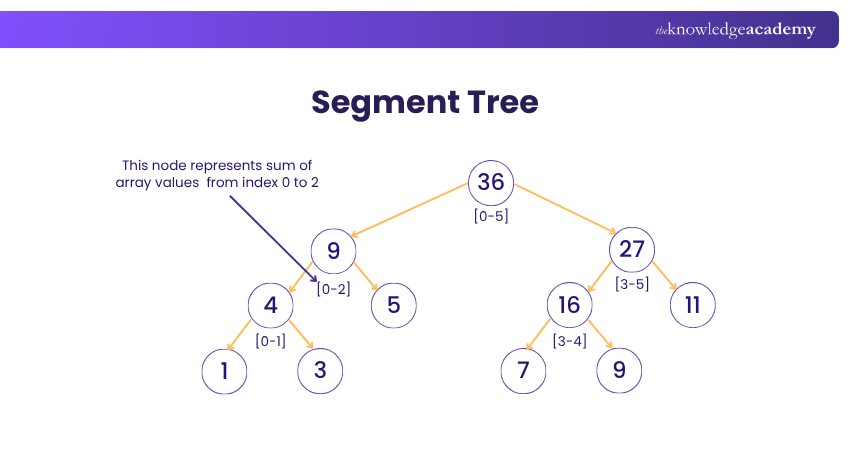
Each node stores information summarising the data within its corresponding segment. Common applications of Segment Trees include range sum queries, range minimum/maximum queries, and other associative operations.
A Segment Tree can be constructed recursively or iteratively, depending on the implementation. Its hierarchical organisation enables many common range queries and point updates to be performed in logarithmic time.
Additionally, Segment Trees can efficiently support updates to individual elements in the underlying array without reconstructing the entire tree. The ability to efficiently handle a variety of range queries makes Segment Trees valuable in fields such as computational geometry, database systems, and competitive programming.
A thorough understanding of data structures and Algorithms enhances your ability to effectively implement and apply Segment Trees in these scenarios. Despite their apparent simplicity, Segment Trees offer an elegant solution to complex problems involving large datasets and dynamic updates, showcasing their significance in algorithmic design and optimisation.
7) N-ary Tree
An N-ary Tree is a generalisation of binary trees where each node can have up to N children, providing a more flexible and scalable hierarchical structure. In contrast to binary trees, N-ary Trees accommodate diverse branching factors, offering a nuanced representation of relationships in various applications.
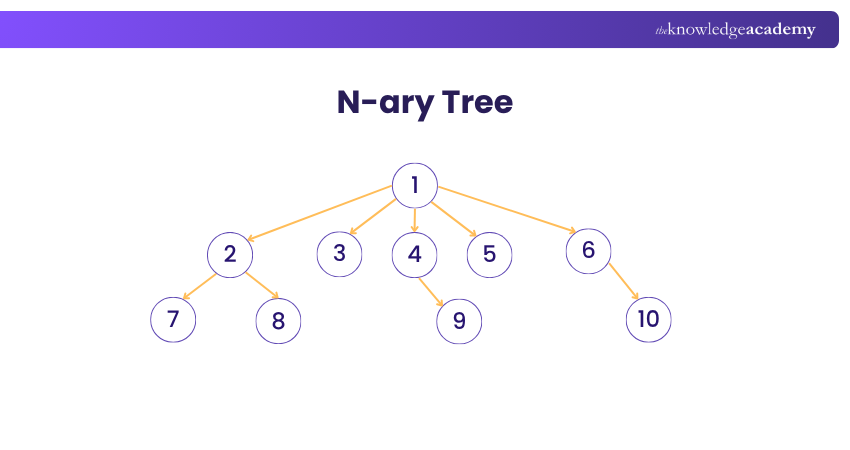
These trees are particularly useful in scenarios where entities have multiple dependencies or associations, such as representing hierarchical file systems, organisational structures, or syntax trees in computer science.
The structure of an N-ary Tree supports efficient storage and retrieval of information, with each node potentially branching into a variable number of child nodes. While the specific use case often dictates the choice of N, common values include 2 (binary trees), 3 (ternary trees), and higher values for more complex relationships.
Despite this additional complexity, N-ary Trees provide a valuable tool for representing and navigating hierarchical relationships in various applications, showcasing their adaptability and versatility in data structure design.
8) B-Tree
A B-Tree is a self-balancing search tree data structure renowned for its efficient handling of large datasets and its suitability for storage systems where reducing disk or storage accesses is important.
Characterised by a variable number of children per node, a B-Tree maintains balance through controlled splits and merges, ensuring a uniform depth. This balance facilitates efficient search, insertion, and deletion operations with a predictable logarithmic time complexity.
Commonly employed in databases and file systems, B-Trees excel in scenarios requiring rapid access to sorted data and support for dynamic updates. The ordered structure allows for range queries and sequential access, making them particularly suitable for indexing, file organisation, and database management. A good understanding of Python data structures can further enhance your ability to implement and utilise B-Trees effectively in various applications.
Moreover, the adaptability of B-Trees to different scenarios and their ability to optimise I/O operations underscore their significance in the design of robust and high-performance storage systems.
Gain practical experience with Django's powerful features and functionalities with our Python Django Training – Join now!
Trees are versatile data structures used to organise hierarchical information and support efficient data operations. Binary Trees, BSTs, AVL Trees, Red-Black Trees, Segment Trees, N-ary Trees and B-Trees each serve different purposes, from fast searching and balancing to range queries and large-scale data storage.

Vishnu Sankar is a Senior Content Writer with 5+ years of experience across content development, software development, web development and system administration. His technical background and professional training support his expertise in IT and Tech, while his extensive research and writing experience covers Project Management and Health and Safety.
View Detail

 If you wish to make any changes to your course, please


