




We may not have the course you’re looking for. If you enquire or give us a call on + 1-866 272 8822 and speak to our training experts, we may still be able to help with your training requirements.
6 Main Types of Information Systems and Their Uses
ByJyoti TuraLast updated on: 02 October 2026
Types of information systems include transaction processing, management information, decision support, executive support, ERP systems, and CRM systems. Each system serves specific business needs, from handling daily transactions to supporting strategic decisions, improving productivity and enabling efficient collaboration.
Key Highlights
1. Different information systems serve different levels of an organisation, from operational tasks to strategic decision-making.2. TPS is best suited to high-volume, routine activities, while MIS focuses more on structured managerial reporting and performance monitoring.3. DSS is useful when decisions are less structured and require analysis, comparison, forecasting, or scenario evaluation.4. ESS gives senior leaders a high-level view of business performance, helping them track trends and focus on long-term priorities.5. ERP and CRM often work across multiple departments, with ERP improving internal coordination and CRM strengthening customer-facing activities.
In this digital world, information systems form the backbone of businesses, enabling efficient operations, informed decision-making, and strategic planning. Companies of all sizes are focusing on information systems for proper collecting, storing, processing, and distributing information within organisations and beyond. There are various types of information systems that ensure smooth operations in management.
This in turn makes the companies from all around the world invest massive amounts in this industry to make their businesses more technology-forward. In this blog, we’ll explore the different types of information systems and their various uses, which help industries become more technologically advanced.
What are the Types of Information Systems?
Information systems support different levels and functions within an organisation, from handling everyday transactions to helping managers make strategic decisions. Each system is designed to manage specific business activities and information needs. Some of the most commonly used types of information systems include the following:
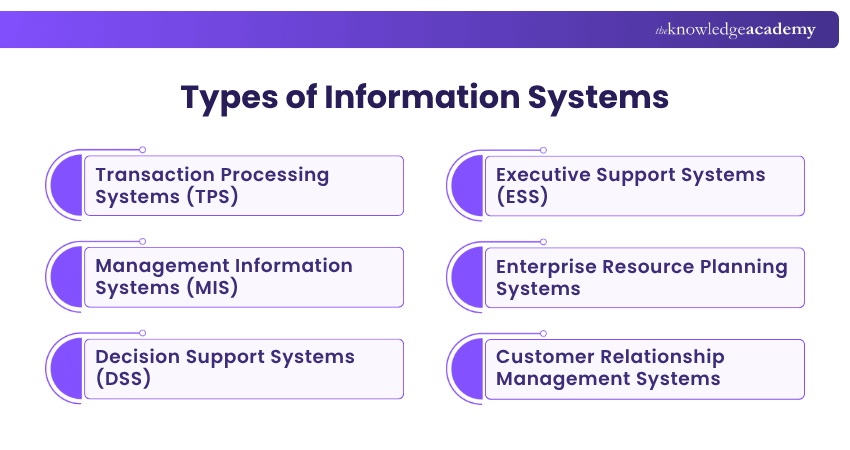
1) Transaction Processing Systems (TPS)
Transaction Processing Systems (TPS) support the day-to-day operations of organisations by capturing, processing, and storing routine business transactions. These systems may process transactions in real time or in batches and are commonly used for activities such as sales, payments, orders, payroll, reservations, and inventory updates.
Essential Components and Functions:
At the heart of TPS lie several vital components, including databases, servers, and software applications designed to record transactions instantly. When a transaction occurs, TPS captures the pertinent data, processes it according to predefined rules, and stores the resulting information in a centralised database. This rapid processing is vital, especially in sectors where time-sensitive actions are crucial.
Uses of TPS in Modern Businesses:
a) Retail Operations: In retail, TPS ensures swift and accurate processing of sales transactions. It manages inventory levels in real time, triggering reorder requests when stocks run low, thus preventing shortages and ensuring customer satisfaction.
b) Banking and Finance: Banks rely on TPS for handling numerous transactions daily, including deposits, withdrawals, fund transfers, and loan processing. TPS guarantees accuracy, security, and speed, thereby enhancing customer trust in financial institutions.
c) Online Commerce: E-commerce platforms handle a vast number of transactions daily. TPS manages online purchases, updates product availability, processes payments securely, and tracks shipments, ensuring a seamless shopping experience for customers.
d) Healthcare: In healthcare, transaction-processing functions can support appointment scheduling, patient registration, billing, payments and insurance claims.
e) Transportation and Logistics: TPS supports logistics operations by recording orders, shipment transactions, inventory movements and delivery updates. This is particularly vital for businesses engaged in global trade, enabling them to coordinate complex logistics with precision.

2) Management Information Systems (MIS)
Management Information Systems (MIS) is another type of information system, which bridges the gap between raw data and strategic decision-making. MIS is a comprehensive framework that leverages technology to gather, process, store, and disseminate information to support managerial functions within an organisation.
It serves as the backbone of modern management, ensuring that decision-makers are equipped with accurate, timely, and relevant data to steer their organisations toward success.
Key Components and Functions:
MIS comprises various elements, including databases, software applications, hardware resources, and skilled personnel. These components collaborate to collect vast amounts of data from diverse sources, such as transaction processing systems, and transform this data into meaningful information.
Through data analysis and reporting tools, MIS provides executives and managers with insightful summaries, forecasts, and performance metrics, aiding in strategic planning and tactical decision-making processes.
Uses of MIS in Modern Businesses:
a) Planning and Budgeting: MIS provides managers with historical performance data, operational reports and departmental information that can support budgeting, resource planning and short- to medium-term management decisions.
b) Performance Monitoring: MIS enables the continuous monitoring of Key Performance Indicators (KPIs) and other metrics crucial to evaluating the organisation’s performance. Managers can identify areas of improvement, assess the effectiveness of strategies, and make data-driven decisions to enhance overall efficiency.
c) Resource Management: MIS optimises resource allocation by analysing data related to human resources, finances, inventory, and production. This ensures that resources are utilised efficiently, reducing wastage and enhancing productivity.
d) Management Reporting: MIS provides routine, scheduled and exception reports that help managers monitor operations, compare actual performance with targets and identify areas requiring attention.
e) Communication and Collaboration: MIS facilitates seamless communication and cooperation between departments and teams within an organisation. With a centralised platform for information sharing, MIS enhances teamwork, accelerates problem-solving, and fosters innovation.
Make every message clearer and more effective with our Communication Skills Courses – Join now!
3) Decision Support Systems (DSS)
Decision Support Systems (DSS) are computer-based systems designed to help decision-makers analyse information, compare alternatives and address complex or less-structured problems. They may use analytical models, data visualisation, predictive techniques and, in some cases, AI or Machine Learning.
1) Key Components and Functions:
DSS consists of a range of components, including databases, analytical models, user interfaces, and decision engines. These components synergise to analyse vast datasets, identify patterns, and generate meaningful reports.
It often employs technologies such as data mining, predictive modelling, and Machine Learning (ML) algorithms to identify patterns and trends and forecast potential outcomes. The intuitive interfaces allow decision-makers to interact with the system, pose queries, and explore scenarios to gain deeper insights into complex problems.
2) Uses of DSS in Modern Businesses:
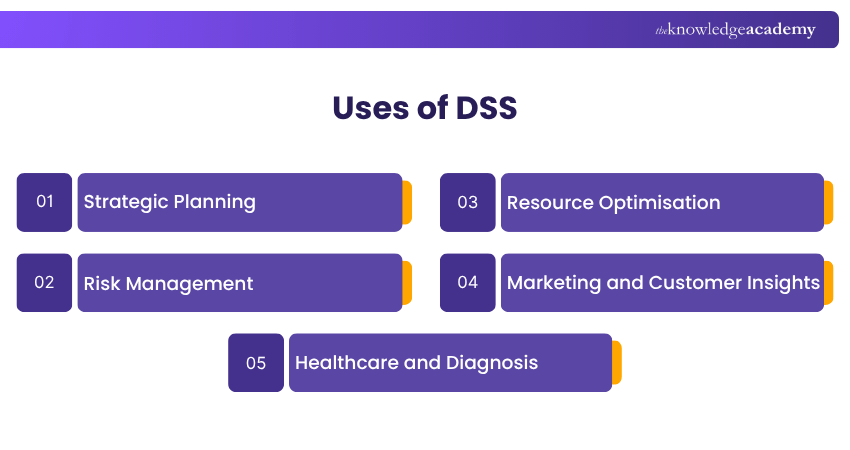
a) Strategic Planning: DSS aids executives in strategic planning by providing in-depth analyses of market trends, competitor strategies, and customer behaviours. By simulating various scenarios, decision-makers can assess the potential impact of different methods, enabling the selection of the most viable and lucrative options.
b) Risk Management: DSS is instrumental in risk assessment and management. By analysing historical data and current market conditions, DSS can identify potential risks, allowing organisations to develop proactive strategies to mitigate these risks.
c) Resource Optimisation: DSS optimises resource allocation by analysing factors such as demand patterns, production capacities, and supply chain logistics. By identifying bottlenecks and inefficiencies, organisations can streamline their operations, reduce their overall costs, and enhance overall productivity.
d) Marketing and Customer Insights: DSS analyses customer data to identify preferences, purchasing patterns, and feedback. This information is important for crafting targeted marketing campaigns, personalised customer experiences, and improving customer satisfaction.
e) Healthcare and Diagnosis: Clinical Decision Support Systems can analyse patient information and relevant clinical knowledge to provide alerts, recommendations or other information that assists healthcare professionals with diagnosis and treatment decisions.
4) Executive Support Systems (ESS)
Executive Support Systems (ESS) is another important type of information system, which is designed to assist senior management in strategic decision-making processes. Tailored to the needs of high-level executives, it provides comprehensive information from internal and external sources, enabling leaders to analyse trends, assess organisational performance, and formulate long-term strategies.
1) Essential Components and Functions:
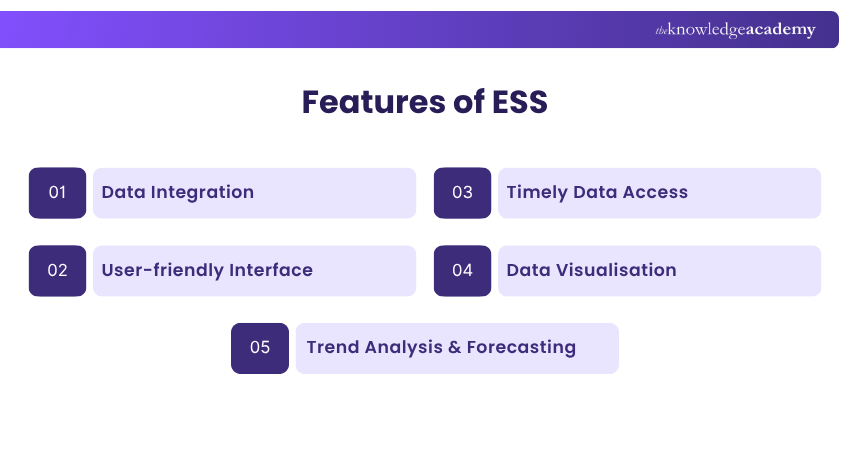
ESS integrates data from various sources, including internal databases, market intelligence, and competitor analyses. Utilising advanced analytical techniques and intuitive visualisation tools, ESS presents information in the form of concise reports, charts, and graphs. Its user-friendly interface allows executives to explore data effortlessly, enabling them to delve deep into critical aspects of the business environment.
2) Uses of ESS in Modern Businesses:
a) Strategic Decision-making: ESS assists executives in making decisions by providing a holistic view of the organisation's performance metrics, market trends, and competitive landscapes. By analysing this data, leaders can identify emerging opportunities, anticipate threats, and devise strategies to achieve long-term objectives.
b) Performance Monitoring: It tracks KPIs and benchmarks organisational performance against predefined goals. Executives can monitor real-time data, enabling them to assess progress, identify areas of improvement, and align the organisation's efforts with its strategic vision.
c) Executive Dashboards: ESS consolidates high-level KPIs, financial information, operational metrics and external indicators into dashboards, allowing senior leaders to monitor the organisation and identify issues requiring strategic attention.
d) Competitor Analysis: ESS provides in-depth insights into competitors' activities, market positioning, and product strategies. By understanding the competitive landscape, executives can fine-tune their strategy, identify market gaps, and develop offerings that stand out in the industry.
e) Communication and Collaboration: ESS enhances communication and collaboration among top executives. By providing a centralised platform for accessing relevant information, it ensures that all executives are on the same page, fostering cohesive decision-making processes.
5) Enterprise Resource Planning Systems
Enterprise Resource Planning (ERP) Systems help organisations coordinate core business activities through a unified platform. Instead of maintaining separate systems for different departments, ERP allows information to be shared across the organisation, improving consistency, visibility, and operational efficiency.
1) Key Components and Functions:
ERP Systems commonly include modules for finance and accounting, human resources, procurement, inventory management, supply chain management, and production planning. Their main functions include centralising business data, automating routine processes, improving information flow between departments, supporting reporting, and providing real-time visibility into organisational activities.
2) Uses of Enterprise Resource Planning Systems:
a) Financial Management: Helps organisations manage budgets, expenses, revenue, payments, accounts, and financial reporting in one place. It also improves visibility into financial performance and supports better planning.
b) Human Resource Management: Supports employee records, payroll, attendance, leave, recruitment data, and other workforce-related activities. It helps HR teams maintain accurate information and manage employees more efficiently.
c) Inventory Management: Tracks stock levels, product movement, warehouse activities, and availability. It helps organisations avoid shortages or excess inventory and maintain better control over stored goods.
d) Procurement Management: Supports purchasing activities by managing suppliers, purchase requests, purchase orders, and related approvals. It helps organisations improve purchasing efficiency and maintain better supplier coordination.
e) Supply Chain Management: Helps coordinate suppliers, production, logistics, inventory movement, and distribution. It increases visibility across the supply chain and helps organisations manage the flow of goods more effectively.
f) Business Reporting: Combines information from different departments to generate reports, dashboards, and performance insights. These reports help managers monitor operations, identify trends, and make more informed decisions.
6) Customer Relationship Management Systems
Customer Relationship Management (CRM) Systems are information systems designed to help organisations manage interactions with current and potential customers. They bring customer details, communication history, sales activities, enquiries, and service information into one central system, making it easier for teams to maintain relationships and manage the customer journey.
1) Key Components and Functions:
CRM Systems typically include contact management, lead management, sales tracking, marketing automation, customer service, and reporting tools. Their key functions include storing customer information, tracking interactions, managing sales opportunities, supporting marketing activities, monitoring service requests, and analysing customer behaviour.
2) Uses of Customer Relationship Management Systems:
a) Customer Data Management: Stores customer contact details, preferences, purchase history, and previous interactions in one place. This gives teams a clearer view of each customer and helps them provide more consistent and personalised communication.
b) Lead Management: Helps businesses capture, organise, and track potential customers from their first enquiry through different stages of the sales process. It also allows sales teams to prioritise promising leads and follow up more effectively.
c) Sales Management: Supports sales teams in monitoring opportunities, tracking deal progress, recording activities, and managing pipelines. This helps improve visibility into ongoing sales efforts and makes forecasting more structured.
d) Marketing Support: Helps organisations segment customers, manage campaigns, track responses, and coordinate targeted communication. This makes it easier to deliver more relevant messages to different customer groups.
e) Customer Service: Records enquiries, complaints, service requests, and support interactions so teams can respond more efficiently. It also helps maintain continuity when different employees handle the same customer.
f) Customer Analysis: Uses stored customer data to identify behaviour patterns, preferences, engagement levels, and buying trends. These insights can help organisations improve customer retention, refine services, and support future sales and marketing decisions.
Trainer’s Tip
When comparing information systems, ask three questions:
1. Who primarily uses the system?2. What business activity or decision does it support?3. What type of information does it produce?These questions make it easier to distinguish systems that may otherwise appear similar.
Equip yourself with the skills needed to optimise customer interactions with CRM Training – Sign up now!
Importance of Information Systems in Modern Businesses
Information systems streamline business operations by automating processes, managing data efficiently, and ensuring seamless communication within and outside the organisation. They enhance decision-making processes by providing timely, accurate, and relevant information to managers and executives, enabling them to make informed choices that drive the company's growth.
Moreover, information systems facilitate improved customer service and engagement. Through CRM systems and data analytics, businesses can understand customer preferences, anticipate demands, and personalise interactions, leading to enhanced customer satisfaction and loyalty. It is also significant in supply chain management, optimising inventory, logistics, and distribution processes.
Additionally, information systems can improve organisational flexibility by helping businesses respond to changing operational and market conditions. They can also support innovation by making information easier to access, analyse and share across the organisation.
From Information to Impact
Each information system plays a different role, but their purpose is ultimately the same: turning data into useful action. When the right system supports the right task or decision, businesses can work more efficiently, respond faster, and make better use of the information they already have.
Gain practical insights into information security best practices with CISSP Courses – Join now!

Jyoti Tura is a Senior Web & UX/UI Manager with 7+ years of experience in front-end development, web development and user-focused interface design. Her technical expertise and managerial responsibilities support her knowledge across IT and Tech, Leadership and Management.
View Detail

 If you wish to make any changes to your course, please


