




We may not have the course you’re looking for. If you enquire or give us a call on 01344203999 and speak to our training experts, we may still be able to help with your training requirements.
Types of Data Entry: A Comprehensive Look
ByVidhya NairLast updated on: 19 September 2026
Explore the diverse world of data entry with our comprehensive blog covering various types of data entry. From medical and legal data entry to specialised roles, learn about the evolving trends shaping the industry. Discover the nuances of different data entry tasks and stay ahead in this dynamic field.

Data Entry is the process of entering, updating, or verifying data from various sources into a digital format and is essential for many industries and businesses. Data Entry professionals help organisations store, organise, and analyse information. However, not all data entry jobs are the same. There are different types of data entry that require different skills, tools, and methods.
If you are a beginner in the data entry domain and want to know more about the Types of Data Entry, this blog is for you. In this blog, we will explore the types of data entry, their features and nuances, and their opportunities in the market.
Different Types of Data Entry
Here is a list of the common types of data entry used in the industry:
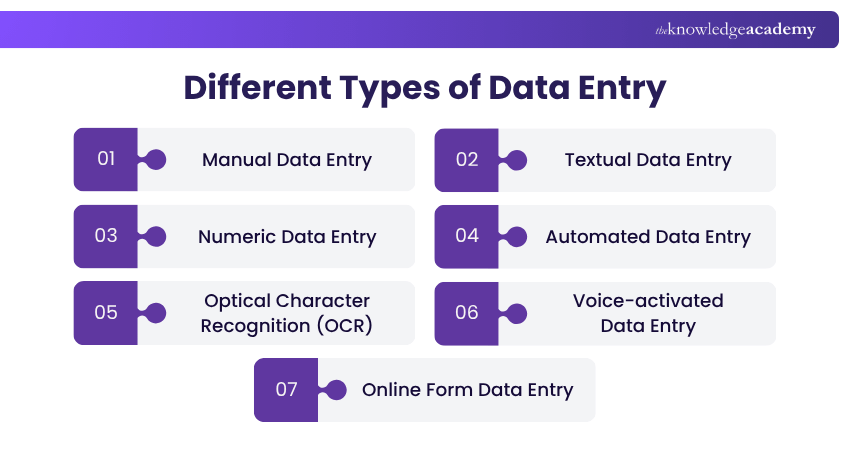
1) Manual Data Entry
Manual data entry, the traditional method of inputting information into computer systems or databases, remains a fundamental approach in various industries. This process involves human operators entering data using keyboards or other input devices, ensuring the accurate transfer of information from physical documents to digital formats. Despite technological advancements, manual data entry is still crucial for tasks that demand precision and attention to detail.
Manual data entry is essential in maintaining accurate records in administration, finance, and healthcare. This method allows professionals to meticulously input textual or numerical data, contributing to the reliability of databases, and ensuring the integrity of information. While automation technologies continue to evolve, the foundational role of manual data entry persists in scenarios where human expertise is essential for quality control and accuracy.

2) Textual Data Entry
Textual data entry is a fundamental data entry process focused on transforming written or printed text into digital formats. Operators manually input text into computer systems using keyboards or other input devices in this method. It is crucial to convert physical documents, forms, or text-based content into a digital form for efficient storage, retrieval, and analysis.
This type of data entry is prevalent in various industries, including administrative, legal, and academic sectors, where documents must be digitised for ease of handling and processing. Accuracy in textual data entry is paramount to ensure the faithful representation of the original text, making it a foundational aspect of data entry processes.
3) Numeric Data Entry
Numeric data entry is a specialised form of data input primarily dealing with numerical values. In various industries, especially finance and accounting, accurate representation of numerical information is crucial for decision-making and analysis. Numeric data entry involves entering figures, statistics, or any data in numerical format into databases, spreadsheets, or other digital systems. This process demands precision to ensure error-free records, mainly when dealing with financial transactions, budgeting, or statistical analysis.
The emphasis on numerical accuracy makes this type of data entry essential for maintaining the integrity of financial records and conducting meaningful data-driven analyses. Whether handling invoices, budget sheets, or any numeric dataset, the meticulous nature of numeric data entry ensures that organisations can rely on accurate numerical information for their operational and strategic needs.
4) Automated Data Entry
Automated data entry is a transformative approach that harnesses technology to streamline and expedite the input of information into digital systems. Employing software or scripts, this method reduces reliance on manual Data Entry, minimising errors, and enhancing efficiency. It is particularly advantageous for tasks involving large datasets or repetitive data input, where the risk of human error is high.
Automated data entry systems can extract, process, and input information swiftly, allowing businesses to manage vast amounts of data precisely. From financial transactions to inventory management, automation is crucial in various industries, enabling organisations to focus on more complex tasks while ensuring data accuracy and consistency.
Discover your path to excellence with our PA and Secretarial Courses – Sign up now!
5) Optical Character Recognition (OCR)
Optical Character Recognition (OCR) is a transformative technology designed to bridge the gap between printed or handwritten text and digital data. This innovative system converts text from physical documents, images, or scanned pages into machine-encoded characters that computers can understand. OCR software analyses characters' patterns, shapes, and arrangements, enabling accurate textual information extraction without manual Data Entry.
Widely used in various industries, OCR enhances efficiency by automating tasks such as document digitisation, data extraction, and text recognition. Its applications range from digitising historical documents and automating data entry processes to facilitating text-to-speech functionalities. OCR is pivotal in streamlining workflows, reducing manual effort, and unlocking the potential for advanced data analytics and information management in the digital age.
Did You Know?
A well-designed Data Entry system can prevent mistakes before they happen. Tools such as data validation can restrict what users are allowed to enter, for example by accepting only certain dates, numbers, text lengths, or predefined choices. This shifts Data Entry from simply correcting errors to actively preventing them.
6) Voice-activated Data Entry
Voice-activated data entry represents a cutting-edge approach to information input, relying on speech recognition technology. Users can articulate commands or provide information verbally, and the system transcribes and inputs the spoken words into digital form. This method is particularly advantageous when manual input, such as in hands-free environments or situations requiring quick data capture, is impractical.
This technology enhances efficiency and contributes to accessibility by enabling users with mobility challenges to interact with digital systems seamlessly. Voice-activated data entry finds applications in various domains, from virtual assistants on personal devices to industrial settings where workers must record information while keeping their hands free for other tasks. As technology advances, voice-activated data entry is pivotal in shaping more intuitive and accessible human-computer interactions.
7) Online Form Data Entry
Online form data entry is a crucial aspect of the digital era, revolutionising how information is collected and processed. Organisations leverage online forms, such as customer feedback, surveys, and registrations. Users fill out digital forms on websites, providing electronically captured and stored information.
This method offers numerous advantages, including time efficiency, reduced paperwork, and seamless data accuracy. Online form data entry eliminates the need for physical forms and manual transcription, streamlining the entire information gathering process.
Transform your office expertise into a competitive advantage with our Office Skills Training – Sign up now!
Specialised Data Entry Jobs
Data Entry is omnipresent across industries and is crucial in maintaining accurate and organised records. Each data entry job description will pertain to a certain sector, and candidates should have a clear understanding while proceeding with the job applications. However, various specialised jobs cater to specific sectors' unique needs within Data Entry. Here are some of these specialised data entry roles, their intricacies and their importance in diverse professional domains:
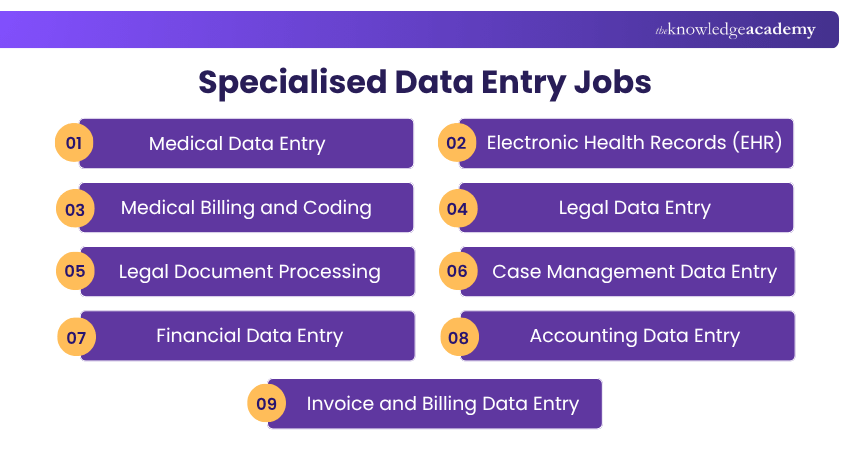
a) Medical Data Entry: Accuracy and precision are paramount in the healthcare sector. Medical data entry involves transcribing patient information, diagnoses, and treatment details into electronic systems. This meticulous process ensures that healthcare providers have access to up-to-date patient records, facilitating efficient and informed decision-making.
b) Electronic Health Records (EHR): EHR data entry focuses on creating and updating digital records of patients' health information. This includes medical history, medications, test results, and treatment plans. Efficient EHR data entry enhances patient care by providing a comprehensive overview of healthcare professionals, fostering better collaboration among medical teams.
c) Medical Billing and Coding: Ensuring the financial aspects of healthcare run smoothly; medical billing and coding. Data entry involves translating medical procedures and diagnoses into standardised codes for billing purposes. Accurate coding is essential for healthcare facilities to receive proper reimbursement, highlighting the financial intricacies within the healthcare system.
d) Legal Data Entry: Legal professionals deal with vast amounts of information; precise data entry is critical for maintaining legal records. This includes entering case details, court proceedings, and client information accurately. Legal data entry ensures that law firms can access crucial information promptly, supporting legal proceedings and decision-making.
e) Legal Document Processing: Legal document processing involves organising, cataloguing, and entering information from legal documents into digital systems. This includes contracts, agreements, court orders, and other legal paperwork. The accuracy of this data entry is pivotal for legal research, case preparation, and maintaining compliance.
Learn a faster way to record information with Teeline Shorthand Course – Join now!
f) Case Management Data Entry: In legal and social work settings, case management data entry involves recording and updating details related to client interactions, case progress, and interventions. This helps professionals monitor and evaluate the effectiveness of their services, contributing to improved client outcomes.
g) Financial Data Entry: Data entry is integral to managing vast amounts of financial information in the financial sector. This includes entering transactions, updating ledgers, and maintaining financial records. Accurate financial data entry is crucial for financial analysis, budgeting, and regulatory compliance.
h) Accounting Data Entry: Accounting data entry involves recording financial transactions, including invoices, receipts, and expenditures. This meticulous task ensures businesses maintain accurate financial records, supporting financial reporting, audits, and strategic decision-making.
i) Invoice and Billing Data Entry: Efficient invoice and billing data entry is essential for businesses to manage revenue streams. This involves entering details from invoices, purchase orders, and receipts accurately. Timely and precise billing data entry contributes to effective financial management and client relations.
Future Trends in Data Entry
Several future trends are poised to shape how data entry is approached, enhancing efficiency and accuracy in information management.
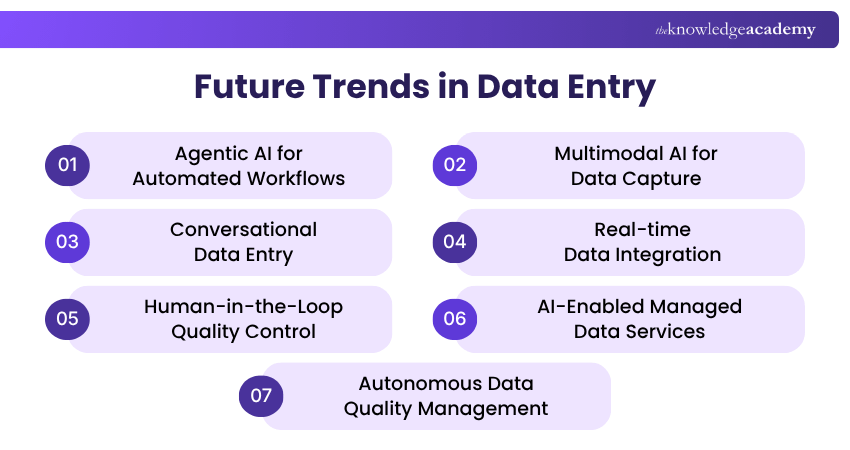
Agentic AI for Automated Workflows: AI agents will increasingly manage extraction, validation, exception handling and system updates across multi-step data-entry workflows.
Multimodal AI for Data Capture: AI will capture structured data from text, handwriting, scanned documents, images and audio, reducing manual input.
Conversational Data Entry: Natural-language assistants will allow users to add, update, query and correct data through simple conversational instructions.
Real-time Data Integration: Connected systems will increasingly exchange and validate information in real time, reducing duplicate entry and improving consistency.
Human-in-the-Loop Quality Control: People will focus more on reviewing exceptions, checking accuracy and handling complex cases while AI manages routine data-entry tasks.
AI-Enabled Managed Data Services: Businesses may increasingly use ongoing AI-supported data services focused on outcomes such as accuracy, processing speed and data quality.
Autonomous Data Quality Management: AI-powered systems will increasingly detect duplicates, standardise formats, validate records and correct routine data-quality issues automatically.
Every accurate record starts with a small action: entering the right information in the right place. As Data Entry evolves with smarter tools, the real value lies in making information usable, trustworthy, and ready for better decisions.

Vidhya Nair is a Senior Copywriter with 7+ years of experience across copywriting, content writing and communication. Her extensive research and editorial experience supports her ability to present topics across Business Skills and Human Resources with clarity and purpose.
View Detail

 If you wish to make any changes to your course, please


