




We may not have the course you’re looking for. If you enquire or give us a call on 01344203999 and speak to our training experts, we may still be able to help with your training requirements.
Home
 Resources
IT Security & Data Protection
Three Pillars of Cyber Security: Process, Technology, & People
Resources
IT Security & Data Protection
Three Pillars of Cyber Security: Process, Technology, & People
Resources
IT Security & Data Protection
Three Pillars of Cyber Security: Process, Technology, & People
Three Pillars of Cyber Security: Process, Technology, & People
ByNilotpal SarmahLast updated on: 03 October 2026
This blog explains the three pillars of cyber security and explores how they help organisations and businesses implement cyber security effectively.
Key Topics Covered
a. Cyber security relies on the combined strength of people, processes, and technology.b. Processes provide the policies, procedures, and response plans needed to manage cyber risks.c. Technology helps organisations protect, detect, monitor, and respond to cyber threats.d. People play a critical role through awareness, secure behaviour, and informed decision-making.e. The three pillars are most effective when they work together as part of a coordinated security strategy.
Cyber security is critical for modern-day businesses. Most companies store information about their performance, customers, competitors, and others on local and cloud servers. Digitisation of business processes has made it imperative that companies adopt the appropriate and most effective measures of securing their data.
As cyber threats continue to evolve, organisations need effective cyber security policies to protect their data, systems, and business operations.
Maintaining cyber security requires continuous risk management, monitoring, and improvement. It enables companies to manage their digital systems and infrastructure better and safeguard their data. A widely used way of approaching cyber security is through three interconnected pillars: people, process, and technology. These three combine and work together to secure the company's data effectively. In this blog, we will discuss the three pillars of cyber security in detail. So, read on!
What are the Three Pillars of Cyber Security?
Cyber security threats continue to evolve, and technology alone is not enough to manage cyber risk effectively. As attackers adopt new techniques and organisations become increasingly dependent on digital systems, companies need an approach that brings together people, processes, and technology.
Here, the role of the three pillars of cyber security is vital. The following are the three pillars:
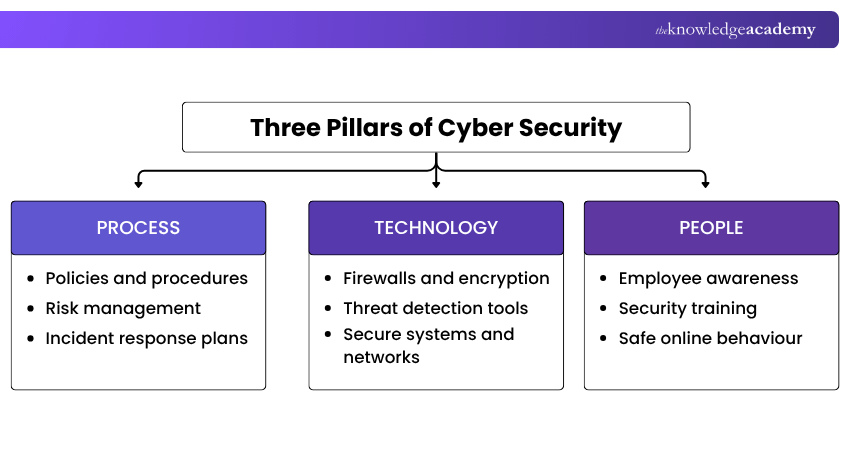
1) Process
The pillar of process is critical to effectively implementing a cyber security strategy and architecture. It focuses on developing frameworks and procedures that help prevent, detect, respond to, and recover from cyber incidents. The process entails effective management systems and policies, cyber security audits, and gap analysis.
To use this pillar, an organisation must understand its systems and identify the data that needs to be protected. Here the focus is on identifying vulnerable data and systems and determining processes to help secure the company's network.

2) Technology
Technology is another pillar of cyber security. It is one of the most visible aspects of developing and maintaining the security of digital systems and infrastructure. Cyber security professionals must use appropriate security technologies to design secure systems and processes to secure the network.
However, security professionals should focus on more than just implementing new security technologies. Instead, they should use their knowledge to identify the right technology to safeguard the network and digital infrastructures. Digital solutions must be designed and integrated to create a strong security position and avoid any security gaps.
3) People
People are one of the three core pillars of cyber security. This pillar involves hiring skilled and experienced cyber security professionals and training every employee to keep the data secure online. As digital technology has become integrated into different aspects of business operations, cyber security cannot be maintained only by security professionals.
This pillar focuses on employee awareness, behaviour, and training. Companies must train their employees to help them learn ways to secure their data online. The human element continues to play a significant role in data breaches, but people should not simply be treated as the organisation's “weakest link”. Effective cyber security also depends on designing usable security processes and technologies that help employees make secure decisions.
Trainer’s Insight
Advanced security tools may be less effective if employees do not know how to use them or if clear response procedures are missing. Similarly, well-trained employees need appropriate technologies and processes to identify, report, and respond to cyber threats.
Learn to turn cyber risks into actionable security strategies with the Cyber Security Risk Management Training now!
How do the Three Pillars of Cyber Security Work Together?
The three pillars of cyber security are most effective when they work together rather than in isolation. People need the right knowledge and awareness, processes provide clear procedures and responsibilities, and technology supplies the tools needed to prevent, detect, and respond to cyber threats.
For example, if an employee receives a phishing email, people need to recognise the warning signs, processes should explain how to report and handle the incident, and technology can help block malicious emails or detect suspicious activity. When all three pillars support one another, organisations can build a more coordinated and resilient cyber security approach.
Even more, strong cyber security does not depend on technology alone. Organisations need clear processes, appropriate security technologies, and people who understand their cyber security responsibilities. When all three pillars work together, they create a stronger and more resilient approach to protecting systems and data.
Make cyber awareness your first line of defence by signing up for the Cyber Security Awareness Training today!

Nilotpal Sarmah is a Senior Content Writer with 11+ years of overall experience spanning engineering, operations and content development. His technical knowledge and extensive writing experience enable him to simplify specialised topics across IT and Tech, Business Skills, Project Management, Health and Safety, and ISO and Compliance.
View Detail

 If you wish to make any changes to your course, please


