




We may not have the course you’re looking for. If you enquire or give us a call on 01344203999 and speak to our training experts, we may still be able to help with your training requirements.
Solana vs Ethereum and Their Key Differences Explained
ByVidhya NairLast updated on: 10 October 2026
The primary differences between Solana vs Ethereum lie in their speed, fees and use cases. The choice between them depends on your specific needs within Web3. Ethereum is known for its extensive Developer ecosystem supporting DeFi, NFTs and DAOs. Solana often offers much faster transaction speeds and lower fees.
When it comes to Blockchain giants, Ethereum and Solana often steal the spotlight but for very different reasons. While Ethereum is the seasoned pioneer powering smart contracts and DeFi, Solana is the speedster boasting lightning-fast transactions and ultra-low fees. For any Blockchain enthusiast, learning the Solana vs Ethereum distinctions is key.
If you are dipping your toes into this cutting-edge landscape, look no further. This blog will help you out by outlining every difference between Solana vs Ethereum, from their consensus mechanisms to their environmental impact. So read on and pick the Blockchain that fits your vision like a glove!
What is Solana?
Solana (SOL) is a high-performance Blockchain platform for enabling decentralised applications (dApps) and crypto projects with exceptional speed and low transaction costs. It was launched in 2020 and its claim to fame is its ability to be one of the fastest Blockchains.
It's capable of processing up to 65,000 transactions per second (TPS). Solana has become the ideal choice for Developers building DeFi platforms, NFT marketplaces, and Web3 applications, creating a vibrant ecosystem that rivals other major Blockchains like Ethereum.

What is Ethereum?
Ethereum first surged in 2017 and, despite periods of sharp rises and drops, has cemented its position as one of the most influential cryptocurrencies. As an open-source Blockchain platform, Ethereum was designed to reduce Bitcoin’s network congestion while supporting smart contracts and decentralised transactions.
In 2022, it transitioned from a Proof-of-Work (PoW) to a Proof-of-Stake (PoS) model, where validators securely verify transactions through staking. This improved its scalability and sustainability within its growing ecosystem.
Solana vs Ethereum: Key Differences
In our exploration of the contrasts between Solana vs Ethereum, it becomes apparent that each platform possesses distinct strengths and weaknesses. Let's delve deeper into the difference between Solana and Ethereum:
1) Consensus Mechanisms
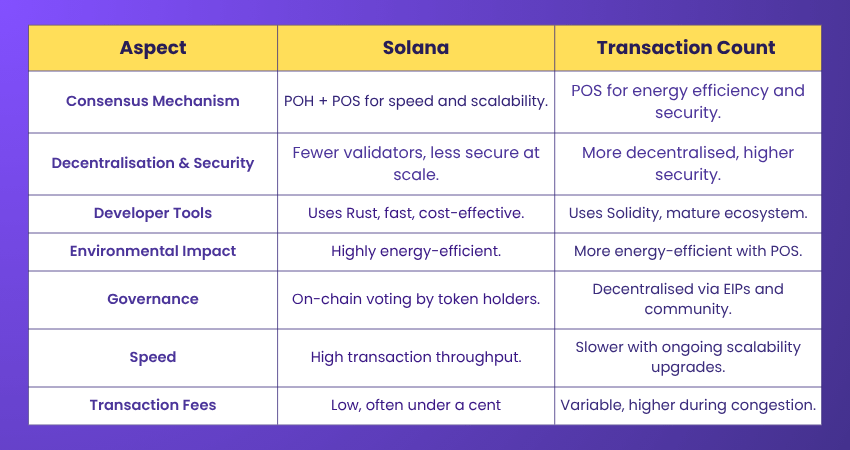
Ethereum and Solana employ divergent consensus mechanisms to authenticate transactions and uphold their respective Blockchains. Ethereum's network relies upon the energy-efficient PoS mechanism. Conversely, Solana takes a unique approach with its consensus mechanisms – combining PoH and PoS to attain elevated throughput and scalability.
PoH forges a historical record of events, enabling validators to efficiently arrive at a consensus regarding the order of transactions. PoS adds an additional layer of security, as validators are selected depending on the number of tokens they have, and are willing to "stake" as collateral.
2) Decentralisation and Security
Ethereum, like many Ethereum Alternatives, is highly decentralised due to its large number of validators and extensive network of nodes, making it more secure and resistant to attacks. The transition to Proof of Stake (PoS) has further enhanced security while also reducing energy consumption.
On the other hand, Solana prioritises speed and scalability but compromises on decentralisation by using fewer validators, which can make it less secure in comparison to other networks. Blockchain's PoH consensus mechanism is faster but less proven for maintaining security on large scales.
3) Developer Experience and Tools
The major strength of Ethereum is its developed and advanced environment, which includes a large number of development tools, frameworks and languages. Smart Contracts are mainly built with the Solidity Programming Language. Solana is already steadily growing as Developers are encouraged all around and targeted efforts are being made to equip them with the proper tools.
Smart Contracts on Solana are preferably coded in Rust; therefore, Developers widely use this programming language. The speed and affordable cost are two major advantages of the platform that would enable Developers to create, test and deliver their applications promptly.
Gain the skills to navigate the digital currency revolution with our Bitcoin and Cryptocurrency Course – sign up now!
4) Environmental Impact
Ethereum 2.0’s new PoS mechanism helps it reduce energy consumption by a margin as compared to its predecessor. However, Solana's blend of PoH and PoS mechanisms affords it an advantage in terms of energy efficiency. The significantly reduced energy consumption aligns with the demand for Blockchain platforms to adopt more environmentally conscious practices.
5) Governance Models
Ethereum's governance model has evolved over time, primarily through Ethereum Improvement Proposals (EIPs) and community discussions. Conversely, Solana is charting its own course in terms of governance. The platform utilises an on-chain governance model, allowing token holders to actively participate in decision-making.
This approach enables a more streamlined Decision-making Process and potentially accelerates the implementation of protocol upgrades. However, like any governance model, it requires careful consideration to maintain fairness and inclusivity.
6) Speed
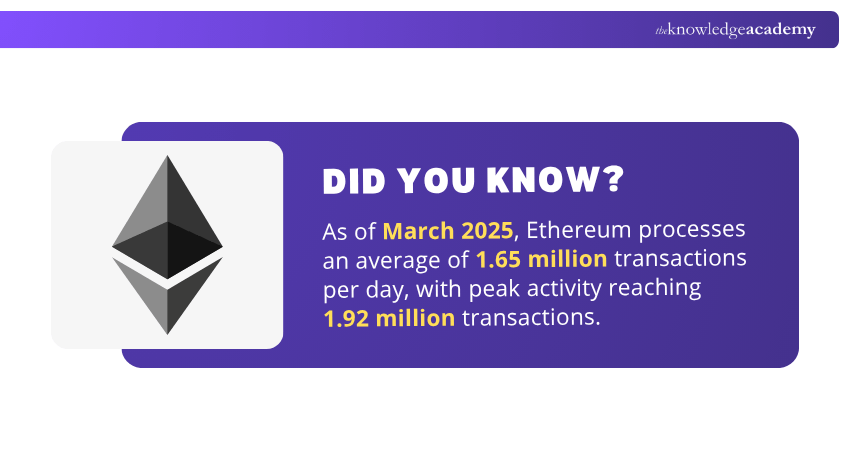
Both Solana and Ethereum are highly respected Blockchains in the market. Solana’s development team has successfully created a fast and reliable Blockchain capable of handling significantly more transactions than Ethereum. On the other hand, Ethereum remains the leading network in the market, showing no signs of slowing down. Therefore, after conducting your own research, it might be wise to consider holding both tokens in your portfolio.
7) Transaction Fees
Ethereum's transaction fees, known as gas fees, can fluctuate substantially, especially during periods of high network congestion. In contrast, Solana offers extremely low transaction fees, often costing only a fraction of a cent per transaction, which makes it highly appealing for users and Developers. This low cost is possible due to its high throughput and efficient consensus mechanism.
Gain practical insights and hands-on experience in the decentralised realm with our Blockchain Courses – start your journey now!
Solana vs Ethereum: A Technical Perspective
Solana and Ethereum share more in common than most people realise. Both operate on a Proof of Stake (PoS) consensus mechanism and empower Developers to build decentralised applications using smart contracts. However, their architecture differs greatly. Solana adopts a monolithic design, while Ethereum embraces a modular framework, which defines their unique scalability and performance approaches.
Network Metrics
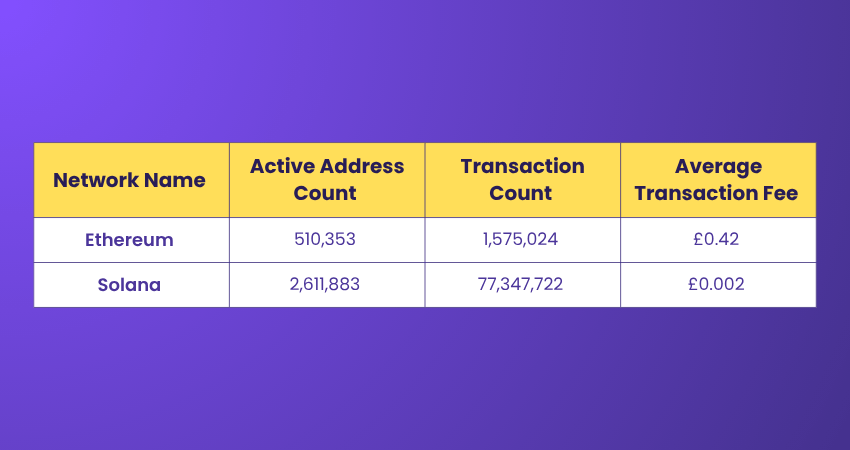
Analysing network metrics reveals the overall activity and engagement on both these Blockchains. Solana shows a far greater number of active addresses and transactions than Ethereum, while also offering substantially lower average transaction fees. This highlights its scalability and cost efficiency.
Popular Use Cases of Ethereum and Solana
Ethereum and Solana offer compelling use cases, particularly within the realms of Decentralised Finance (DeFi), Non-Fungible Tokens (NFTs), and Web3 Gaming. Let’s take a closer look at how each Blockchain is shaping these rapidly evolving spaces.
1) Decentralised Finance (DeFi)
1) Ethereum:
a) Protocols: Aave (lending/borrowing), Uniswap (decentralised exchange), Compound (money markets).
b) Total Value Locked (TVL): Billions of dollars.
c) Features: Borrow, lend, swap, and earn yield on crypto assets without traditional intermediaries.
2) Solana:
a) Projects: Raydium (automated market maker), Mango Markets (margin trading), Serum (order book-based DEX).
b) TVL: Smaller compared to Ethereum.
c) Advantages: Speed and low cost attract users for active trading and complex DeFi strategies.
2) Non-fungible Tokens (NFTs)
1) Ethereum:
a) Marketplaces: OpenSea, Rarible.
b) Popular Projects: Bored Ape Yacht Club, CryptoPunks.
c) Challenges: High gas fees can make minting and smaller transactions expensive.
2) Solana:
a) Marketplaces: Magic Eden.
b) Popular Projects: DeGods, Okay Bears.
c) Advantages: Lower fees for creators and buyers. Recently, Solana's daily trading volume for NFTs has overtaken Ethereum.
3) Web3 Gaming
1) Ethereum:
a) Popular Games: Axie Infinity.
b) Challenges: Scalability issues and high fees impact gameplay experience.
2) Solana:
a) Upcoming Games: Star Atlas, Aurory.
b) Advantages: Greater potential for immersive, graphically intensive Blockchain gaming environments. Speed and low fees are key for smooth and accessible play-to-earn experiences.
Which Coin is Better, Solana or Ethereum?
At times, Solana has surpassed Ethereum in areas such as daily active users and transaction speed, yet it remains behind in market capitalisation. For investors, Ethereum delivers a mature and stable ecosystem, whereas Solana attracts newer Developers and users with its speed and low transaction costs.
What has more Potential, Solana or Ethereum?
Deciding whether Ethereum or Solana has more potential depends on the investment horizon, your risk tolerance and the niche you believe Blockchain tech will serve. For steady long-term adoption and institutional trust and building on a “safe bet”, Ethereum has a better likelihood of being a foundation layer in the future. For higher growth potential and where speed, usability and new apps matter, Solana might offer more upside.

Vidhya Nair is a Senior Copywriter with 7+ years of experience across copywriting, content writing and communication. Her extensive research and editorial experience supports her ability to present topics across Business Skills and Human Resources with clarity and purpose.
View Detail

 If you wish to make any changes to your course, please


