




We may not have the course you’re looking for. If you enquire or give us a call on 01344203999 and speak to our training experts, we may still be able to help with your training requirements.
What is the SHA-256 Algorithm, and How Does It Work?
ByJyoti TuraLast updated on: 18 September 2026
Interested in learning What is the SHA-256 Algorithm? SHA-256 is a hash function that produces a 256-bit hash value, ensuring data integrity and security. This blog explains SHA-256 Algorithm’s, applications, and significance in modern cryptography and blockchain technology. Keep reading to learn more!

In our increasingly digital world, Data Security has become paramount. Safeguarding sensitive information requires robust cryptographic algorithms. The SHA-256 Algorithm is a cornerstone of modern Cyber Security. This cryptographic hash function converts data into a unique string of characters, ensuring data integrity and authenticity.
By understanding how the SHA-256 Algorithm works, you can appreciate its vital role in protecting your digital assets. Join us as we delve into the technical intricacies of this cryptographic powerhouse.
What is Hashing?
Hashing is a process that modifies input data into a fixed-size string of characters, typically a hash code. This transformation is governed by a hash function, which ensures that even a slight change in the input data produces a significantly different output. Hash functions are fundamental in ensuring data integrity and security.
They are commonly used in data storage, retrieval, and encryption processes, providing a quick way to verify data integrity by comparing hash values.

What is SHA-256?
SHA-256, short for Secure Hash Algorithm 256-bit, is a member of the SHA-2 family. Developed by the National Security Agency (NSA) and released by the National Institute of Standards and Technology (NIST) in 2001, SHA-256 produces a unique 256-bit (32-byte) hash for any given input. Its robustness and security have made it a fundamental component in contemporary cryptographic applications.
How Does SHA-256 Work?
SHA-256 works by processing input data through a series of logical operations and transformations. The input message is initially padded to make its length a multiple of 512 bits. This padded message is then divided into blocks of 512 bits each. The algorithm processes each block in a series of rounds involving bitwise operations, modular additions, and logical functions. The final output is a 256-bit hash value, which uniquely represents the input data.
SHA-256 Algorithm Main Features
SHA-256 boasts several features that make it a preferred choice in cryptographic applications:
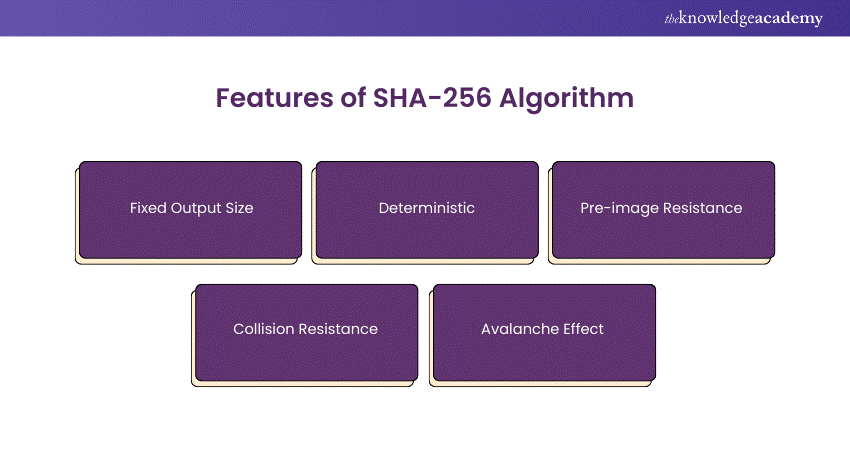
a) Fixed Output Size: Regardless of the size of input data, SHA-256 always produces a 256-bit hash.
b) Deterministic: Identical input will consistently yield the same hash output.
c) Pre-image Resistance: It’s computationally infeasible to reverse-engineer the original input from its hash output.
d) Collision Resistance: Finding two distinct inputs that yield the same hash output is extremely improbable.
e) Avalanche Effect: A small change in the input significantly changes the hash output.
Secure your future with our Introduction to System and Network Security Course today and gain the essential skills to protect digital environments!
Steps of SHA-256 Algorithm
The SHA-256 Algorithm follows a structured sequence of steps:
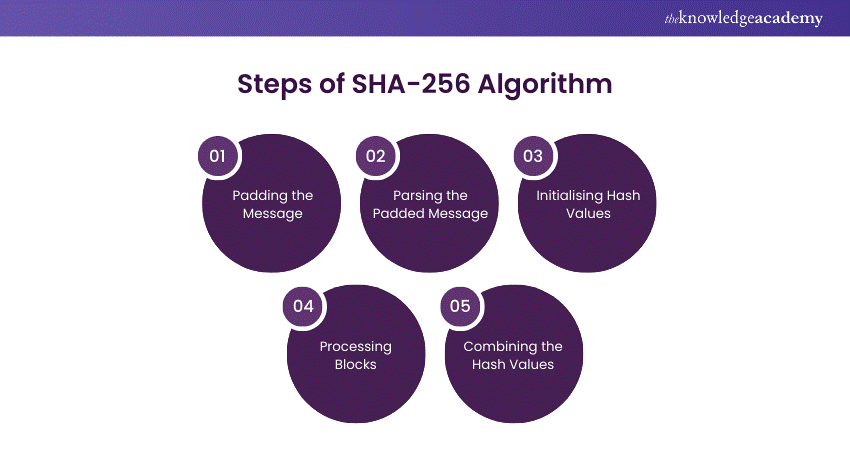
a) Padding the Message: The original message is padded with a ‘1’ bit, followed by ‘0’ bits, until it is 64 bits shy of a multiple of 512. The last 64 bits of this padded message indicate the length of the original message.
b) Parsing the Padded Message: The padded message is divided into 512-bit blocks for processing.
c) Initialising Hash Values: Eight 32-bit hash values are initialised. These values are constants defined in the SHA-256 standard.
d) Processing Blocks: Each 512-bit block is processed through 64 rounds of compression functions. These rounds involve bitwise operations, modular additions, and logical functions.
e) Combining the Hash Values: After processing all blocks, the final hash values are concatenated to produce the 256-bit hash output.
Interesrted to learn how technology works, unlock the blueprint of technology through our blog on What is Reverese Engineering.
SHA-256 Algorithm Applications
SHA-256 has a wide range of applications, underscoring its importance in various s
ecurity protocols and systems.
Digital Signatures
SHA-256 is commonly used in creating digital signatures. When a document is signed digitally, SHA-256 generates a hash of the document, which is then encrypted with the signer’s private key. This encrypted hash serves as the digital signature, verifying the document’s authenticity and integrity.
Password Hashing
In password hashing, SHA-256 converts plain-text passwords into hash values before storing them in a database. This guarantees that even if the database is breached, the original passwords are protected. Each login attempt hashes the entered password and compares it with the stored hash, verifying the user’s identity.
Blockchain Technology
Blockchain technology relies heavily on SHA-256 for security and integrity. Every block in a blockchain includes the SHA-256 hash of the preceding block, ensuring they are securely connected. This chaining of blocks ensures that any alteration in a block would change its hash, breaking the chain and making tampering evident.
File Integrity
SHA-256 is used to verify file integrity. By generating a hash of a file before and after transmission, one can ensure the file hasn’t been altered. Any change in the file content results in a different hash, indicating potential corruption or tampering.
SSL/TLS Certificates
SHA-256 is integral in SSL/TLS certificates, which secure communication over the internet. These certificates utilise SHA-256 to establish a secure connection between a browser and a web server, ensuring that the transmitted data remains confidential and intact.
Elevate your skills—join our Cyber Security Courses now and become a guardian of the digital realm.
Advantages and Disadvantages of SHA-256 Algorithm
Advantages:
a) High Security: SHA-256’s robustness makes it resistant to cryptographic attacks, ensuring data integrity and security.
b) Wide Adoption: Its widespread use in various applications signifies its reliability and trustworthiness.
c) Fixed Output: The 256-bit fixed output makes it suitable for numerous cryptographic applications.
Disadvantages:
a) Computationally Intensive: SHA-256 can be resource-intensive, requiring significant computational power, which might be a drawback in low-resource environments.
b) Not Collision-proof: While highly resistant, SHA-256 is not entirely immune to collisions. Advances in computational power may pose future risks.
Interested to learn how technology works, unlock the blueprint of technology through our blog on "What is Reverese Engineering"

Jyoti Tura is a Senior Web & UX/UI Manager with 7+ years of experience in front-end development, web development and user-focused interface design. Her technical expertise and managerial responsibilities support her knowledge across IT and Tech, Leadership and Management.
View Detail

 If you wish to make any changes to your course, please


