


 Top Rated Course

We may not have the course you’re looking for. If you enquire or give us a call on 01344203999 and speak to our training experts, we may still be able to help with your training requirements.
Serverless Computing: Benefits, Uses and Challenges
Lily Turner 16 July 2026Serverless Computing enables Developers to run applications without managing servers, automatically scaling resources and charging only for execution time. Serverless architectures are often associated with event-driven programming, where events such as HTTP requests or database updates trigger various functions.

Training Outcomes Within Your Budget!
We ensure quality, budget-alignment, and timely delivery by our expert instructors.
Table of Contents
Want to build and launch powerful apps without ever touching a server! It's a dream scenario for Developers made possible by one of the biggest leaps in computing innovation: Serverless Computing. Essentially, you write the code, and the Cloud does the rest. From instant scaling and unparalleled scalability to cost savings, Serverless Computing is changing how we think about development.
But like any other innovation, there’s more going on behind the curtain, such as real challenges and smart use cases worth knowing. This blog explores What is Serverless Computing in detail, spotlighting its benefits, drawbacks, workings and more. Read on and incorporate this powerhouse tech into your next project!
Table of Contents
1) Understanding Serverless Computing
2) How Does Serverless Computing Work?
3) Use Cases for Serverless Computing
4) Benefits of Serverless Computing
5) Challenges of Serverless Computing
6) Serverless Computing vs Cloud Computing
7) Backend Services Provided by Serverless Computing
8) Conclusion
Understanding Serverless Computing
Serverless Computing is a Cloud Computing execution model where the Cloud provider manages the allocation of machine resources. This enables the Developer to focus on writing and deploying code without worrying about Server Management. It is well-suited for event-driven applications, Application Programming Interface (API) and microservices.
Serverless applications have four attributes:
1) Variable in Price: Vendors charge you for what you use
2) Self-maintenance: Clients don't have to perform server maintenance
3) Scalable: They continuously scale up and down with no client programming help
4) Reliable: The products have built-in high availability and fault tolerance
How Does Serverless Computing Work?
Here's how Serverless Computing works:
1) Developers write the application code.
2) They load it into the Serverless Computing environment. It stays there until an event triggers the code.
3) At that point, the Serverless Computing vendor executes the code in the Cloud environment.
4) Once the event is over, the code turns dormant again.
5) In the Serverless Computing model, these events are called functions.
Use Cases for Serverless Computing
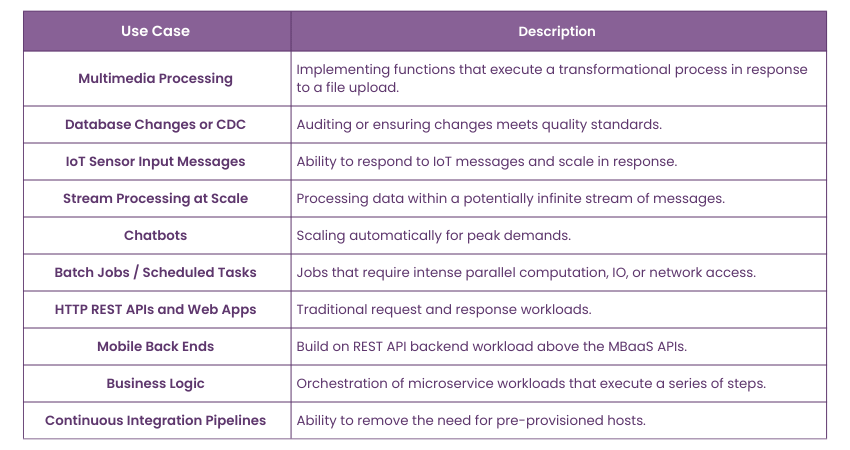
Serverless is incredibly flexible and can address a wide variety of application problems. Here are some popular use cases:
Benefits of Serverless Computing
Serverless Computing offers numerous key benefits that can elevate your organisation's efficiency and agility:
Faster Deployment
a) By eliminating any need for Server Management, Developers can kick back and focus solely on writing code.
b) This leads to quicker releases and faster time-to-market.
c) This accelerates development cycles and allows for rapid iteration based on user feedback.
Cost Efficiency
a) With a pay-as-you-use model, Serverless Computing can adjust the resources based on demand.
b) This approach lowers the Total Cost of Ownership (TCO).
c) It includes networking, security, and DevOps Management tasks within the service cost.

Seamless Scalability
a) Serverless architectures automatically scale from zero to peak demand.
b) It adapts to customer needs and provides a consistent user experience regardless of load.
c) This elasticity helps ensure the applications remain reliable during varying traffic conditions.
Simplified Management
a) By offloading Infrastructure Management to a Cloud provider, your team can concentrate on developing and deploying applications.
b) They don't have to worry about the operational overhead of maintaining servers.
c) This simplification reduces complexity and helps Developers focus on delivering value through innovative features.
Your mastery of Cloud Computing, storage, networking, and more awaits! Sign up for our Developing Serverless Solutions on AWS Course now and power up your Cloud expertise!
Challenges of Serverless Computing
Despite its many benefits, Serverless Computing is not without its challenges. Here are some challenges you must consider:
Security Concerns
a) When you use Serverless Computing, you give some of your data to another company. Their data might be at risk if they lack strong security.
b) Since the server is managed by someone else, you have less control over its security settings, which could make your data more vulnerable.
c) It can be harder to ensure the service provider follows all the rules and regulations to keep your data safe.
Data Privacy Issues
a) In Serverless Computing, your data might be stored on the same servers as other people's data.
b) This sharing could lead to accidental leaks or unauthorised access.
c) Your data could be stored in different countries under privacy laws. This can make it tricky to know exactly how your data is protected.
d) If the service doesn't have strict rules about who can see your data, unauthorised people might access it.
Increased Complexity
a) When something goes wrong in a serverless setup, finding the problem can be challenging because the system is divided into many parts.
b) Serverless applications often rely on multiple external services.
c) If one of these services has an issue, it can affect your whole application.
d) Serverless functions are usually stateless, meaning they don't remember past interactions.
e) Managing this can add complexity to your application.
Vendor Lock-in
a) Using one provider's serverless services can make it difficult to switch to another provider later without changing your application.
b) Moving your data from one provider to another can be complicated and involve additional costs.
c) Some providers might require you to sign long-term agreements, limiting your ability to change services if your needs evolve.
Embrace the future of Cloud Computing with our Developing Serverless Solutions on AWS Course - Sign up now!
Serverless Computing vs Cloud Computing
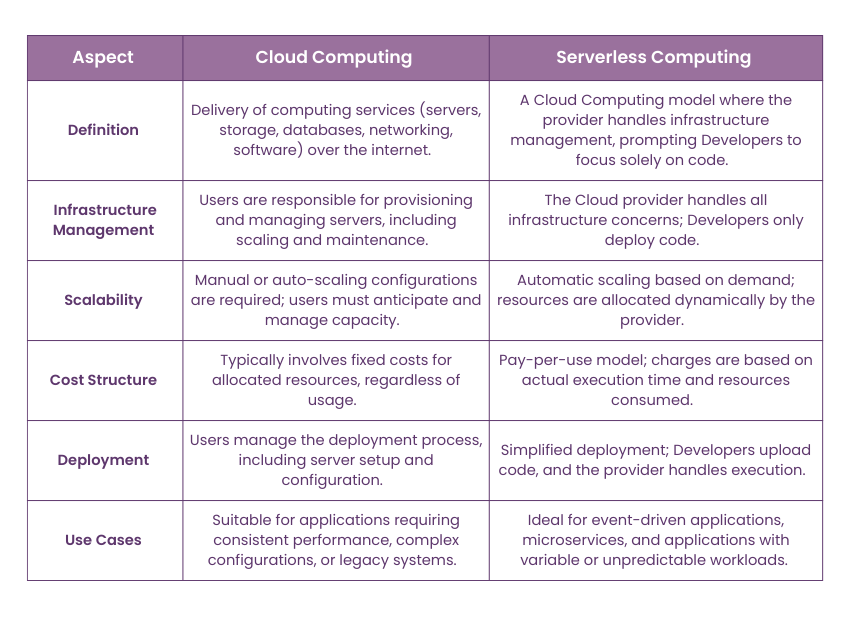
Here are the key distinctions between Serverless Computing and Cloud Computing:
Backend Services Provided by Serverless Computing
Serverless Computing can provide a wide array of backend services, including but not limited to:
1) API Gateway Management.
2) Database operations such as reading, writing and queries.
3) Event stream processing.
4) User authentication and authorisation.
5) File storage and retrieval.
6) Background task execution.
Become a master practitioner in the world of AWS Cloud. Sign up for our AWS Cloud Practitioner Training now!
Conclusion
Serverless Computing offers a more innovative and quicker way to build and scale applications. It's transforming modern development with powerful use cases, cost-saving benefits and amazing scalability. As part of the broader shift towards Server and Serverless Architecture, it introduces both opportunities and complexities. Yet, like any tech transformation, it comes with security, complexity, and vendor lock-in challenges. By understanding the rewards and risks outlined in this blog, you can decide if serverless is the right move for your next project.
Focus purely on development and shed the burden of Server Management! Our Serverless Computing With Amazon Web Services Course will show you how - Sign up now!
Frequently Asked Questions
What is the Primary Goal of Serverless Computing?

Serverless Computing's main goal is to allow Developers to create, run and launch applications without the burden of managing servers.
Which Service Provides Serverless Computing?
Amazon, Microsoft and Google are among the most prominent Serverless Computing service providers such as AWS Lambda, Microsoft Azure Functions and Google Cloud Functions.

Lily Turner


Senior AI/ML Engineer and Data Science Author
Lily Turner is a data science professional with over 10 years of experience in artificial intelligence, machine learning, and big data analytics. Her work bridges academic research and industry innovation, with a focus on solving real-world problems using data-driven approaches. Lily’s content empowers aspiring data scientists to build practical, scalable models using the latest tools and techniques.
View Detail

 If you wish to make any changes to your course, please


