




We may not have the course you’re looking for. If you enquire or give us a call on 01344203999 and speak to our training experts, we may still be able to help with your training requirements.
Ruby vs Python: Which Programming Language Should You Choose?
ByVidhya NairLast updated on: 10 October 2026
Curious about Ruby vs Python? Ruby and Python are both versatile, general-purpose languages, but each has unique strengths. Compare their performance, syntax, use cases, and career scope to understand which language suits your development goals, project needs, and long-term career growth in tech.

Ruby and Python are two of the most popular programming languages in the world. Have you ever wondered which language is more efficient for web development? Or which one offers a smoother learning curve for beginners? This blog will explore Ruby vs Python in various aspects, such as syntax, performance, libraries, frameworks, community, and more.
What is Ruby?
Ruby, created by Japanese computer scientist Yukihiro Matsumoto, is a dynamic, object-oriented programming language known for its simplicity and productivity. It emphasises elegant syntax and readability, supporting multiple programming paradigms. Ruby data types play a crucial role in enhancing its expressive nature and developer-friendly features.
Popular in web development, especially with Ruby on Rails, Ruby’s support for automatic memory management and dynamic typing makes it ideal for both beginners and experienced developers seeking efficiency and creativity. Proficiency in Ruby can also assist in preparing for Ruby interview questions, which typically focus on its fundamental features and practical uses in development.

What is Python?
Python, created by Guido van Rossum, is a high-level, versatile programming language known for its readability and simplicity. Its clear syntax makes it ideal for both beginners and experienced developers.
Supporting multiple Programming paradigms, including object-oriented, imperative, and functional, Python is widely used in web development, data analysis, artificial intelligence, and more. Its extensive libraries and frameworks enhance its popularity, making it a go-to language for various applications.

Key Differences Between Ruby and Python
While Ruby and Python are both high-level, interpreted languages with similar goals, they differ in design philosophy, application, and ecosystem. Here's a breakdown of their key distinctions:
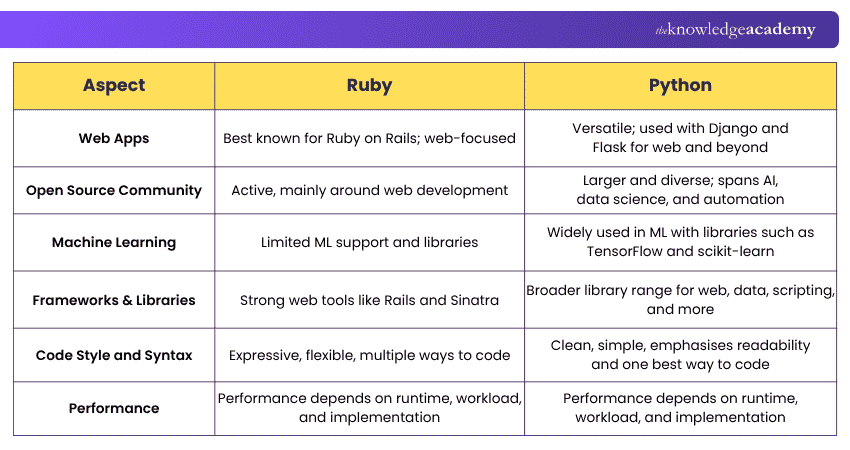
1) Web Apps
Ruby is widely known for web development, primarily through Ruby on Rails, which encourages convention over configuration. Python, while also strong in web development with Django and Flask, is more general-purpose and used across broader domains.
2) Open-Source Community
Both languages have vibrant open-source communities. However, Python’s global reach is broader, encompassing fields like AI, automation, and scientific computing, while Ruby’s community is more concentrated around web development.
3) Machine Learning
Python is widely used in machine learning with an extensive ecosystem, including TensorFlow, Keras, and scikit-learn. Ruby lacks depth and community support in this area, making it less suitable for data-driven or AI projects.
4) Frameworks and Libraries
Ruby offers powerful tools like Ruby on Rails and Sinatra for web development. Python, in contrast, provides a more diverse set of libraries for web, data science, automation, and more, making it more versatile overall.
5) Code Style and Syntax
Python is known for its straightforward, readable syntax that emphasises simplicity. Ruby offers expressive and elegant code with multiple ways to achieve the same result, appealing to developers who value flexibility and creativity.
6) Performance
Performance varies considerably according to the runtime, application, libraries, and workload. Both languages prioritise developer productivity over raw execution speed, while modern implementations provide optimisation technologies to improve performance. Benchmarking the actual application is more useful than assuming one language is universally faster.
Strengthen your automation skills and write efficient scripts with our Python Scripting Training – Sign up today!
Similarities Between Ruby and Python
Ruby and Python share many characteristics that make them popular choices among developers. Here are some key similarities between Ruby and Python:
1) High-Level Languages: Both Ruby and Python are high-level, interpreted languages, making them easy to read and write and suitable for rapid development.
2) Dynamic Typing: Both languages use dynamic typing, allowing for more flexibility in coding and reducing the need for explicit type declarations.
3) Object-Oriented: Ruby and Python are both object-oriented languages, supporting concepts like classes, inheritance, and polymorphism, which help in organising and managing code efficiently.
4) Extensive Libraries and Frameworks: Both languages boast extensive libraries and frameworks that simplify development tasks. Ruby has Rails, while Python has Django and Flask, among others.
5) Community Support: Both Ruby and Python have strong, active communities that contribute to a wealth of resources, including documentation, tutorials, and third-party libraries.
6) Cross-platform Compatibility: Both languages are cross-platform, meaning they can run on various operating systems like Windows, macOS, and Linux without requiring significant changes to the code.
7) Focus on Developer Productivity: Both Ruby and Python emphasise developer productivity and code readability, making them popular choices for beginners and experienced developers alike.
Trainer’s Tip: Build the same small application in Ruby and Python. Compare setup, readability, libraries, debugging, and maintenance rather than choosing on syntax alone.
Which Offers More Career Opportunities Between Python and Ruby?
Both Ruby and Python offer career opportunities, but Python has broader adoption across areas such as AI, data science, backend development, automation, and scientific computing. The 2025 Stack Overflow Developer Survey reported a seven-percentage-point increase in Python adoption from 2024, highlighting its continued growth across several technical domains.
Ruby remains valuable for web development, particularly through Ruby on Rails, but its ecosystem is more concentrated around web applications. Python’s wider use across multiple development fields can provide access to a broader range of technical roles, while Ruby remains relevant for professionals working with Rails-based applications and existing Ruby systems.
Strengthen your coding foundation and build practical development skills with our Programming Training – Register now!
Quick Decision CheckWhich matters most to you?□ Broad AI and Data Science ecosystem□ Automation and scripting□ Ruby on Rails development□ Expressive, flexible syntax□ Wide range of libraries and applicationsMore AI, data science, or automation-focused needs? Explore Python further.More Ruby on Rails or Ruby-focused development needs? Explore Ruby further.
Which Language is Better for Automation Scripting?
Python is widely regarded as the top automation scripting language due to its simple syntax, extensive libraries, and broad applicability in tasks like file manipulation, data scraping, and system administration. Its strong support for testing frameworks such as pytest and Robot Framework makes it ideal for a variety of automation scenarios.
Ruby, while also used in automation, especially with Selenium and web testing, is less prevalent and has fewer specialised tools and community resources compared to Python. For most automation use cases, Python’s versatility, ecosystem, and ease of use make it the better choice.
Keep This in Mind:□ Match the language to your project requirements and goals.□ Check available libraries, frameworks, and community support.□ Consider maintainability, team expertise, and long-term scalability.□ Test performance using workloads similar to your application.□ Build a small project in both before deciding.

Vidhya Nair is a Senior Copywriter with 7+ years of experience across copywriting, content writing and communication. Her extensive research and editorial experience supports her ability to present topics across Business Skills and Human Resources with clarity and purpose.
View Detail

 If you wish to make any changes to your course, please


