




We may not have the course you’re looking for. If you enquire or give us a call on 01344203999 and speak to our training experts, we may still be able to help with your training requirements.
12 Principles of Teaching: The Fundamentals of Successful
ByThe Knowledge AcademyLast updated on: 02 October 2026
Principles of teaching are evidence-informed guidelines that can help educators plan instruction, explain concepts, engage learners and assess understanding. They can support clearer lessons, stronger participation and more effective learning across different educational settings. Keep reading!

What This Blog Covers
1. Meaning and purpose of the Principles of Teaching2. 12 practical principles for effective instruction3. Student engagement, collaboration, and subject knowledge4. Feedback, guidance, assessment, and learning support5. Strategies for retention and knowledge transfer
Great teaching isn’t just about delivering lessons, it’s about inspiring minds, fostering curiosity, and creating meaningful learning experiences. The Principles of Teaching serve as the foundation for effective education, guiding educators to engage students, encourage Critical Thinking, and adapt to diverse learning needs. Let’s explore the key principles that shape impactful teaching!
What are the Principles of Teaching?
Principles of Teaching are practical, evidence-informed guidelines that help educators plan instruction, explain concepts, engage learners, provide feedback, and evaluate understanding. There is no single universally accepted list of teaching principles, so the following 12 bring together widely used practices from established instructional approaches that can support effective teaching across different learning environments.
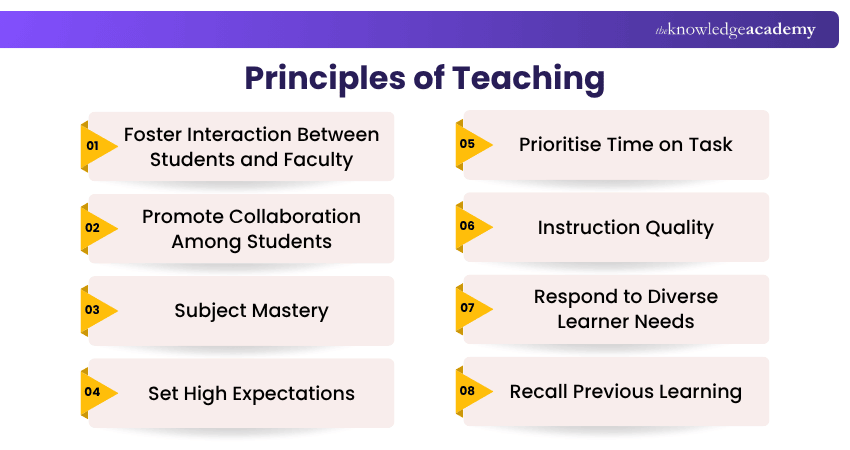
1) Foster Interaction Between Students and Faculty
Build positive relationships with learners by communicating clearly, learning their names and creating opportunities for constructive interaction. Personalised feedback, relevant experiences and one-to-one conversations can help build trust and create a more supportive and engaging learning environment.

2) Promote Collaboration Among Students
Encourage learners to work collaboratively where appropriate. Group activities, peer tutoring and cooperative learning can help them discuss ideas, solve problems together and develop communication and social skills.
3) Subject Mastery
Teachers need a secure understanding of the subject they teach. Strong subject knowledge helps them explain concepts accurately, answer questions, recognise misconceptions, and select suitable examples that support student understanding.
4) Set High Expectations
Set appropriately high expectations for all learners while providing the support they need to meet them. Encourage hard work, give positive feedback, and help those who struggle. Recognise effort, progress and achievement while providing clear guidance on how learners can improve.
5) Prioritise Time on Task
Lesson time is limited, so it is important to use it purposefully. Clear goals, structured activities and realistic timelines can help learners remain focused on the task. To help, set realistic goals, teach time management, and guide students in setting their own learning and submission timelines. This keeps lessons smooth and productive.
Build stronger mentoring skills with our Mentoring Training Course – Join today!
6) Instruction Quality
Present new information clearly and in manageable steps. Teachers can use explanations, modelling, examples, and regular checks for understanding to help students follow new concepts and gradually build confidence.
7) Respond to Diverse Learner Needs
Learners differ in their prior knowledge, confidence, interests, language, and support needs. Teachers can use varied explanations, examples, activities, and appropriate scaffolding to help learners access the same learning goals without assigning them fixed “learning styles”.
8) Recall Previous Learning
Connect new concepts with knowledge students have already developed. Brief reviews, retrieval questions, quizzes, and discussions can help teachers identify what learners remember and create stronger links between previous and new learning.
a) Ask about past experiences
b) Check their understanding of previous lessons
c) Relate old topics to new ones
d) Encourage students to use prior learning in current tasks
9) Provide Timely Feedback
Provide feedback while learners still have an opportunity to understand and apply it. Effective feedback should highlight what was done well, identify areas for improvement, and give learners clear guidance on their next steps.
a) Give feedback while learners can still act on it
b) Identify what was done well and what needs improvement
c) Provide clear next steps for further learning
10) Offer Learning Guidance
Help students learn better by sharing strategies and resources. Show them how to understand and remember content. Modelling can help learners understand a task by showing worked examples, non-examples and the thinking behind each step. Teachers should break down examples live, explaining each part.
For example, when showing a persuasive speech, they can highlight key points, explain why they work, and discuss them. Then, Teachers should rebuild the speech, showing how all parts come together to make a strong argument. To support learning:
a) Give clear instructions.
b) Show different learning strategies.
c) Use examples and non-examples.
d) Provide case studies, images, and comparisons.
11) Evaluate Performance
Evaluation helps teachers check what learners understand and identify where further support is needed. This can include questioning, guided practice, independent tasks, quizzes and other forms of assessment.
a) Joint practice helps students think through concepts with guidance. Teachers ask key questions, encourage group work, give feedback, and introduce important vocabulary.
b) Independent practice lets students show what they understand on their own. This helps teachers see how well learners can apply the concept independently and identify areas that may need further practice.
To support learning:
a) Plan student activities
b) Offer feedback and practice tests
c) Create quizzes and assessments

12) Boost Retention and Knowledge Transfer
Help students retain learning by revisiting important concepts and applying them in different contexts. Opportunities to retrieve, explain, compare, and use knowledge in unfamiliar situations can strengthen understanding and encourage transfer beyond the original lesson.
a) Connect lessons to past and future topics to build strong understanding
b) Use retrieval practice by asking learners to recall previously taught concepts at suitable intervals.
c) Use different formats to present information, like turning notes into concept maps
d) Set clear goals and align activities to help students grasp concepts deeply
Revisiting and applying knowledge across different contexts can support retention and help learners transfer what they have learned.
Strengthen your teaching approach with our Online Teacher Training – Join now!
The Principles of Teaching help educators structure instruction, engage learners, connect new and prior knowledge, provide useful feedback, and assess understanding. Applying these principles thoughtfully can support clearer teaching, stronger participation, and more meaningful learning experiences.

The Knowledge Academy develops accessible learning content across Project Management, IT, Cybersecurity, Data Science, Business Analysis, HR, Accounting and Finance, Leadership and Health and Safety. Its resources combine subject research with clear explanations to help professionals build practical knowledge across a wide range of disciplines.
View Detail

 If you wish to make any changes to your course, please


