


We may not have the course you’re looking for. If you enquire or give us a call on 01344203999 and speak to our training experts, we may still be able to help with your training requirements.
History of PMI (Project Management Institute): A Brief Guide
ByNilotpal SarmahLast updated on: 17 October 2026
The Project Management Institute (PMI) was founded in 1969 by five professionals to share knowledge, discuss common challenges and advance project management practices. This blog explores PMI's founders, major milestones, professional certifications, global growth and contributions to modern project management.
Inside PMI's Journey
1. The Beginning: A shared need for professional collaboration2. The Breakthrough: Growing recognition of project management expertise3. The Expansion: Development of international professional communities4. The Transformation: Greater emphasis on adaptability and value delivery5. The Next Chapter: Responding to emerging technologies and industry needs
How did a small professional community grow into an international organisation?
PMI’s story began with a shared ambition: bring project professionals together, encourage knowledge sharing and strengthen the profession.
What followed were decades of milestones, from the introduction of PMP® certification to the publication of the PMBOK® Guide. To understand how these developments shaped PMI’s role, let’s first look at what the organisation does.
What is the Project Management Institute (PMI)?
The Project Management Institute (PMI) is a global non-profit professional organisation established in 1969 to advance the project management profession. It supports professionals and organisations through globally recognised certifications, standards, research and learning resources.
PMI also provides opportunities for knowledge sharing and professional development through its international network of chapters and communities. These networks help professionals exchange practical experiences, build connections, and learn from peers.

History of PMI
For this overview, PMI’s history is grouped into three periods covering its founding, international growth and recent developments. From establishing a professional community to introducing recognised certifications and adapting to emerging technologies, PMI's journey shows how its activities have developed alongside changes in project management.
1) The Foundation Era (1969–1983)
PMI's origins date back to the late 1960s, when project management professionals, including James R. Snyder and Gordon Davis, recognised the need for an organisation to exchange knowledge and address common challenges. Discussions at the Three Threes Restaurant in Philadelphia helped shape this vision.
In October 1969, PMI held its first formal meeting at the Georgia Institute of Technology in Atlanta, USA. Its establishment was formalised through articles of incorporation filed in Pennsylvania.
Five individuals were recognised as the founders of PMI:
a) James R. Snyder: Often called the "Father of PMI", he played a central role in establishing the organisation and served as its first Executive Director.
b) Eric Jenett: Contributed to PMI's early development and later became the first individual to receive PMP certification.
c) J. Gordon Davis: Helped establish PMI and supported the development of professional and academic connections.
d) E.A. "Ned" Engman: Encouraged professionals to participate in establishing a dedicated project management association.
e) Susan C. Gallagher: Supported PMI's early operations and contributed to the development of its seminars and symposiums.
During the 1970s, PMI focused on knowledge sharing, common terminology, professional standards and learning opportunities. In 1982, it began developing procedures for a professional certification programme, laying the foundation for its next stage of growth.
2) The Growth Era (1984–2019)
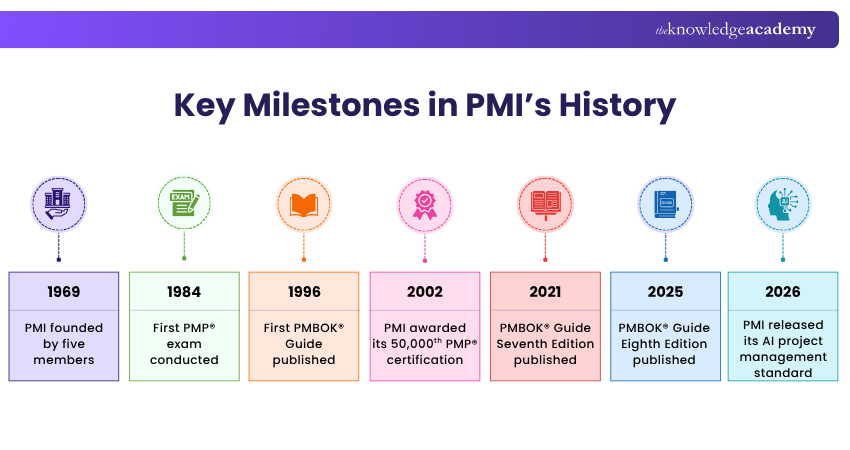
PMI experienced significant growth in its certification programmes, standards and international presence between 1984 and 2019. A major milestone was the introduction of the Project Management Professional (PMP)® certification in 1984.
The first PMP examination took place on 6 October 1984 in Philadelphia, USA, with 43 of the 56 candidates passing. Eric Jenett, one of PMI's founders, received PMP certification number one.
In 1996, PMI released the first edition of A Guide to the Project Management Body of Knowledge (PMBOK® Guide), providing a common reference for project management knowledge and practices.
Other significant developments during this era included:
1) 2002: PMI awarded its 50,000th PMP® certification, marking a significant milestone in the certification programme's growth.
2) 2000s–2010s: PMI expanded its certification portfolio, introducing credentials such as CAPM, PgMP and PMI-ACP.
3) 2019: PMI celebrated its 50th anniversary.
During this period, PMI also expanded its chapters, professional publications, conferences and educational programmes, strengthening its international presence.
3) The Modern Era (2020–Present)
Since 2020, PMI has continued updating its standards, certifications and learning resources to reflect changes in project management. With the growing adoption of predictive, agile and hybrid approaches, alongside technologies such as artificial intelligence (AI), PMI has increasingly focused on adaptability, value delivery and responsible technology adoption.
Important developments during this era include:
a) PMBOK Guide Seventh Edition (2021): PMI introduced a principles-based approach emphasising project outcomes, adaptability and value delivery.
b) 40 Years of PMP® Certification (2024): PMI celebrated four decades of PMP certification, recognising its development since the first examination in 1984.
c) PMBOK Guide Eighth Edition (2025): PMI released an updated edition incorporating six core principles, seven performance domains and expanded coverage of AI, procurement and Project Management Offices (PMOs).
d) AI Standard (2026): PMI published The Standard for Artificial Intelligence in Portfolio, Program and Project Management, providing guidance on responsible AI adoption, governance and risk management in project-based work.
Major Contributions of PMI to Project Management
PMI's contributions extend beyond its historical milestones. Through recognised standards, professional certifications, research and education, the organisation has helped strengthen project management knowledge and practices worldwide.
1) Development of Project Management Standards
One of PMI's major contributions is developing professional standards and guidance for managing projects, programmes and portfolios. These resources provide common terminology and guidance on recognised project management practices.
Some of PMI's key publications include:
1) PMBOK® Guide: Provides principles, performance domains and guidance that professionals can adapt to different project environments and delivery approaches.
2) The Standard for Program Management: Fifth Edition: Provides guidance on managing related projects and programme activities to realise benefits and support strategic objectives.
3) The Standard for Portfolio Management: Fourth Edition: Supports the management of portfolios of projects, programmes and other activities to achieve organisational objectives.
4) Other Standards and Practice Guides: Provide specialised guidance on areas such as risk management, scheduling and project estimating.
Together, these resources help organisations improve decision-making, establish consistent practices and manage projects more effectively.
2) Professional Certifications and Career Development
PMI offers professional certifications that validate knowledge, experience and specialised skills across different areas of project management. These certifications support professionals at various career stages. Let’s explore some of them below:
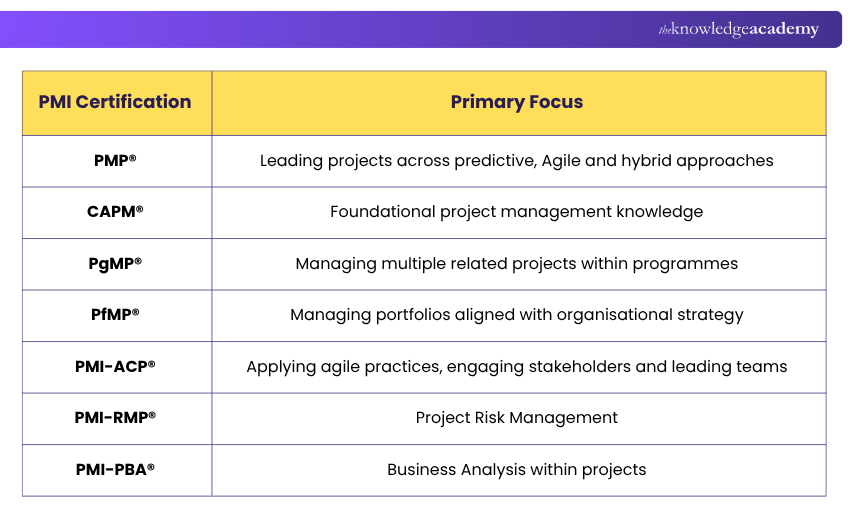
These certifications help professionals demonstrate their capabilities and support career development. PMI also encourages continuous learning through educational resources, professional events and certification maintenance requirements.
Pro Tip: Choosing the Right PMI Certification
Consider your existing experience and career responsibilities before selecting a certification. CAPM focuses on foundational knowledge, PMP recognises project leadership experience, while specialised credentials such as PMI-RMP and PMI-ACP focus on particular areas of practice.
3) Research, Education and Global Communities
PMI supports the project management profession through research, educational resources and professional communities. Its key contributions include:
1) Research and Publications: Explores developments in project management, including leadership, project performance, workforce requirements and emerging technologies.
2) Professional Communities: Provides networking, volunteering and knowledge-sharing opportunities through PMI chapters and professional communities.
3) Events and Conferences: Organises events that encourage professional learning, collaboration and knowledge exchange.
4) Professional Recognition: Recognises achievements through awards such as the PMI Fellow Award and Project of the Year Award.
Together, these initiatives support continuing professional development across industries and geographical regions.
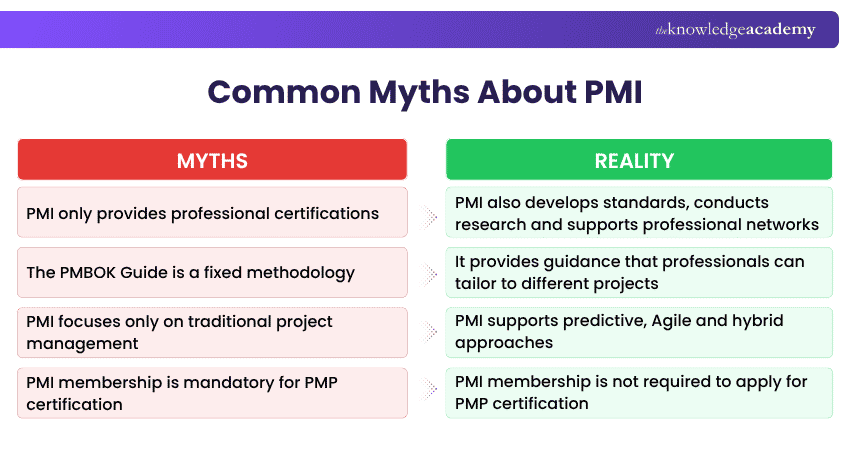
Common Myths About PMI
PMI's Role in Modern Project Management
Today, Project Managers face changing requirements, technological developments, complex stakeholder expectations and increasing pressure to deliver valuable outcomes.
PMI continues supporting professionals in responding to these challenges through standards, certifications and learning opportunities.
Its role in modern project management includes:
1) Supporting Flexible Project Delivery: PMI recognises predictive, Agile and hybrid approaches, encouraging professionals to select suitable practices based on project requirements.
2) Encouraging Value Delivery: PMI's guidance emphasises achieving meaningful outcomes and aligning project activities with organisational objectives.
3) Advancing Digital and AI Capabilities: PMI provides guidance on responsible AI adoption, governance and emerging technologies affecting project delivery.
4) Supporting Continuous Learning: Its certifications, educational resources and communities encourage professionals to maintain and develop their capabilities.
5) Strengthening Global Collaboration: PMI connects professionals through chapters, international events and opportunities to share professional knowledge.
Since its establishment in 1969, PMI has played a key role in advancing project management through certifications, standards and research. It continues to support professionals in adapting to emerging technologies and evolving industry needs.

Nilotpal Sarmah is a Senior Content Writer with 11+ years of overall experience spanning engineering, operations and content development. His technical knowledge and extensive writing experience enable him to simplify specialised topics across IT and Tech, Business Skills, Project Management, Health and Safety, and ISO and Compliance.
View Detail

 If you wish to make any changes to your course, please


