




We may not have the course you’re looking for. If you enquire or give us a call on + 1-866 272 8822 and speak to our training experts, we may still be able to help with your training requirements.
Objectives of Production Management Explained
ByThe Knowledge AcademyLast updated on: 10 October 2026
Objectives of production management are the guiding principles that streamline manufacturing processes to maximise efficiency and quality. This blog explores the goals of production management, from optimising resource utilisation to ensuring timely product delivery. Learn how a well-defined strategy in the objectives of production management can drive business success.

In This Blog
1. Production objectives provide measurable priorities for managing day-to-day operations.2. Different production challenges require different priorities rather than a one-size-fits-all approach.3. Decisions should account for trade-offs between cost, output, safety and operational reliability.4. Production performance can be assessed using indicators such as defects, downtime and schedule adherence.5. Continuous monitoring helps managers identify problems early and take corrective action.
In the modern business scenario, production management plays a pivotal role in ensuring operational excellence. It covers activities ranging from planning and resource allocation to process optimisation and execution. Understanding these activities is integral to effective production management.
Production Managers plan, coordinate and control production activities to ensure products are manufactured efficiently, safely, within budget and according to quality and delivery requirements.
The objectives of production management provide direction to businesses striving for operational success. In this blog, we will discuss these key objectives and explore how they help organisations optimise operations through effective planning, coordination and control.
Objectives of Production Management
These objectives, ranging from optimising resource allocation and ensuring top-notch quality to managing costs and adhering to deadlines, form the foundation of a robust strategy that breathes life into the production process. So, let's begin to understand how production management plays an important role in driving a company's success.
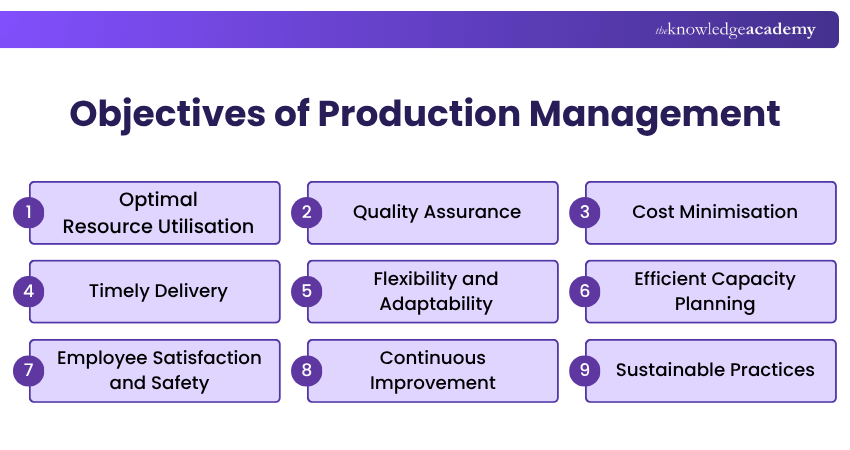
1) Optimal Resource Utilisation
One of the key objectives of production management is to ensure the efficient utilisation of resources. This includes managing raw materials, labour, equipment, and time in a way that minimises waste and maximises output. In the process of optimising resource allocation, a business can reduce costs and enhance overall productivity, contributing to the broader Scope of production management.
By using resources efficiently, organisations can also identify opportunities to improve their production processes.
Example: In a manufacturing plant, Production Managers can optimise the use of raw materials, labour and machinery by scheduling production according to demand and reducing idle machine time and material waste.

2) Quality Assurance
Maintaining product quality is a key objective of production management. Maintaining established quality standards is vital for customer satisfaction and lasting business success. Production Managers must plan processes that support quality, implement quality control measures, monitor production processes, and address any issues that could compromise the final product's quality.
Example: In an automotive assembly plant, quality checks can be performed throughout production to identify defects before vehicles move to subsequent stages. When abnormalities are detected, corrective action can be taken to prevent defective products from progressing further.
Quick Check
Watch for rising defect rates, repeated rework, frequent customer complaints, inconsistent output or increasing inspection failures. These can indicate that a production process requires closer investigation and corrective action.
3) Cost Minimisation
Controlling production costs is a critical objective that directly impacts a company's profitability. Production Managers strive to identify and eliminate inefficiencies in processes, reduce wastage, and streamline operations to produce goods and services at the lowest practical cost without compromising required quality standards. Production management functions support this goal by effectively planning, organising and controlling production activities.
Example: A garment manufacturer can minimise production costs by improving material utilisation, reducing fabric waste, optimising production schedules and limiting unnecessary machine downtime while maintaining required quality standards.
4) Timely Delivery
Meeting delivery schedules is essential for maintaining customer trust and fulfilling market demand. Production management aims to create realistic production timelines and ensure that goods and services are produced on schedule and delivered on time. This objective involves effective coordination of various stages of production and efficient scheduling.
Example: In food manufacturing, Production Managers coordinate ingredient availability, processing, packaging and production schedules to ensure finished products are ready for distribution on time, particularly for products with limited shelf lives.
Gain practical skills in portfolio management and annual product planning with the Product Management Training – Register now!
5) Flexibility and Adaptability
In today’s dynamic business environment, adapting to changing market conditions and demand is essential. Production management objectives include establishing flexible production processes that can adapt quickly to evolving customer preferences, technologies and market trends.
Example: An electronics manufacturer may adjust production schedules and assembly lines when demand shifts between different device models. Flexible processes allow the business to respond to changing customer demand or product specifications without causing major production disruptions.
Trainer’s Insight
Production flexibility is easier to build before demand changes occur. Cross-training employees, maintaining alternative suppliers and designing adaptable production schedules can help organisations respond more effectively when conditions change.
6) Efficient Capacity Planning
Production Managers ensure sufficient production capacity to address both immediate and future requirements. Excess capacity can increase operating costs and leave resources underutilised, while insufficient capacity can cause production delays and make it difficult to meet demand. Effective capacity planning helps balance available resources with expected production requirements.
Example: A pharmaceutical manufacturer can forecast expected demand and assess whether its existing equipment, workforce and production facilities have sufficient capacity. If demand is expected to increase, additional shifts, equipment or production capacity may be planned in advance.
7) Employee Satisfaction and Safety
A productive workforce is the basis of successful production management. This objective encompasses maintaining a safe working environment, providing appropriate training and skill development opportunities and supporting efficient working practices. A well-trained and supported workforce can contribute to safer, more efficient and reliable production processes.
Example: In a manufacturing facility, Production Managers can support workforce safety and productivity by providing appropriate training, maintaining equipment, establishing safe working procedures and managing workloads effectively.
8) Continuous Improvement
Production management objectives also include fostering a culture of continuous improvement. This involves regularly evaluating production processes, identifying bottlenecks or inefficiencies, and implementing enhancements to optimise operations over time. Continuous improvement leads to increased efficiency and competitiveness.
Example: Toyota, for instance, played a major role in developing and popularising production practices associated with lean manufacturing through the Toyota Production System (TPS). Through continuous kaizen activities, employees identify waste, address inefficiencies and improve production processes over time.
9) Sustainable Practices
Modern production management recognises the importance of sustainability. Businesses aim to minimise their environmental footprint by adopting eco-friendly production methods, reducing waste generation, and conserving resources. Implementing sustainable practices can reduce environmental impacts, improve resource efficiency and support an organisation's wider sustainability goals.
Example: Manufacturing companies might invest in more energy-efficient equipment, monitor resource consumption, and implement eco-friendly practices. Over time, these incremental changes contribute to reduced environmental impact and a greener footprint.
Production Management Health Check
Before reviewing your production strategy, ask:
1. Are production targets aligned with available capacity?2. Are recurring defects and bottlenecks being tracked to their root causes?3. Can production adapt when demand or requirements change?4. Are safety risks identified before they disrupt operations?5. Are improvement actions measured to confirm that they actually work?
Demonstrate your proficiency in the software with the SAP Training – Join today!

The Knowledge Academy develops accessible learning content across Project Management, IT, Cybersecurity, Data Science, Business Analysis, HR, Accounting and Finance, Leadership and Health and Safety. Its resources combine subject research with clear explanations to help professionals build practical knowledge across a wide range of disciplines.
View Detail

 If you wish to make any changes to your course, please


