


 Top Rated Course

We may not have the course you’re looking for. If you enquire or give us a call on 01344203999 and speak to our training experts, we may still be able to help with your training requirements.
MSP Roles and Responsibilities of a Programme Manager
Grace Mitchell 15 July 2026Want to know what MSP Programme Managers do? This blog will provide a detailed understanding of MSP Roles and Responsibilities, including the types of Programme Managers in MSP and how different roles of MSP will help your organisation in various ways. Read more to become an effective Programme Manager and transform your organisation!

Training Outcomes Within Your Budget!
We ensure quality, budget-alignment, and timely delivery by our expert instructors.
Table of Contents

In today's fast-paced and dynamic business environment, organisations face increasing challenges in managing complex programmes that span multiple projects and stakeholders. This is where the Programme Manager brings their experience, knowledge, and strategic vision. As an integral role within the Managing Successful Programmes (MSP) framework, the MSP Roles of a Programme Manager include orchestrating the execution of strategic initiatives and delivering the desired outcomes.
The success of any programme in an organisation relies heavily on the expertise and leadership of a skilled Programme Manager. An effective Programme Manager possesses excellent communication and interpersonal skills, allowing them to collaborate with diverse stakeholders, including senior executives, Project Managers, team members, and external partners. In this blog, you will learn about the MSP Roles of a Programme Manager, their responsibilities, and more.
In this blog, you will learn about the MSP Roles of a Programme Manager, their responsibilities, and more.
Table of Contents
1) Who is an MSP Programme Manager?
2) Roles and Responsibilities of an MSP Programme Manager
a) Strategic Leader
b) Governance Champion
c) Program Planner and Coordinator
d) Stakeholder Manager
e) Benefits Realisation Facilitator
f) Risk and Issue Manager
g) Communication and Reporting Specialist
3) Types of Programme Managers
4) Conclusion
Who is an MSP Programme Manager?
An MSP Programme Manager is an experienced professional responsible for overseeing and managing the successful delivery of complex programmes within the MSP framework. They possess a unique combination of leadership, strategic thinking, and Project Management skills.
With a deep understanding of the organisation's objectives and strategic goals, the Programme Manager ensures that the programme aligns with these priorities and contributes to the business's overall success with the help of MSP Guide Principles.
They are visionaries who translate strategic objectives into actionable plans, sets a clear direction, and inspires others to work towards a common goal. Additionally, they are experts in governance and MSP risk management. They establish governance structures, ensuring that decision-making processes are in place and compliant with regulations.
They proactively identify and address risks, mitigating potential obstacles that could hinder the programme's progress. The Programme Manager also excels in stakeholder management, actively engaging with diverse stakeholders and fostering open communication to maintain alignment and support throughout the programme lifecycle.
The MSP Programme Manager leverages the MSP Blueprint, a crucial component of the MSP framework, to guide the programme's direction and execution. The Blueprint provides a detailed outline of the programme's vision, design, and outcomes, ensuring a clear and consistent understanding among all stakeholders.

Roles and Responsibilities of an MSP Programme Manager
Within the Managing Successful Programmes (MSP) framework, the Programme Manager assumes various key roles essential for successfully delivering strategic program management and achieving strategic programmes. Let's explore these roles and their corresponding responsibilities in detail:
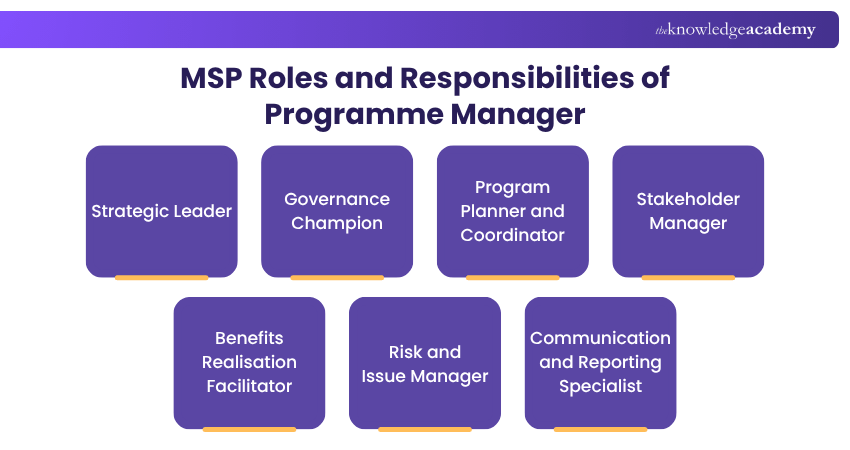
1) Strategic Leader
The Programme Manager plays a crucial role in defining and articulating the programme's strategic vision. They align the programme's objectives with the organisation's strategic goals, ensuring that it contributes to the overall business strategy.
By understanding the strategic context, the Programme Manager provides clarity and direction to the programme team and stakeholders, enabling them to work towards a common goal. Their responsibilities include:
a) Defining the programme's strategic vision and objectives
b) Aligning the programme with the organisational strategy
c) Establishing a strategic roadmap for achieving programme goals
2) Governance Champion
Establishing effective governance structures is vital for programme success, and the Programme Manager is responsible for implementing robust governance arrangements. They create the Programme Board, comprising senior executives and key stakeholders, to oversee decision-making, monitor progress, and resolve issues.
The Programme Manager ensures the programme operates within defined frameworks and adheres to established governance processes. They provide regular updates and reports to the Programme Board, informing them about the programme's performance and seeking necessary approvals. Thus, their responsibilities include:
a) Establishing governance arrangements and structures
b) Overseeing decision-making processes
c) Ensuring compliance with regulatory requirements
Read and Discover our MSP Exam Preparation Guide: Foundation and Practitioner to boost your exam success!
3) Program Planner and Coordinator
Programme planning and coordination are vital responsibilities of the Programme Manager. They develop a comprehensive programme plan that encompasses key activities, milestones, dependencies, and resource requirements. The Programme Manager coordinates with Project Managers and stakeholders to ensure alignment, integration, and efficient delivery of programme components, keeping the Differences between Program Manager and Project Manager in mind. Their responsibilities include:
a) Developing a detailed programme plan
b) Coordinating activities and resources across projects
c) Monitoring progress and ensuring adherence to the plan
Master the MSP Strategic Mindset to drive your business forward!
4) Stakeholder Manager
Engaging and managing stakeholders is critical to a Programme Manager's role. They identify key stakeholders, assess their interests, and develop strategies for effective engagement. The Programme Manager establishes strong relationships, communicates regularly, and ensures that stakeholder expectations are understood and incorporated into the programme's activities. Their responsibilities are as follows:
a) Identifying and analysing stakeholders
b) Developing stakeholder engagement strategies
c) Facilitating communication and collaboration with stakeholders
Crack your interview with confidence! Explore our list of must-know Program Manager Interview Questions!
5) Benefits Realisation Facilitator
Programme Managers are responsible for ensuring the realisation of programme benefits. They work closely with stakeholders to define measurable benefits, develop strategies for their achievement, and establish mechanisms to track progress.
The Programme Manager monitors benefit realisation, takes corrective actions when necessary, and ensures that the programme remains focused on delivering the expected outcomes. Their responsibilities include the following:
a) Defining measurable benefits and outcomes
b) Developing benefit realisation strategies
c) Monitoring progress and adjusting strategies as needed
6) Risk and Issue Manager
Managing risks and issues is a crucial responsibility of the Programme Manager. They identify potential risks, assess their impact, and develop mitigation strategies. The Programme Manager establishes processes for risk identification, monitoring, and response. They proactively manage issues, facilitating their resolution and minimising their impact on the programme's progress. Their responsibilities include the following:
a) Identifying and assessing risks
b) Developing risk mitigation and contingency plans
c) Facilitating issue resolution and escalation
Build a successful MSP from the ground up – get your MSP Startup Guide today!
7) Communication and Reporting Specialist
Effective communication and reporting are vital for programme success, with the Programme Manager serving as the key communication hub. They ensure smooth information flow among stakeholders by providing regular updates on the programme’s progress, achievements, challenges, and future milestones. In addition to understanding the Programme Manager Job Description, they facilitate effective communication channels, promote collaboration, and uphold transparency. Their responsibilities include:
a) Facilitating effective communication among stakeholders
b) Preparing regular progress reports and updates
c) Promoting transparency and collaboration within the programme
Gain essential programme management expertise with the MSP® Foundation Training – Join today!
Types of Programme Managers
While the core responsibilities of Programme Managers remain consistent across different programmes, their specific focus and expertise may vary depending on the nature of the programme. Let's explore some of the different types of Programme Managers based on their areas of specialisation:
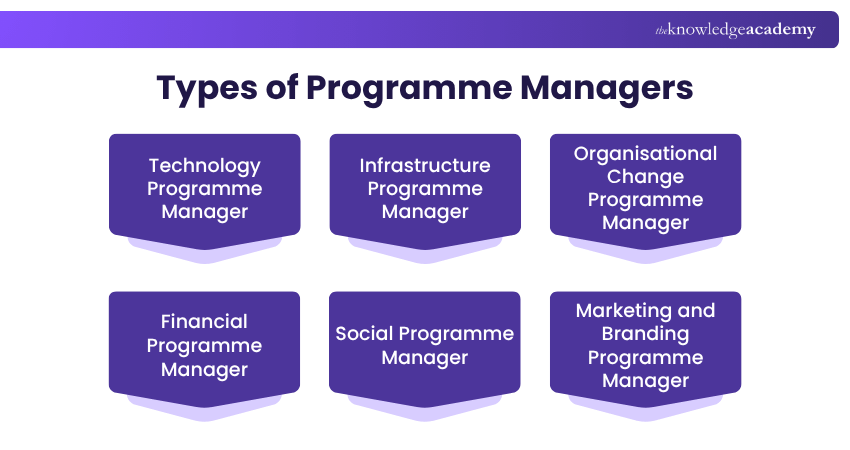
1) Technology Programme Manager
Technology Programme Managers possess in-depth knowledge and expertise in managing complex technology-focused programmes. They are well-versed in handling projects related to software development, infrastructure upgrades, system implementations, and digital transformations. A Technical Programme Manager typically oversees these types of programmes, ensuring the technical requirements are met while aligning with overall business goals.
These Programme Managers understand the technical aspects of the programme, coordinate with Information Technology (IT) teams and vendors, and ensure the seamless integration of technology solutions to achieve programme objectives.
2) Infrastructure Programme Manager
Infrastructure Programme Managers are skilled in managing large-scale infrastructure development programmes. They are experienced in overseeing projects related to construction, transportation, utilities, and other physical infrastructure projects.
These Programme Managers have a strong understanding of engineering principles, project scheduling, resource allocation, and risk management specific to infrastructure projects. They collaborate with various stakeholders, including architects, engineers, contractors, and government agencies, to deliver the infrastructure programme successfully.
3) Organisational Change Programme Manager
Organisational Change Programme Managers specialise in driving transformational change within an organisation. They focus on managing programmes that involve significant changes in processes, structures, culture, and ways of working.
These Programme Managers are proficient at stakeholder engagement, communication, and change management models. They work closely with key stakeholders to define the change vision, create change strategies, and facilitate the adoption of new organisational processes and behaviours.
Learn to manage programmes that deliver real change and business value with the MSP® Training – Join now!
4) Financial Programme Manager
Financial Programme Managers excel in managing programmes that involve financial transformations, mergers and acquisitions, or financial services initiatives. They have a deep understanding of financial regulations, risk management, and financial reporting.
They collaborate with financial experts, auditors, legal teams, and regulatory bodies to ensure compliance and drive financial performance within the programme. They also focus on benefit realisation, particularly in terms of financial outcomes and cost efficiency, with guidance from the MSP Pricing Guide to ensure the best pricing strategies.
5) Social Programme Manager
Social Programme Managers specialise in managing programmes that address social issues and community development. They lead programmes related to social welfare, education, healthcare, environmental sustainability, and other social initiatives.
These Programme Managers work closely with non-profit organisations, government agencies, community leaders, and volunteers to deliver social impact. They understand social dynamics, stakeholder engagement, and the importance of measuring social outcomes and benefits.
6) Marketing and Branding Programme Manager
Marketing and Branding Programme Managers focus on programmes that involve marketing campaigns, brand development, product launches, and market expansion. They have expertise in market research, brand strategy, customer engagement, and campaign management. These Programme Managers collaborate with marketing teams, creative agencies, and sales teams to ensure effective marketing initiatives and brand alignment within the programme.
Conclusion
The role of an MSP Programme Manager is multifaceted and critical in driving the success of complex programmes. We hope this blog has helped improve your understanding of the MSP Roles and responsibilities of a Programme Manager, its different types, and the Benefits of MSP in achieving strategic objectives.
Strengthen your programme leadership capabilities with the MSP® Practitioner Training – Join now!
Frequently Asked Questions
What are the 7 Principles of MSP?

The 7 Principles of Managing Successful Programmes (MSP) guide programme delivery and organisational change by providing a structured framework for leadership, governance, and benefits realisation. They emphasise strategic alignment, value delivery, capability development, and continuous learning to ensure successful and sustainable programme outcomes.
What are the Typical MSP job Titles?
Typical MSP job titles include Programme Manager, Business Change Manager, Benefits Manager, Risk Manager, and Programme Office Manager. Other roles include Project Manager, IT Service Manager, and Solution Architect, all working together to deliver, govern, and support successful programme outcomes.

Grace Mitchell


Senior Project Management Consultant and Author
Grace Mitchell is a highly experienced project management professional with over 15 years of expertise in leading large-scale projects across industries, including construction, IT, and finance. With qualifications in PRINCE2®, PMP®, AgilePM®, and MSP®, Grace specialises in delivering complex programmes with precision and clarity. Her writing is grounded in real-world application and focuses on helping learners build confidence in project delivery and stakeholder management.
View Detail

 If you wish to make any changes to your course, please


