


We may not have the course you’re looking for. If you enquire or give us a call on +44 1344 203 999 and speak to our training experts, we may still be able to help with your training requirements.
Strategic Program Management: A Complete Guide
ByGrace MitchellLast updated on: 16 October 2026
This exploration dives into the heart of this crucial discipline, helping you understand its key components and how to implement effective strategies. Uncover the valuable benefits it offers and conclude your journey with a newfound understanding of strategic program management's significance in achieving organisational goals and success.
Overview
1. Strategic program management connects multiple related initiatives with broader organisational goals.2. It helps coordinate resources, dependencies, governance, stakeholders, and expected benefits across programs.3. Effective program management keeps work aligned with changing priorities while supporting informed decision-making.4. A strong strategic approach focuses not only on project delivery but also on long-term outcomes and benefits realisation.
When multiple projects are running at once, success depends on more than meeting deadlines and budgets. The real challenge is ensuring every initiative contributes to something bigger and continues to create value as priorities change.
This is where strategic program management becomes essential. It provides a structured way to guide interconnected initiatives, balance competing demands, and maintain focus on the outcomes that matter most to the organisation.
Understanding Strategic Program Management
Strategic program management involves coordinating related projects and other program activities to achieve strategic objectives and realise benefits that would be difficult to achieve if they were managed separately. Unlike individual projects, programs are characterised by interdependencies, shared resources, broader outcomes, and collective impact.
To distinguish between projects and programs, it's essential to recognise that projects focus on delivering specific outputs within predefined constraints, such as time, budget, and scope. On the other hand, programs coordinate related projects and other activities, providing strategic direction to realise broader outcomes and benefits.
Strategic alignment is a critical aspect of program management. Programs should be aligned with the organisation's overall strategy and objectives, ensuring that the efforts invested in the program contribute to the organisation's success. Organisations can optimise their resources, increase efficiency, and achieve long-term strategic goals by adopting this approach.

Strategic Program Management Life Cycle
Organisations can manage programmes through lifecycle activities such as initiation, planning, execution, control, and closure, while maintaining strategic alignment, benefits management, stakeholder engagement, and governance throughout.
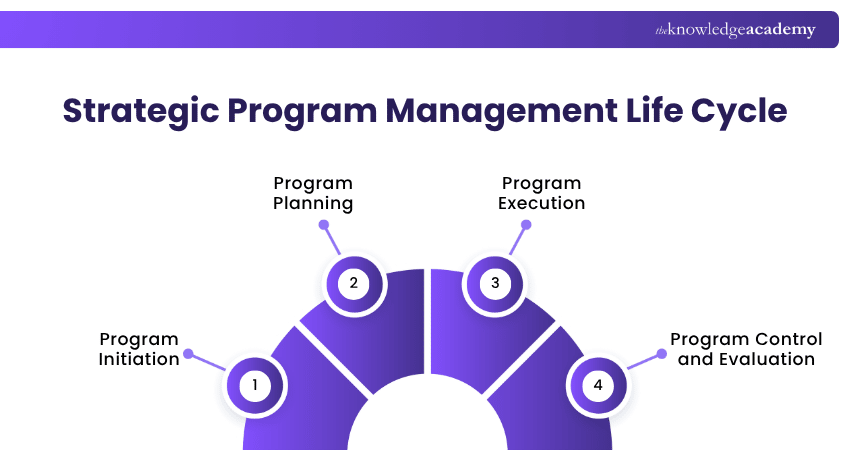
1) Program Initiation
Program initiation is the first step in strategic program management. It involves defining the program objectives, identifying the strategic fit, and understanding the stakeholders. During this phase, it is essential to assess the feasibility and alignment of the program with the organisation's strategic priorities. By clearly defining the program's objectives, the organisation can ensure that all efforts are directed towards achieving the desired outcomes.
2) Program Planning
Once the program is started, a comprehensive plan is developed to guide its execution. This involves creating a program roadmap that outlines the program's major milestones, deliverables, and dependencies.
Additionally, establishing a program governance structure ensures effective decision-making and accountability throughout the program's lifecycle. The program charter or equivalent authorising documentation can define the program's mandate, objectives, scope, and governance expectations.
Pro Tip: Before approving a new project within a program, check whether it directly supports a strategic objective or expected benefit. This helps prevent resources from being spread across low-value work.
3) Program Execution
During the program execution phase, the focus shifts to managing program resources, monitoring progress, and addressing risks and issues. Resource management involves coordinating personnel, budgets, capabilities, and other resources across projects and program activities.
Regular monitoring of program progress helps identify any deviations from the plan, allowing for timely corrective actions. Addressing risks and issues helps reduce their potential impact on program outcomes, benefits, and strategic objectives.
4) Program Control and Evaluation
Program control and evaluation are ongoing processes that ensure the program remains on track and delivers the intended results. Tracking program performance through appropriate KPIs and metrics provides insight into progress, risks, stakeholder outcomes, and benefits realisation, supporting informed decision-making.
Regular program reviews are conducted to assess achievements, identify areas for improvement, and adapt the program strategy as needed. Flexibility and agility are essential in responding to changing circumstances, ensuring the program remains aligned with the organisation's strategic goals.
5) Program Closure
Program closure marks the formal completion of the programme once its objectives have been achieved or the programme has reached its planned end. This stage involves confirming that deliverables and outcomes have been transitioned appropriately, obtaining final approvals, closing outstanding activities, and documenting lessons learned.
It also includes reviewing overall programme performance, assessing the realisation of intended benefits, completing final reports, and archiving relevant records. A structured closure process helps organisations capture valuable insights and support the continued management of benefits after the programme has ended.
Get the skills and knowledge you need to succeed as a project manager with our PMI Project Management Ready Training - Join now!
Implementing a Strategic Program Management Strategy
By implementing these strategic program management practices, organisations can establish a solid foundation for successful program execution, enabling effective governance, standardised processes, and enhanced collaboration across programs.
1) Establishing Program Governance
Establishing clear program governance helps organisations define decision-making responsibilities, accountability, oversight, and reporting structures. A Program Management Office (PMO) can support this by providing guidance, standardisation, and coordination across programmes while helping Program Managers maintain alignment with organisational objectives.
2) Establishing Program Management Methodologies and Frameworks
Developing and implementing program management methodologies and frameworks provides a structured approach to program planning, execution, governance, and control. These frameworks outline standardised processes, Program Management Tools, and templates that facilitate effective program planning, execution, and control.
3) Ensuring Effective Communication and Collaboration
Successful strategic management implementation requires open and effective communication channels. It includes fostering collaboration among stakeholders, Program Managers, and project teams, enabling seamless information sharing and decision-making throughout the program lifecycle.
Take your Program Management skills to the next level with our Program Management Professional (PgMP)® Training - Join now!
Benefits of Strategic Program Management
Here are the key benefits of strategic program management
a) Enhanced Alignment with Organisational Strategy: It helps keep program's aligned with long-term organisational objectives and changing strategic priorities.
b) Improved Resource Utilisation and Efficiency: Programs can improve resource utilisation by coordinating priorities, dependencies, and shared resources across related initiatives, supporting greater efficiency and more informed cost decisions.
c) Greater Visibility and Control Over Interrelated Projects: A strategic approach provides better visibility into project interdependencies, enabling informed decision-making and proactive risk management.
d) Increased Ability to Manage Program Risks and Adapt to Changes: It identifies and addresses risks, allowing for timely mitigation and adaptation to changes in the external environment.
Learn the essentials of Project Management with our extensive range of PMP® Training - Register now!
Strategic Program Management Checklist
□ Confirm every program objective supports organisational strategy□ Define expected benefits and how they will be measured□ Map dependencies between projects and program activities□ Clarify governance, ownership, and decision-making authority□ Allocate resources according to strategic priorities□ Identify major risks, assumptions, and constraints early□ Establish clear communication channels for stakeholders□ Track outcomes and benefits, not only project milestones□ Review whether changing priorities affect program value□ Close or redirect activities that no longer support strategic goals.

Grace Mitchell creates practical Project Management content covering project delivery, governance, stakeholde engagement and programme coordination. Her knowledge of established methodologies helps readers understand complex project environments and approach project delivery with greater structure and confidence.
View Detail

 If you wish to make any changes to your course, please


