


 Top Rated Course

We may not have the course you’re looking for. If you enquire or give us a call on 01344203999 and speak to our training experts, we may still be able to help with your training requirements.
The 10 Most Powerful Supercomputers in the World
Scarlett Adams 11 December 2025Supercomputers are ultrapowerful machines designed to perform complex calculations at incredibly high speeds for solving large-scale problems. They are measured in trillions or even quadrillions of operations per second. They’re used for tasks like climate modelling, scientific research, AI training, and national security.

Training Outcomes Within Your Budget!
We ensure quality, budget-alignment, and timely delivery by our expert instructors.
Table of Contents

Buckle up! We’re heading into a world where supercomputers like Frontier and Leonardo are quite literally shaping the future. The Powerful Supercomputers in the world aren’t just fast but solve the universe’s biggest mysteries. Ready to meet the machines shaping the future of science, AI, and security? Read on!
Whether it’s mapping the universe, predicting hurricanes, or simulating human cells, Supercomputers are quietly powering the breakthroughs of tomorrow. In this blog, we’ll introduce you to the top 10 Most Powerful Computer in the World. Each one is a beast in its own field, with unmatched speed, complexity, and brainpower.
Table of Contents
1) Introduction to Supercomputing
2) Top 10 Most Powerful Supercomputers
a) El Capitan
b) Frontier
c) Aurora
d) Eagle
e) HPC6
f) Fugaku
g) Alps
h) LUMI
i) Leonardo
j) Selene
3) Conclusion
Introduction to Supercomputing
Supercomputers solve problems that are far too complex for regular computers to handle. From simulating nuclear explosions to modelling climate change they play a vital role. They also help in decoding human DNA to predict cosmic phenomena. These computers are the behind-the-scenes heroes of cutting-edge science and innovation.

Key Takeaways:
1) Supercomputers perform trillions to quadrillions of calculations
2) They are designed for solving complex, large-scale problems
3) Common uses include climate modelling, AI training, drug discovery
4) Supercomputers use thousands of processors working in parallel
5) They are critical tools in research, defense, and global innovation
Top 10 Most Powerful Supercomputers
Here are the top 10 Powerful computers with examples:
1) El Capitan
El Capitan is the undisputed heavyweight champion of supercomputing as of 2024. Designed for the U.S. Department of Energy, this monster is expected to reach over 2 exaFLOPS. It means it can perform two billion-billion operations per second.
It’s being built to handle national security simulations, including nuclear stockpile management, without actual testing. El Capitan uses Hewlett Packard Enterprise (HPE) Cray EX architecture and is powered by Advanced Micro Devices (AMD)’s latest Graphics Processing Units (GPUs) and Central Processing Units (CPUs). This beast doesn't just crunch numbers; it devours them.
Location: Lawrence Livermore National Laboratory, California
Performance: Expected to exceed 2 exaFLOPS
Turn everyday tasks into power moves with our Computer Science Course - Join now!
2) Frontier
Frontier made history as the first publicly verified exascale supercomputer. Built using AMD processors and HPE’s Cray EX architecture, Frontier is blazing fast and energy efficient.
It supports diverse research, from Artificial Intelligence (AI) training and medical research to materials science and nuclear physics. Its massive power allows it to simulate complex systems with incredible accuracy and speed, making it a cornerstone of scientific advancement.
Location: Oak Ridge National Laboratory, Tennessee
Performance: 1.2 exaFLOPS
3) Aurora
Still rolling out but already turning heads, Aurora is Intel’s answer to the exascale race. It is designed with Intel’s Xeon CPUs and Ponte Vecchio GPUs. Aurora aims to be one of the fastest and most energy-efficient systems ever.
The focus are Artificial Intelligence and Deep Learning. Aurora will empower scientists to build AI models that require massive training data. Thus, revolutionising fields like personalised medicine and climate prediction.
Location: Argonne National Laboratory, Illinois
Performance: Expected 2 exaFLOPS+
4) Eagle
Eagle is unique but not based in a government lab but is instead a cloud-based supercomputer operated by Microsoft Azure. It's used for AI training on a massive scale, featuring tens of thousands of NVIDIA A100 GPUs.
While not quite exascale, its architecture is focused on machine learning and AI workloads, making it ideal for training next-gen language models and Computer Vision systems.
Location: Microsoft Azure, USA
Performance: ~561 petaFLOPS (mixed-precision)
5) HPC6
HPC6 is the most Powerful Supercomputer in the Middle East, Built by Saudi Aramco. This is used for energy simulations, seismic imaging, and climate modelling. It is essential for oil exploration and renewable energy transition.
It’s proof that supercomputing is no longer exclusive to the U.S., Europe, or Japan. Countries around the world are now investing in computational horsepower to drive innovation and sustainability.
Location: Aramco, Saudi Arabia
Performance: ~450 petaFLOPS
Say goodbye to confusion and master workplace tech today with Google Slides Training. Join Today!
6) Fugaku
Fugaku held the top spot for several years before the exascale giants arrived. Developed by Fujitsu and RIKEN, this ARM-based machine revolutionised high-performance computing in Asia.
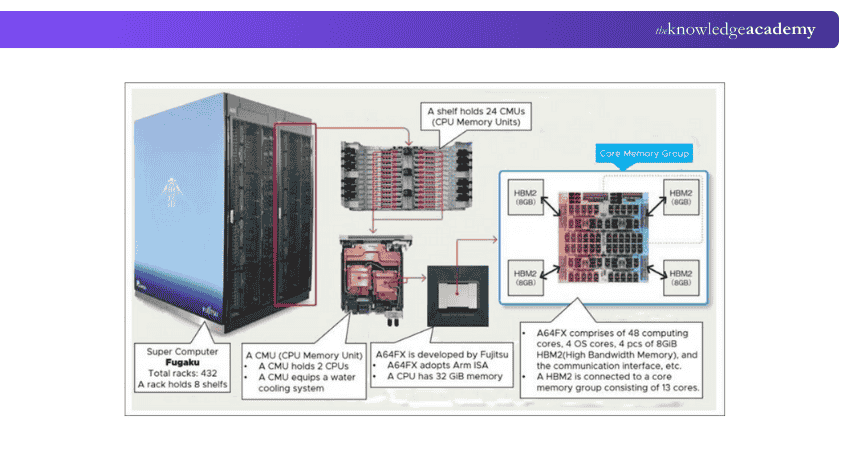
It’s used for everything from COVID-19 drug discovery to weather simulations and disaster response planning. Fugaku's architecture is designed for both speed and flexibility. It is capable of tackling a vast range of scientific problems with incredible precision.
Location: RIKEN Center for Computational Science, Kobe
Performance: ~442 petaFLOP
7) Alps
Alps is Europe’s rising star, designed to support climate research, materials science, and astrophysics. Built by HPE and powered by NVIDIA’s Grace Hopper Superchips, Alps represents the next generation of AI-driven research in Europe.
Its integration with AI and Machine Learning gives it a unique edge, bridging the gap between traditional high-performance computing and next-gen AI modelling. Expect big things from this Alpine powerhouse.
Location: Swiss National Supercomputing Centre
Performance: Estimated 270+ petaFLOPS
8) LUMI
Large Unified Modern Infrastructure (LUMI) is the most Powerful supercomputer in the EU. It’s part of the EuroHPC initiative, which aims to boost Europe’s competitiveness in high-performance computing.
Built by HPE Cray and powered by AMD, LUMI supports research in health, quantum physics, and clean energy. There are bonus points of this supercomputer. It runs on 100% renewable hydroelectric energy, making it one of the greenest Supercomputers in the world.
Location: CSC – IT Center for Science, Finland
Performance: ~375 petaFLOPS
9) Leonardo
Leonardo is another European AI-and-science powerhouse, focused on fields like Aerospace Engineering, genomic analysis, and advanced simulations. It features Atos BullSequana systems with NVIDIA GPUs and Intel CPUs.
Italy is positioning Leonardo as part of a broader European mission for technological independence and AI development. Its modular design makes it highly scalable and future ready.
Location: CINECA, Italy
Performance: ~250 petaFLOPS
10) Selene
Selene is NVIDIA’s in-house supercomputer, built using its own DGX A100 system. It’s used primarily for AI model training, GPU testing, and software optimisation.
While smaller than others on this list, Selene plays a key role in developing the tech that powers many other Supercomputers. It’s like a workshop where the tools for giants are forged.
Location: NVIDIA, California
Performance: ~63 petaFLOPS
Conclusion
You can conclude with a basic understanding of the 10 Most Powerful Computers in the World. From exascale monsters like El Capitan and Frontier, to eco-conscious titans like LUMI, the race for computational dominance is both fierce and inspiring. One thing is certain; the future is being calculated at a rate that’s hard to imagine and even harder to ignore.
Be the go-to tech hero in your office! Register to our OneNote Training today.
Frequently Asked Questions
How Much Ram do Supercomputers Have?

Supercomputers typically have terabytes to petabytes of RAM to handle massive data sets. For example, Frontier has over 9 petabytes of RAM. This enormous memory allows them to run complex simulations like weather forecasting or molecular modelling. They work at high speed without bottlenecks, ensuring smooth and efficient performance.
Which Processor is Used in a Supercomputer?
Supercomputers use high-performance processors like AMD EPYC, Intel Xeon, or Fujitsu A64FX, often paired with Powerful GPUs such as NVIDIA A100 or Hopper. These CPUs and GPUs work together to deliver massive parallel processing power, enabling complex simulations, AI training, and scientific research at incredible speeds.
What are the Other Resources and Offers Provided by The Knowledge Academy?
The Knowledge Academy takes global learning to new heights, offering over 3,000 online courses across 490+ locations in 190+ countries. This expansive reach ensures accessibility and convenience for learners worldwide.
Alongside our diverse Online Course Catalogue, encompassing 19 major categories, we go the extra mile by providing a plethora of free educational Online Resources like Blogs, eBooks, Interview Questions and Videos. Tailoring learning experiences further, professionals can unlock greater value through a wide range of special discounts, seasonal deals, and Exclusive Offers.
What is The Knowledge Pass, and How Does it Work?
The Knowledge Academy’s Knowledge Pass, a prepaid voucher, adds another layer of flexibility, allowing course bookings over a 12-month period. Join us on a journey where education knows no bounds.
What are the Related Courses and Blogs Provided by The Knowledge Academy?
The Knowledge Academy offers various End User Training, including the Google Slides Training, Keynote Training and the Google Drive Training. These courses cater to different skill levels, providing comprehensive insights into What is Customer Relationship Management.
Our Office Applications Blogs cover a range of topics related to Computers, offering valuable resources, best practices, and industry insights. Whether you are a beginner or looking to advance your Team-work skills, The Knowledge Academy's diverse courses and informative blogs have got you covered.
Upcoming Office Applications Resources Batches & Dates
Date
 Computer Science Course
Computer Science Course
Fri 10th Apr 2026
Computer Science Course
Fri 10th Jul 2026
Computer Science Course
Fri 9th Oct 2026

 If you wish to make any changes to your course, please


