




We may not have the course you’re looking for. If you enquire or give us a call on 01344203999 and speak to our training experts, we may still be able to help with your training requirements.
Lua vs Python: Choosing Your Scripting Side
ByRichard HarrisLast updated on: 26 September 2026
Want to discover the strengths and nuances of Lua and Python? If so, this blog can empower you to make the right choice for your projects. Dive into this blog on Lua vs Python to understand their unique features that assist in making informed programming decisions for projects.

Lua and Python emerge as two powerful contenders, each with its own set of strengths and capabilities. When faced with the decision of which scripting language to adopt, understanding the nuances and differences between Lua vs Python becomes crucial.
Lua, with its minimalist syntax and lightweight design, finds its niche in embedded systems, game development, and scripting tasks. On the other hand, Python's multi-paradigm nature makes it a favourite for web development, artificial intelligence, and so on.
In this comprehensive blog, we will look into the intricacies of Lua vs Python. You can read this blog to explore their inheritance models, speed capabilities, syntax structures, and more. Let's begin!
What is Lua?
Lua is a lightweight, high-level, and multiparadigm scripting language. It was designed with embedding in applications in mind but has gained popularity in various fields, including game development and web programming. Lua is known for its simplicity, efficiency, and ease of integration into existing codebases.

Benefits and Drawbacks of Lua
Below are a few benefits and drawbacks of Lua:
1) Advantages
Lua, a lightweight and efficient scripting language, offers several advantages that developers should weigh when considering its use. Some of its advantages are as follows:
a) Lightweight: Lua's lightweight nature is one of its standout features. It consumes relatively few resources, making it an excellent choice for resource-constrained environments like embedded systems.
b) Efficiency: Due to its minimalistic design and focus on performance, Lua can execute embedded scripting tasks efficiently. This efficiency is beneficial for real-time applications like video games, where swift processing is crucial for a seamless user experience.
c) Embeddability: Lua's simplicity extends to its ease of integration with existing applications. It is designed to be embedded within other software, providing scripting capabilities without introducing excessive overhead.
d) Simplicity: Lua boasts a straightforward and intuitive syntax, making it accessible for developers of all levels. Beginners find Lua easy to learn and use, while experienced developers appreciate its simplicity for implementing complex algorithms.
2) Disadvantages
Apart from the advantages discussed, there are certain drawbacks associated with Lua. Some of them are as follows:
a) Limited Libraries: Lua's standard library is smaller compared to languages like Python. This means that developers may need to rely on additional third-party libraries to access certain functionalities.
b) Less Popular: Lua may not enjoy the same level of widespread adoption as more mainstream languages like Python. This can lead to fewer resources, tutorials, and community support compared to popular languages.
c) Lack of Built-in Features: Some developers find Lua lacking in built-in features that are standard in other languages. For tasks outside its standard library, developers may need additional modules or application-provided functionality.
Pro Tip
Prototype Before You Commit: Test a small feature in both languages before choosing one for a larger project.
What is Python?
Python is a versatile, high-level, and general-purpose programming language known for its readability and simplicity. It is renowned for its extensive standard library and finds widespread applications in web development, scientific computing, data analysis, artificial intelligence, and numerous other fields. Its syntax prioritises code readability and enables developers to articulate concepts concisely, resulting in streamlined code development processes.

Benefits and Drawbacks of Python
Below are a few benefits and drawbacks of Python:
1) Advantages
Python, as a versatile and widely used programming language, offers several benefits. Those advantages include the following:
a) Readability: Python's clean and easy-to-understand syntax is one of its most prominent features. Python's readability reduces the time spent debugging and understanding code, enhancing overall productivity.
b) Vast Standard Library: Python offers a comprehensive standard library, equipping developers with a plethora of pre-built modules for diverse functions. This extensive assortment streamlines typical programming activities, including managing files, manipulating data, and handling network operations.
c) Versatility: Python is a multi-paradigm language, accommodating different programming styles such as procedural, object-oriented, and functional programming. This versatility allows developers to choose the best approach for their projects, adapting to different requirements and coding preferences.
d) Community Support: Python supports a large and active community of developers worldwide. This community provides extensive support through forums, tutorials, and documentation.
2) Disadvantages
Along with the advantages, there are certain drawbacks that developers should consider. Some of them are as follows:
a) Speed: Python can be slower compared to languages like C or C++, especially for CPU-intensive tasks. While Python's ease of use is advantageous, developers may encounter performance issues when handling large-scale computations or real-time processing.
b) Global Interpreter Lock (GIL): In standard CPython builds, the Global Interpreter Lock (GIL) generally allows only one thread to execute Python code at a time. This can limit performance for CPU-intensive multithreaded tasks. However, newer Python versions also support optional free-threaded builds that can operate without the GIL.
c) Mobile Development: Python is less commonly used than platform-native technologies for mobile app development. However, modern CPython supports Android and iOS as tier 3 platforms, typically by embedding the Python interpreter within a mobile application.
Trainer’s Insight
The best scripting language is often determined by existing systems, team expertise, deployment requirements, and future scalability rather than a single technical advantage.
Excel in your career with our R Programming Course - Register today!
Differences Between Lua vs Python
When it comes to choosing between Lua and Python for your projects, understanding the difference between them is essential. Let's explore various aspects where Lua and Python diverge in the following points:
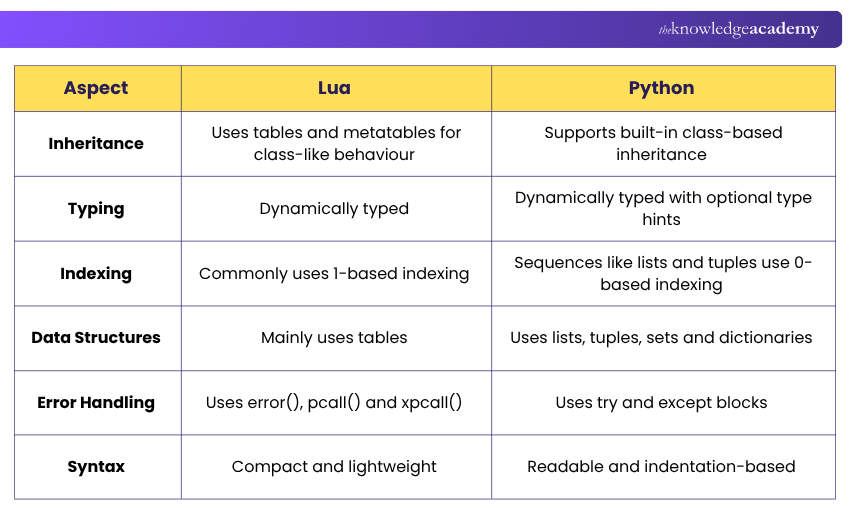
a) Inheritance: Lua does not provide built-in class-based inheritance. Developers can implement prototype-style or class-like inheritance patterns using tables and metatables. On the other hand, Python utilises class-based inheritance.
b) Typing: Lua is dynamically typed, with flexible variable types. In comparison, Python is dynamically typed, with optional type hints.
c) Error Handling: Lua commonly uses functions such as error(), pcall() and xpcall(). In contrast, Python uses structured try, except, else and finally blocks.
d) Language: Lua offers a simple syntax and minimalistic design. On the other hand, Python provides a readable and expressive syntax.
e) Indexing: Lua tables conventionally use 1-based indexing. But Python sequences such as lists and tuples use 0-based indexing.
f) File format: Lua typically uses the .lua file extension. In contrast, Python uses .py for scripts.
g) IDE: Lua has a limited selection of Integrated Development Environments (IDEs). Whereas Python offers a wide range, such as PyCharm, VS Code, and Jupyter.
h) Syntax: Lua offers lightweight syntax with minimal keywords. In contrast, Python provides clean and readable syntax with significant indentation.
i) Control flow: Lua offers simple control flow constructs. While Python provides more advanced options like list comprehensions and generators.
j) Data Structures: Lua uses tables as the primary structure for arrays, dictionaries, objects and more. Whereas Python provides dedicated structures such as lists, tuples, sets and dictionaries.
k) Multiparadigm: Lua is multi-paradigm with an emphasis on procedural and functional programming. While Python supports procedural, object-oriented, and functional programming.
l) Base: Lua is lightweight and minimalistic. In contrast, Python's richer standard library has a wide range of modules.
Strengthen your machine learning skills with the Python With Machine Learning Training – Join now!
Keep This in Mind
Lua and Python are both versatile scripting languages, but they suit different needs. Lua is valued for its lightweight design and easy embedding, while Python stands out for its extensive libraries, broad ecosystem, and wide range of applications. The right choice depends on your project requirements, performance expectations, and development environment.

Richard Harris creates technically detailed yet accessible content on full-stack development, software architecture and modern development frameworks. His knowledge of frontend and backend technologies helps developers understand how scalable, efficient and high-performing applications are designed and built.
View Detail

 If you wish to make any changes to your course, please


