


We may not have the course you’re looking for. If you enquire or give us a call on 01344203999 and speak to our training experts, we may still be able to help with your training requirements.
PRINCE2 Agile® in Large Projects: How Does It Help?
ByNilotpal SarmahLast updated on: 23 October 2026
PRINCE2 Agile® combines structured project governance with Agile flexibility to support the delivery of large, complex projects. This blog explores how it helps organisations coordinate teams, manage changing requirements, improve collaboration and maintain control throughout project delivery.

What You'll Learn
1. PRINCE2 Agile® combines structured project governance with Agile ways of working.2. It supports coordination and accountability across multiple teams involved in large projects.3. Iterative delivery helps teams respond to changing requirements and incorporate stakeholder feedback.4. Tailoring governance and delivery practices is important when managing complex projects.5. Effective application depends on project complexity, organisational readiness and team capabilities.
Imagine managing a project involving several departments, hundreds of deliverables and teams working towards different deadlines. Suddenly, customer requirements change, one team's delay affects another and senior management needs an immediate progress update. How can you maintain control without slowing everyone down?
This is where PRINCE2 Agile can help. It brings together the structured governance of PRINCE2 project management and the flexibility of Agile ways of working. For large projects, this combination can support coordination, informed decision-making and adaptable delivery. Let's explore how PRINCE2 Agile® works in complex environments and how organisations can apply it properly.
How to Apply PRINCE2 Agile® in Large Projects?
Applying PRINCE2 Agile® in large projects requires a balance between structured governance and flexible delivery practices. With multiple teams, complex dependencies and evolving requirements, organisations need a clear approach to maintaining control while adapting to change. The following steps explain how to apply PRINCE2 Agile® effectively in large-scale projects:
1) Assess Project Complexity and Agile Readiness
Before introducing PRINCE2 Agile, organisations should evaluate the project's complexity, delivery uncertainty and organisational readiness. The assessment may include reviewing:
a) Project Complexity: Identify the number of teams, stakeholders, deliverables and dependencies.
b) Requirement Stability: Consider whether requirements are likely to change during delivery.
c) Team Capabilities: Evaluate experience with agile principles, practices and collaborative working.
d) Organisational Support: Assess leadership commitment and willingness to support agile ways of working.
e) Delivery Constraints: Identify regulatory, technical, contractual or operational requirements that may affect flexibility.

2) Establish Governance and Responsibilities
Large projects need clear decision-making responsibilities and suitable management controls. PRINCE2 Agile can support this by combining defined project governance with an appropriate level of delivery team autonomy.
Organisations should establish who is responsible for major decisions, how issues are escalated and what information is required to maintain project oversight. For example, the Project Board may oversee overall project direction while delivery teams make day-to-day decisions within agreed boundaries.
3) Select and Tailor Agile Delivery Approaches
Different project activities may require different delivery methods. PRINCE2 Agile® does not require every team to use the same framework or technique. Organisations can select suitable practices based on the nature of the work, technical dependencies and delivery constraints.
For example, a software development team may use Scrum, while a support or operational team may use Kanban to manage workflow.
4) Coordinate Delivery Across Teams
Managing multiple teams requires shared objectives, clear dependencies and consistent communication. Organisations should identify how deliverables are connected and establish arrangements for coordinating work. Practical activities may include:
a) Dependency Mapping: Identify relationships between deliverables and activities.
b) Shared Delivery Objectives: Ensure teams understand the wider project priorities.
c) Cross-team Communication: Establish regular opportunities to discuss progress and blockers.
d) Issue Escalation: Define how unresolved problems are raised and addressed.
e) Integration Planning: Coordinate work that must come together to form a usable product or service.
These arrangements help teams maintain flexibility without losing sight of the overall project.
5) Monitor Performance and Adapt Plans
Large projects require regular assessment of delivery progress, emerging risks and changing priorities. PRINCE2 Agile can combine stage-level controls with shorter delivery feedback cycles to support informed decisions.
For example, if a team identifies a technical challenge during an iteration, the Project Manager can assess its impact on wider project objectives and coordinate an appropriate response. Plans should be reviewed when circumstances change, while significant decisions remain subject to the project's agreed governance arrangements.
Blend the best of PRINCE2 with the speed of Agile for stellar project delivery with the PRINCE2 Agile® Foundation and Practitioner (Version 2) Course - Sign up!
How Does PRINCE2 Agile® Help Manage Large Projects?
PRINCE2 Agile® supports large projects by combining consistent management practices with adaptable delivery methods. Here are the key ways it can help organisations manage complexity:
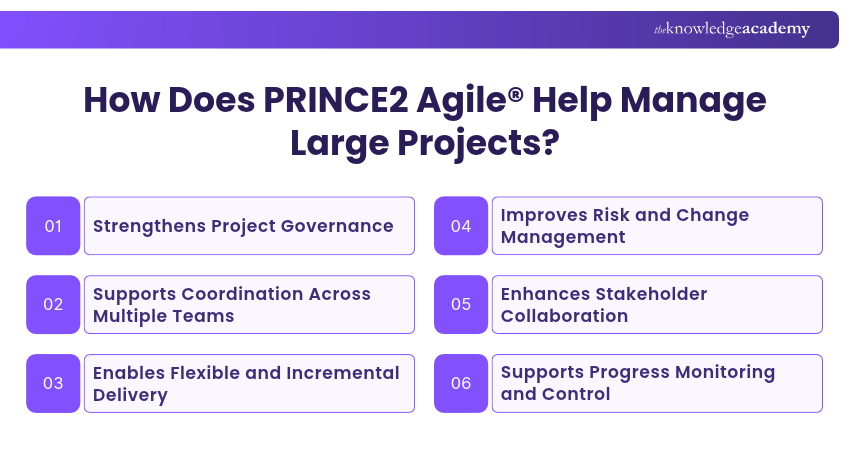
1) Strengthens Project Governance
Large projects involve important decisions about funding, scope, risks, resources and business objectives. Without clear governance, responsibilities may become unclear and decision-making can become inconsistent. PRINCE2 Agile supports defined responsibilities, continued business justification and appropriate project controls.
This helps management maintain oversight while delivery teams use suitable agile practices. For example, senior management may establish overall project priorities and approve major decisions, while agile teams manage the detailed delivery of agreed products.
2) Supports Coordination Across Multiple Teams
Large projects often involve teams working on different but related deliverables. Poor coordination can create delays, duplication or conflicting priorities. PRINCE2 Agile® supports the alignment of delivery activities with shared project objectives. Clear responsibilities, dependency management and communication arrangements can help teams understand how their work affects the wider project.
For example, a software development team may need to complete certain features before another team can begin integration testing. Identifying this dependency early helps both teams coordinate their activities.
3) Enables Flexible and Incremental Delivery
Large projects may experience changing requirements, especially when new information becomes available during delivery. Agile ways of working support iterative and incremental delivery, allowing teams to develop, review and improve products through feedback.
For example, an organisation developing a customer portal may develop and test selected features incrementally rather than waiting until every planned feature is complete. These increments can be reviewed by stakeholders and released when they meet the project's agreed requirements.
This can support:
a) Earlier Feedback: Stakeholders can review completed increments and suggest improvements.
b) Greater Adaptability: Teams can respond to emerging information within agreed project boundaries.
c) Progressive Delivery: Products can be developed and reviewed in manageable increments.
d) Better Prioritisation: Teams can focus on work that delivers the greatest value within project constraints.
4) Improves Risk and Change Management
Large projects face risks involving technology, resources, suppliers, stakeholders and dependencies. Changes in one area may also affect other teams or deliverables. PRINCE2 Agile supports structured risk and change management while allowing delivery teams to respond to emerging requirements.
For example, if a supplier cannot deliver a required component on time, the Project Manager may assess its wider impact while delivery teams consider alternative sequencing or implementation options. This approach helps maintain oversight of significant risks without treating every adjustment as a major project-level change.
Trainer's Insight
Avoid unnecessary complexity. Large projects already involve several layers of coordination. Adding excessive documentation, approval stages or inconsistent reporting practices can increase complexity.
5) Enhances Stakeholder Collaboration
Large projects may involve senior management, customers, suppliers, employees and delivery teams. These stakeholders often have different expectations and information needs. PRINCE2 Agile® encourages collaboration and communication while maintaining appropriate governance responsibilities. Agile practices, such as demonstrations, reviews and regular feedback discussions, can help stakeholders understand delivery progress.
For example, representatives from different departments may review a working product increment and provide feedback before further development begins. This helps teams identify concerns earlier and supports alignment between evolving stakeholder expectations and project objectives.
6) Supports Progress Monitoring and Control
Monitoring large projects requires visibility into progress, risks, dependencies and the continued justification for the investment. PRINCE2 Agile supports managing projects through stages and maintaining appropriate oversight of delivery performance. Teams may also use agile practices such as visual work boards, progress reviews and delivery metrics to understand work status.
For example, a Project Manager can review stage-level progress while individual teams monitor their delivery activities through suitable agile tools. The objective is to provide useful information for decision-making without creating unnecessary reporting demands.
Trainer Insight
Large projects need clear decision-making structures, but excessive control can restrict team responsiveness. PRINCE2 Agile® allows organisations to retain appropriate governance while giving delivery teams flexibility in how they complete their work.
Example of PRINCE2 Agile® in a Large Project
Consider a multinational retail company implementing an Enterprise Resource Planning (ERP) system across 50 stores. The project involves multiple teams managing inventory, finance, procurement and system integration. PRINCE2 Agile helps coordinate these activities while maintaining project oversight and adapting to changing requirements.
Here is how PRINCE2 Agile® supports the project:
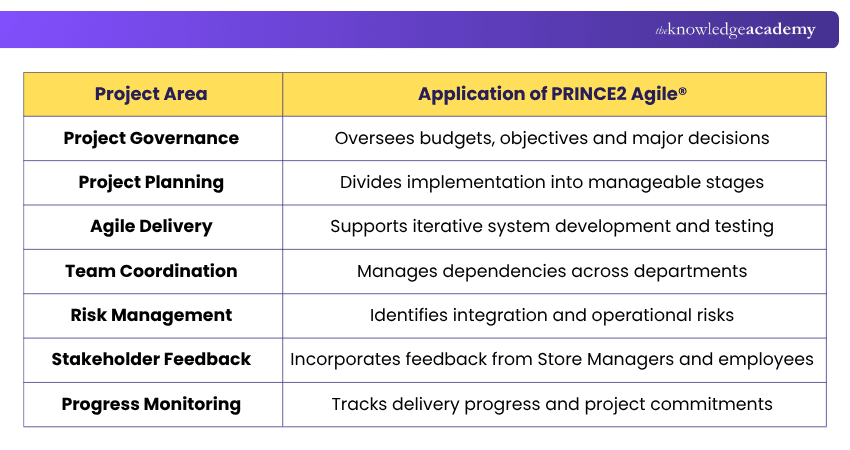
For example, during pilot testing, store managers may identify inventory features that need improvement. Teams can prioritise and test these changes before wider deployment, escalating any significant impacts on budgets or deadlines for approval.
This demonstrates how PRINCE2 Agile® helps large organisations balance structured governance with flexible delivery while coordinating multiple teams.
Strengthen your ability to lead Agile teams and drive project success with PRINCE2 Agile® Practitioner (Version 2) Training – Join now!

Nilotpal Sarmah is a Senior Content Writer with 11+ years of overall experience spanning engineering, operations and content development. His technical knowledge and extensive writing experience enable him to simplify specialised topics across IT and Tech, Business Skills, Project Management, Health and Safety, and ISO and Compliance.
View Detail

 If you wish to make any changes to your course, please


