


 Top Rated Course

We may not have the course you’re looking for. If you enquire or give us a call on 01344203999 and speak to our training experts, we may still be able to help with your training requirements.
ITIL Salary: A Detailed Insight for ITIL Professionals
John Davies 16 July 2026Are you curious about your earning prospects in the field of IT Service Management? Discover how ITIL Certifications can enhance your earning potential. Explore this comprehensive blog on ITIL Salary, where you will learn about ITIL Certification jobs, including their average salary and primary responsibilities.

Training Outcomes Within Your Budget!
We ensure quality, budget-alignment, and timely delivery by our expert instructors.
Table of Contents

As businesses become more dependent on digital services, the demand for IT professionals continues to rise across industries. Companies today need reliable IT systems, seamless service delivery and strong technical support to maintain daily operations.
Among the certifications available in the IT industry, ITIL has become one of the most recognised frameworks for IT Service Management. It helps professionals develop the knowledge and skills needed to improve service efficiency, minimise operational issues and support continuous business growth. In this blog, we will explore ITIL Salary to understand their significance in the IT industry. Let's dive in!
Table of Contents
1) What is ITIL?
2) ITIL Jobs and the Average Salary
3) Levels of ITIL Certification
4) Conclusion
What is ITIL?
Information Technology Infrastructure Library (ITIL) is an internationally accepted framework developed in the 1980s by the British government's Central Computer and Telecommunications Agency (CCTA). It is a set of best practices for IT Service Management It helps organisations provide IT services in an efficient and customer-friendly way.
By following ITIL guidelines, businesses can improve their IT service quality, reduce costs, and ensure better customer satisfaction. ITIL focuses on aligning IT services with the needs of the business and its customers. It covers everything from planning and delivery to support and continuous improvement. This makes it a valuable framework for anyone involved in IT Service Management.
ITIL Jobs and the Average Salary
ITIL jobs provide various opportunities in different fields, each with attractive salaries. Knowing the average salary for ITIL roles can help you understand the earning potential and plan your ITIL career effectively.
Different Job Roles
Here are the various job roles you can pursue after earning ITIL Certifications:
1) Help Desk Analyst: A Help Desk Analyst's primary role is responding to user inquiries and IT product and service issues. They communicate with users through various channels such as email, phone, chat, or ticketing systems and resolve their problems.
2) IT Analyst: IT Analysts ensure that the technology solutions are effectively and efficiently implemented and align with the business objectives. They play a vital role in bridging the gap between the technology and business departments of an organisation. Their key responsibilities include:
a) System analysis
b) Solution design
c) Implementation support
d) Testing and validation
e) Documentation
f) Training and support
3) IT Manager: An IT Manager oversees and manages an organisation’s technology infrastructure. Their key responsibilities include:
a) Strategic planning
b) System management
c) Team leadership
d) Security and compliance
e) Budget management
f) Problem-solving
4) Network Administrator: A Network Administrator plays the role of managing and maintaining an organisation’s computer networks. Their key responsibilities include the following:
a) Network design and implementation
b) Maintenance and troubleshooting
c) Security management
d) User support and training
e) Monitoring and performance optimisation
5) Network Analyst: A Network Analyst plays a vital role in optimising an organisation’s computer networks. Their key responsibilities are:
a) Installation and configuration
b) Troubleshooting
c) Maintenance and upgrades
d) Security
e) Recommendations
6) Network Specialist: A Network Specialist handles responsibilities such as:
a) Analysing, troubleshooting, and evaluating computer network problems
b) Managing an organisation’s computer network infrastructure
c) Designing, maintaining, and implementing software and hardware solutions for computer networks
d) Ensuring that network hardware and software operate correctly and efficiently.
e) Offering technical support to users
7) Network Manager: A Network Manager handles various responsibilities including:
a) Ensuring the network meets current needs and can be scaled for future requirements
b) Overseeing the design, implementation, and maintenance of networking systems
c) Monitoring efficient network connections
d) Managing installation, configuration, and maintenance of computer networks
e) Analysing system designs and overseeing installation processes and programmes
8) Service Delivery Manager: An IT Service Delivery Manager ensures that IT services are delivered efficiently and continue to meet the needs of the organisation and its clients. Here are some key responsibilities:
a) Service Management
b) Team leadership
c) Issue resolution
d) Performance monitoring
e) Client liaison
f) Budget management
g) Continuous improvement
9) IT Project Manager: An IT Project Manager is crucial in ensuring the successful completion of technology-related projects within an organisation. Here are some of their key responsibilities:
a) Planning and defining the scope
b) Resource management
c) Scheduling
d) Risk management
e) Communication
f) Quality assurance
g) Monitoring and reporting
h) Problem-solving
10) IT Director: IT Directors manage technology resources and employees to ensure that operations run smoothly. They aim to improve IT processes and ensure that all parts of a company's IT infrastructure function effectively. This includes managing:
a) Networks
b) Servers
c) Storage
d) Security
e) Applications
Upgrade your ability to create seamless digital experiences with ITIL® 5 Experience Certification Training – Sign up soon!
Average Annual Salary
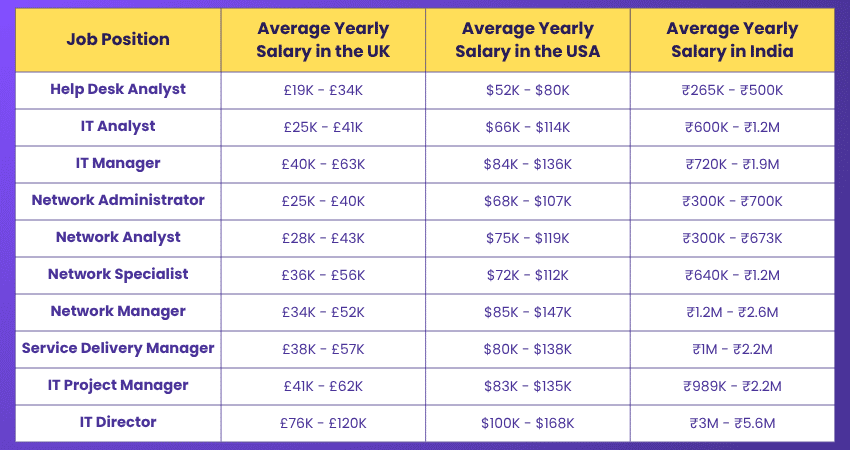
The ITIL Salary is impacted by various factors such as location, industry, certifications and experience. Below is a detailed breakdown of the top ten ITIL Job positions and their salaries based on these roles across three major locations such as the UK, USA and India
Levels of ITIL Certification
The most recent version of ITIL Certification is the ITIL® 5. now, let’s check the levels of this certification:
ITIL® 5 Foundation
ITIL® 5 Foundation is the entry-level certification that introduces professionals to the core concepts, principles, terminology and practices of IT service management. It helps learners understand how digital products and services create value within modern organisations.
ITIL® 5 Practice Manager
The ITIL® 5 Practice Manager is a designation which focuses on practical IT service management skills and operational processes. It combines several practice-based modules covering areas such as incident management, service desk operations, change enablement, service configuration and supplier management.
ITIL® 5 Managing Professional (MP)
ITIL® 5 Managing Professional is designed for professionals who manage digital products and IT-enabled services throughout their lifecycle. This certification focuses on service delivery, product management, user experience and continual service improvement.
ITIL® 5 Strategic Leader (SL)
The ITIL® 5 Strategic Leader certification is aimed at senior professionals involved in leadership, governance and business strategy. It focuses on aligning IT services with organisational goals, driving digital transformation and creating long-term business value.
ITIL® 5 Transformation
ITIL® 5 Transformation is a specialised module that focuses on organisational change, digital evolution and implementing modern ways of working. It acts as a connecting element between operational management and strategic leadership within the ITIL framework.
ITIL® 5 AI Governance
ITIL® 5 AI Governance is an extension module introduced to address the increasing role of Artificial Intelligence (AI) in IT services. This certification is intended for professionals managing AI-enabled services and ensuring governance standards are maintained while implementing advanced digital technologies.
ITIL® 5 Master
ITIL® 5 Master is the highest certification level within the ITIL framework. It is achieved after completing the Practice Manager, Managing Professional and Strategic Leader designations. This level demonstrates a professional’s ability to apply ITIL principles across complex business environments and solve real-world IT service management challenges effectively.
Conclusion
ITIL is a valuable framework for anyone involved in IT Service Management, offering a structured approach to improving IT services. With different levels of certification, including ITIL Foundation, Practitioner, Leader, and Specialist, there are many pathways to enhance your skills and career. As demand for ITIL expertise grows, understanding the ITIL Salary landscape can guide career choices and growth in the IT industry.
Develop globally recognised IT service management skills with ITIL® Certification Courses – Join now!
Frequently Asked Questions
Which Big Companies Use ITIL?

The big companies that use ITIL include Oracle, Deloitte, Marriott International, Intel, Walmart and IBM.
What is the Highest ITIL Certification?
The highest ITIL certification is ITIL® 5 Master. It represents advanced expertise in IT service management and is achieved after completing the Practice Manager, Managing Professional and Strategic Leader designations. It demonstrates the ability to apply ITIL principles effectively across complex organisational and digital environments.

John Davies


Cyber Security Governance & Assurance Specialist
John Davies is a cybersecurity expert specialising in governance, risk management, and compliance. With over 15 years in the field, he has led enterprise-wide security programmes across finance, healthcare and public sector organisations. His content provides practical guidance on building secure environments, managing risk and aligning with regulatory frameworks.


 If you wish to make any changes to your course, please


