




We may not have the course you’re looking for. If you enquire or give us a call on 01344203999 and speak to our training experts, we may still be able to help with your training requirements.
ITIL® Version 5 Certification Pathway: Levels & Roadmap
ByVishnu SankarLast updated on: 03 October 2026
The ITIL® Version 5 Certification Pathway covers its levels, eligibility requirements and progression routes. It also explains how the framework develops capabilities in digital product and service management, transformation, strategy, and responsible AI governance.
The Gist of the Blog
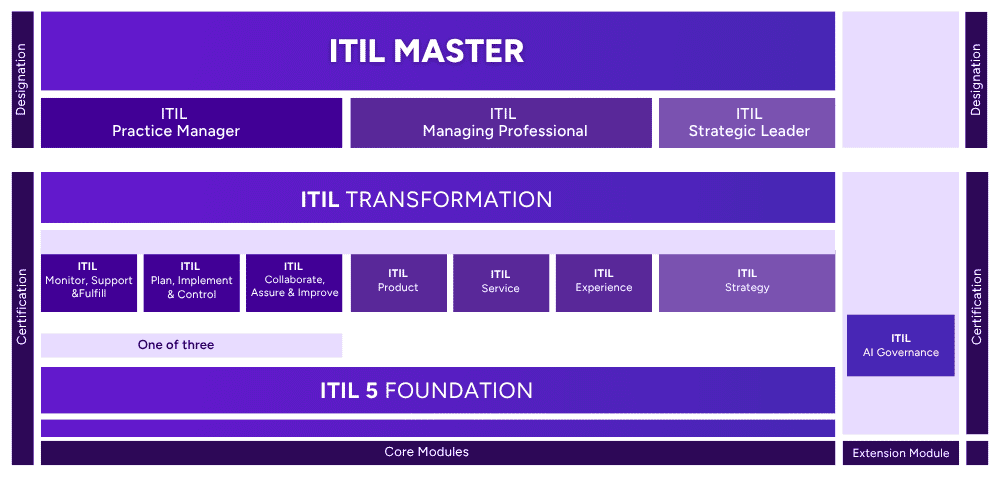
1. ITIL® Foundation is the starting certification.2. Advanced modules form three professional designations.3. Transformation contributes to all three designations.4. Achieving PM, MP and SL leads to Master.5. Transition routes depend on existing ITIL credentials.
Are you wondering how IT Service Management is evolving in a world driven by digital products, automation, and AI? Struggling to understand what has changed and how it affects your career growth? The ITIL® Version 5 Certification Pathway is designed to answer these questions by redefining how organisations create value through modern digital services, experiences, and outcomes.
But which level should you start with, and how do the new pathways connect? More importantly, how does the ITIL® Version 5 Certification Pathway help professionals build capabilities for modern digital product and service management roles? This blog breaks down the ITIL® Version 5 Certification levels, roadmap, and progression clearly, helping you choose the right path with confidence. Let’s get started!
What is ITIL®?
ITIL® is a global best-practice framework for digital product and service management. It provides principles, practices and guidance that help organisations create, deliver and improve value through digitally enabled products and services.
The origin of ITIL dates back to the United Kingdom and the British government employed it to harmonise IT operations. On the other hand, ITIL developed strong international recognition and acceptance over time.
ITIL's main aim is to coordinate IT services with the expectations of the business. ITIL helps organisations manage digital products and services across their lifecycle while continually improving value, outcomes and stakeholder experience.
What is ITIL® Version 5?
ITIL® Version 5 is the latest evolution of the ITIL framework, designed to guide organisations in managing modern, digitally enabled products and services. It expands beyond traditional IT Service Management to provide a unified framework covering the full lifecycle of digital products and services, from strategy and design to delivery, optimisation, and continual improvement.
ITIL® Version 5 builds on the established foundations of ITIL® 4 while strengthening alignment with digital transformation, AI-driven automation, data-led decision-making, and adaptive ways of working. Rather than focusing solely on processes, it emphasises outcomes, collaboration, and value co-creation between service providers and consumers.
Why Choose the ITIL® Version 5 Certification?
Choosing ITIL® Version 5 helps professionals and organisations stay aligned with current and emerging Service Management practices. The framework reflects how services are designed, delivered, and improved in complex digital environments.
Key reasons to choose ITIL® Version 5 include:
1) Strong focus on business value and service outcomes
2) Better alignment with Agile, Lean, and DevOps practices
3) Practical guidance for digital and IT-enabled services
4) Improved support for continual improvement and governance
5) Globally recognised framework applicable across industries
ITIL® Version 5 Certification Pathway
The ITIL® Version 5 Certification Pathway supports progressive learning, helping professionals grow from foundational skills to advanced strategic and transformational capabilities.
1) ITIL® 5 Foundation
ITIL® 5 Foundation is the entry point to the Version 5 framework. It introduces the core concepts, terminology, and principles required to understand how modern digital products and services create value.
For professionals who already hold an eligible ITIL® 4 certification, the optional ITIL® Foundation Bridge (Version 5) provides a focused route to ITIL® Foundation (Version 5) by covering the key updates introduced in the new version.
Fast track your transition to ITIL® 5 and stay ahead in a rapidly evolving digital world by signing up for ITIL® Version 5 Foundation Bridge Training now.
2) ITIL® 5 Practice Manager
Under ITIL® Version 5, Practice Manager is a designation rather than a standalone module set. It is achieved by completing:
a) Any one of the existing bundled ITIL® 4 Practice Manager modules (which remain valid)
b) The mandatory ITIL® Transformation (Version 5) module
c) ITIL® Transformation (Version 5)
The bundled ITIL® 4 Practice Manager modules are structured as follows:
1) ITIL® Monitor, Support, and Fulfil (MSF):
Covers Service Desk, Incident Management, Problem Management, Service Request Management, and Monitoring and Event Management practices.
2) ITIL® Plan, Implement, and Control (PIC):
Covers Change Enablement, Deployment Management, Release Management, Service Configuration Management, and IT Asset Management practices.
3) ITIL® Collaborate, Assure, and Improve (CAI):
Covers Relationship Management, Supplier Management, Service Level Management, Continual Improvement, and Information Security Management practices.
ITIL® Transformation (Version 5) is a shared core module and only needs to be completed once. It also counts towards the Managing Professional and Strategic Leader designations.
3) ITIL® 5 Managing Professional (MP)
The Managing Professional (MP) designation is intended for practitioners responsible for the end-to-end management of digital products and services. It focuses on applying ITIL principles across the service lifecycle, from creation and delivery to continual improvement.
The core Managing Professional modules are:
1) ITIL® Product: Focuses on managing digital products across their full lifecycle, ensuring product decisions align with customer needs, value streams, and business outcomes.
2) ITIL® Service: Covers the effective design, delivery, and operation of services, helping organisations maintain performance, reliability, and continual improvement.
3) ITIL® Experience: Emphasises designing and improving user, customer, and stakeholder experiences by managing service journeys, feedback, and satisfaction metrics.
4) ITIL® Transformation: Focuses on leading organisational change, evolving operating models, and embedding new ways of working to support sustainable digital transformation.
Together, ITIL® Product, Service, Experience, and Transformation, alongside Foundation, form the pathway towards the ITIL® Managing Professional (Version 5) designation.
Quick Check
Which module supports all three ITIL® (Version 5) designations?
A) ProductB) TransformationC) ExperienceAnswer: B) Transformation
4) ITIL® 5 Strategic Leader (SL)
The Strategic Leader (SL) designation focuses on how IT and digital services support organisational strategy, governance, and long-term value creation. It is aimed at senior professionals involved in leadership, policy, and strategic decision-making.
The Strategic Leader pathway includes:
1) ITIL® Strategy: Focuses on aligning IT and digital services with organisational goals, covering governance, investment decisions, and long-term value creation.
2) ITIL® Transformation: Addresses leading organisational change by evolving operating models, embedding new ways of working, and enabling sustainable digital transformation.
5) ITIL® 5 Transformation
ITIL® 5 Transformation is a shared module across multiple designations and plays a central role in the Version 5 framework. It focuses on organisational change, digital evolution, and embedding new ways of working.
1) Practice Manager
2) Managing Professional
3) Strategic Leader
It acts as a unifying element that connects operational execution with strategic direction.
Remember: ITIL® Transformation (Version 5) is a shared core module across Practice Manager, Managing Professional, and Strategic Leader. Once completed, it can count towards all three designations.
6) ITIL® 5 AI Governance
ITIL® AI Governance (Version 5) is an extension module focused on the responsible adoption and governance of Artificial Intelligence. It develops practical capability in areas such as oversight, accountability, transparency, risk management and ethical safeguards across AI-enabled products, services and operations.
The module is a specialist extension within the ITIL® (Version 5) qualification scheme and does not require ITIL® Foundation as a prerequisite.
7) ITIL® 5 Master
ITIL® 5 Master represents the highest level of achievement within the framework. Rather than being a single exam, Master status is achieved by completing all three designations:
1) Practice Manager (PM)
2) Managing Professional (MP)
3) Strategic Leader (SL)
It demonstrates the ability to apply ITIL principles holistically across complex organisational environments and real-world scenarios.
ITIL® Version 5 Eligibility Criteria
Eligibility for ITIL® Version 5 Certifications depends on the level being pursued.
1) There are no prerequisites for ITIL® Foundation (Version 5), making it accessible to learners at all career stages.
2) Advanced ITIL® 5 modules typically require ITIL® 4 or ITIL® Foundation (Version 5), or valid ITIL® 4 designations for transition modules such as Managing Professional Transition.
3) Transition routes are available for specific ITIL® v3 and ITIL® 4 designation holders. ITIL® v3 Foundation alone is not accepted as a prerequisite for higher-level ITIL® (Version 5) certifications.
ITIL® Version 5 vs ITIL® 4
Now, we’ll discuss the difference between ITIL® Version 5 and ITIL® 4:
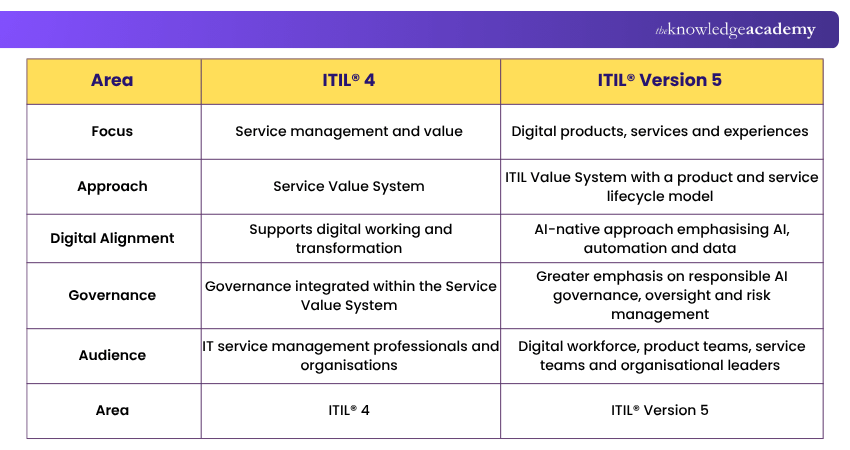
ITIL® (Version 5) builds on the value-focused approach established in ITIL® 4 while integrating digital product and service management more explicitly across the full lifecycle. It also strengthens guidance around experience, transformation, AI-enabled environments and measurable outcomes.
In contrast, ITIL® Version 5 broadens this scope to include digital products, user experience, and clearly defined business outcomes. It broadens the scope from service management towards integrated digital product and service management, with stronger lifecycle and outcome focus.
Version 5 also places stronger emphasis on AI, automation, and data to support faster decisions and innovation. In addition, governance is more robust, with clearer guidance on risk and oversight. As a result, ITIL® Version 5 is relevant to IT professionals, digital teams, product owners, and organisational leaders.
Career Opportunities After ITIL® Version 5
ITIL® (Version 5) develops capabilities across digital product and service management, experience, transformation, strategy and AI governance. Depending on the certifications and designation achieved, it can support professionals working in or aspiring to roles such as:
1) Product Manager: Applies product lifecycle, value and outcome-focused practices to guide the development and improvement of digital products.
2) Product Owner: Supports prioritisation, stakeholder needs and value delivery across digital products and services.
3) Portfolio Manager: Helps align products, services and investments with organisational priorities and strategic outcomes.
4) Chief Digital Officer: Provides strategic direction for digital initiatives, transformation and technology-enabled value creation.
5) IT Operations Manager: Oversees IT operations while supporting service performance, resilience and continual improvement.
6) Service Delivery Manager: Manages service delivery, customer outcomes and operational performance across the service lifecycle.
7) Customer Experience (CX) Lead: Uses experience insights and feedback to improve customer journeys and service outcomes.
8) Digital Experience Manager: Focuses on improving how users and customers interact with digital products and services.
9) Transformation Lead: Supports organisational change, new operating models and the adoption of improved ways of working.
10) AI Governance Lead: Supports responsible AI adoption through governance, oversight, accountability and risk management.
Master strategic decision making through the ITIL® Strategy Version 5 Certification Training – Join today!

Vishnu Sankar is a Senior Content Writer with 5+ years of experience across content development, software development, web development and system administration. His technical background and professional training support his expertise in IT and Tech, while his extensive research and writing experience covers Project Management and Health and Safety.
View Detail

 If you wish to make any changes to your course, please


