


 Top Rated Course

We may not have the course you’re looking for. If you enquire or give us a call on +44 1344 203 999 and speak to our training experts, we may still be able to help with your training requirements.
What is Inferential Statistics? Ultimate Guide to Data Sampling
William Brown 16 July 2026Inferential Statistics analyses sample data to draw conclusions, test hypotheses, and predict population outcomes for informed decision-making. It measures uncertainty with confidence intervals and significance levels for evidence-based choices. Organisations and researchers use it to plan studies and guide policy today.

Training Outcomes Within Your Budget!
We ensure quality, budget-alignment, and timely delivery by our expert instructors.
Table of Contents
Data drives decisions but analysing every detail isn’t always possible. Inferential Statistics lets us study a sample to reveal trends and insights about the bigger picture.
It helps predict outcomes, test ideas, and make smarter choices quickly. In the following sections, we’ll explore its types, errors, and real-world applications of inferential statistics to see how it guides better decisions.
Table of Contents
1) What is Inferential Statistics?
2) The Purpose of Inferential Statistics
3) Different Types of Inferential Statistics
4) Inferential vs Descriptive Statistics
5) Errors in Inferential Statistics
6) Inferential Statistics Example
7) Benefits of Using Inferential Statistics
8) Conclusion
What is Inferential Statistics?
Inferential Statistics is a branch of statistics that helps us draw conclusions about a whole population using data from a smaller sample. Unlike descriptive statistics, it goes beyond summarising data to make predictions and test hypotheses.
This approach is useful when analysing an entire population isn’t feasible. By studying a representative sample, we can estimate population values, measure uncertainty, and make informed decisions backed by data.

The Purpose of Inferential Statistics
Inferential Statistics helps researchers turn limited data into meaningful insights. Beyond describing data, it enables reliable conclusions about a larger population. Its main purposes include:
a) Generalise findings from a sample to a larger population
b) Test hypotheses to validate assumptions or claims
c) Estimate population parameters (like means or proportions)
d) Measure uncertainty using confidence intervals and significance tests
e) Support data-driven decision-making in research and business
Different Types of Inferential Statistics
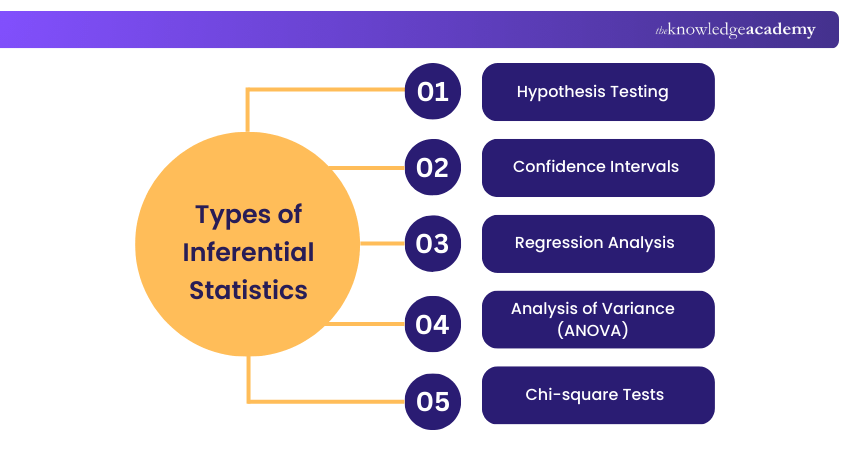
Inferential Statistics consists of several techniques for drawing conclusions, including confidence testing, regression analysis and hypothesis testing. Let's explore them in detail.
1) Hypothesis Testing
Hypothesis testing is a fundamental technique for testing a hypothesis about a population parameter (e.g., a mean) using sample data. This process involves these two steps:
a) Setting up alternative or null hypotheses.
b) Conducting a statistical test to determine whether there's reasonable evidence for rejecting the null hypothesis in favour of the alternative hypothesis.
Example: A researcher might hypothesise that the average income of people in a certain city is more than £40,000 per year. Then, a sample of incomes will be collected and a hypothesis test will be conducted. This will help the researcher determine whether the data provides enough evidence to support or reject this hypothesis.
2) Confidence Intervals
Confidence Intervals provide a broad range of values within which a population parameter lies and a level of confidence associated with the range. They are used to estimate a population parameter's true value based on sample data. The confidence interval's width depends on the sample size and the desired confidence level.
Example: A poller may use a confidence interval to estimate the voter proportion who supports a particular candidate. It would provide a range of values within which the proportion of supporters is likely to lie, along with a confidence level such as 85%.
Want to gain expertise in forecasting future business outcomes? Sign up for our Introduction to Business Analytics Training now!
3) Regression Analysis
Regression Analysis evaluates the relationship between one (or more) independent variables and a dependent variable. It can:
a) Predict the dependent variable's value based on the values of the independent variables.
b) Allow for testing hypotheses regarding the strength of relationships between variables.
Example: A researcher can use regression analysis to examine the relationship between exam scores and hours of study. They can then use the regression model to make predictions about exam scores based on the hours studied.
4) Analysis of Variance (ANOVA)
ANOVA is a technique for comparing means across two or more groups. It analyses whether there are any statistically significant differences among the groups' means. To determine if observed differences were caused by chance or they represent true differences between groups, ANOVA calculates:
a) Between-group variance (variation between the group means).
b) Within-group variance (variation within each group).
Example: Researchers can use ANOVA to compare the effectiveness of various teaching methods on student performance. They could collect student performance data in each group and use ANOVA to determine whether there are any significant differences in performances between the groups.
5) Chi-square Tests
Chi-square Tests help determine whether there's a significant association between two categorical variables. They compare the data's observed frequency distribution to the expected frequency distribution under null hypothesis of independence.
Example: A researcher can utilise a Chi-square Test to examine whether there is a relationship between voting preference and gender. They would collect data from a sample of voters and determine whether gender and voting preference are independent.
Master the craft of designing Statistical Process Control (SPC) systems in our comprehensive Statistical Process Control Course - Sign up now!
Inferential vs Descriptive Statistics
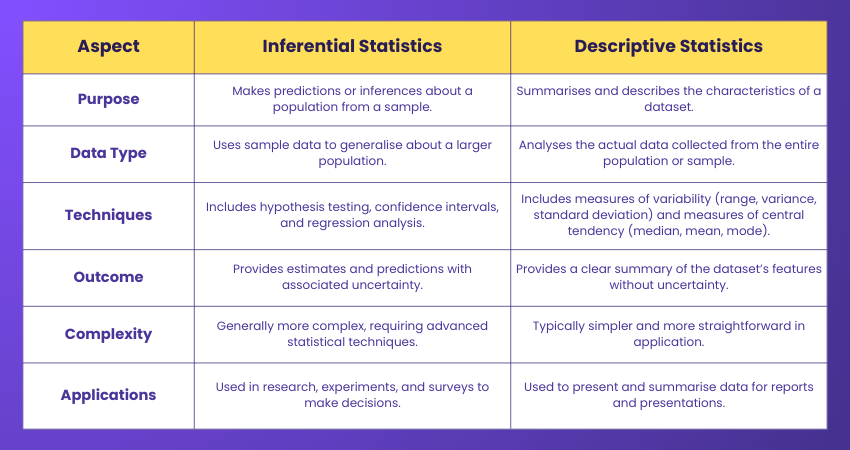
The following table summarises the key distinctions between Inferential Statistics and descriptive statistics:
Errors in Inferential Statistics
Inferential Statistics relies on hypothesis testing, but incorrect conclusions can occur due to sampling uncertainty and decision thresholds.
a) Type I Error: Rejecting a true null hypothesis (a false positive), meaning you conclude an effect exists when it actually does not.
b) Type II Error: Failing to reject a false null hypothesis (a false negative), meaning a real effect or relationship is missed.
c) Minimising Errors: Using suitable sample sizes and carefully chosen significance levels helps reduce these testing mistakes.
Inferential Statistics Example
A delivery company wants to know whether a new routing system actually reduces delivery time. Instead of testing every order ever made, the company studies a sample of 100 orders and compares results with the current system. Inferential statistics allows conclusions about the whole operation using only this smaller dataset.
Experiment Setup
a)100 total deliveries are recorded
b) 50 use the new system and 50 use the old system
c) Delivery times are measured and compared
Step 1: Create Hypotheses
a) Null hypothesis (H₀): The new system does not reduce delivery time
b) Alternative hypothesis (H₁): The new system reduces delivery time
Step 2: Set Significance Level
a) Significance level chosen: 0.05 (5% risk of error)
b) Type I error: Assuming improvement when none exists
c) Type II error: Missing a real improvement
Step 3: Analyse the Data
a) Calculate the average delivery time for both groups
b) Check if the difference between averages is meaningful
Step 4: Perform a Statistical Test
a) Conduct a t-test or z-test to compare the two means
b) If the p-value is less than 0.05, reject the null hypothesis
Step 5: Draw a Conclusion
If the results show deliveries are, for example, 2–5 minutes faster, the company can confidently conclude the new routing system improves performance across the entire population of deliveries, even though only a sample was studied.
Benefits of Using Inferential Statistics
Inferential Statistics help draw conclusions about a population from a sample, enabling data-driven predictions and decisions. Here are the key benefits:
a) Generalisation: Allows conclusions about a large population based on a smaller sample, saving time and resources.
b) Hypothesis Testing: Enables researchers to test theories and determine statistical significance in studies.
c) Predictive Insights: Facilitates forecasting and decision-making by analysing trends and relationships within data.
d) Error Reduction: Uses probability models to quantify uncertainty and minimise errors in conclusions.
e) Efficient Data Analysis: Extracts meaningful insights from limited data, making research and business decisions more effective.
Conclusion
Inferential Statistics transforms raw data into meaningful insights by allowing us to draw conclusions from limited information. It helps organisations, researchers, and professionals make confident predictions, and support better decisions. By understanding its concepts and methods, you can interpret data more effectively and apply it to problems with clarity and confidence.
Master the essential techniques for optimising business decision-making in our Mathematical Optimisation for Business Problems Course - Sign up now!
Frequently Asked Questions
What are the Key Concepts in Inferential Statistics?

Key concepts include sampling, population parameters, and estimation methods such as confidence intervals. It also involves hypothesis testing, significance levels, and p-values to determine whether results are meaningful or due to chance.
What is the Main Purpose of Inferential Statistics?
The key purposes of Inferential Statistics include:
a) Generalisation of findings from a sample
b) Hypothesis Testing
c) Estimation on population parameters
d) Predictions based on current data trends

William Brown


Senior Business Analyst and Strategic Advisor
William Brown is a senior business analyst with over 15 years of experience driving process improvement and strategic transformation in complex business environments. He specialises in analysing operations, gathering requirements and delivering insights that support effective decision making. William’s practical approach helps bridge the gap between business goals and technical solutions.
View Detail

 If you wish to make any changes to your course, please


