




We may not have the course you’re looking for. If you enquire or give us a call on +918037244591 and speak to our training experts, we may still be able to help with your training requirements.
What is the Importance of Report Writing? A Complete Overview
ByGaurav KalitaLast updated on: 03 October 2026
Reports are the backbone of effective communication in both academic and professional realms. Discover the significance of report writing and learn how mastering this skill can enhance your ability to convey information, influence decisions, and propel your career to new heights.

What This Blog Covers
1. How report writing supports evaluation, research and systematic investigation2. How structured reports make important information easier to organise and access3. How reports support evidence-based decision-making and objective communication4. How report writing helps with planning, performance monitoring and quality control5. How strong reporting skills support professional development and complex problem-solving
In a world fuelled by information, articulating ideas, findings, and insights is paramount. One medium that stands out as a cornerstone of effective communication is report writing. But where does the importance of report writing lie in the dynamic world?
To get the answer to this question, read this blog. Learn about the importance of report writing and gain valuable insights into its pivotal role in your personal and professional lives.
Importance of Report Writing
Report writing is the process of organising and presenting information, findings or analysis in a clear and structured format. It is a valuable skill that offers numerous advantages across different situations.
It helps communicate relevant information to a specific audience for a defined purpose. However, its importance extends beyond simply documenting information. The following are the key reasons why it matters:
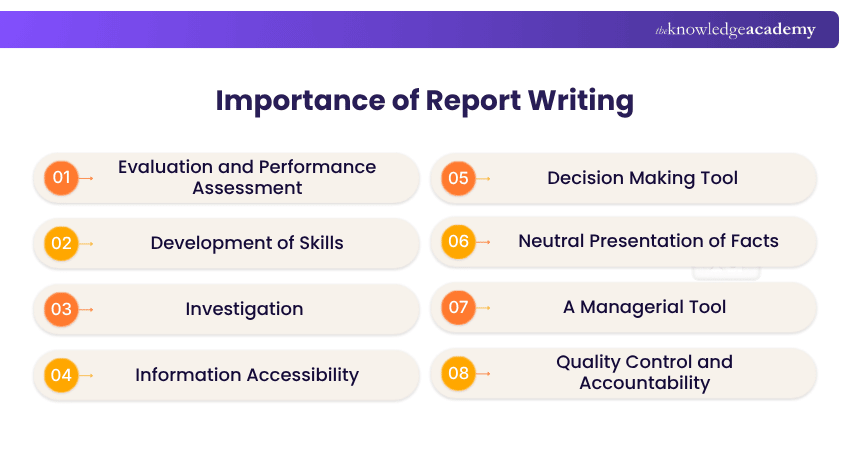
1) Evaluation and Performance Assessment
The importance of report writing can be reflected during the evaluation process. This is because report writing can help you evaluate your own or others’ performance, progress, or outcomes. For example, if you are a student, you can write a report to assess your learning outcomes, achievements, or challenges in a course or a project. As a teacher, you can write a report to evaluate your students’ learning outcomes, strengths, or weaknesses in a course or an assignment.
If you are a researcher, you can write a report to evaluate your research methods, results, or implications in a study or an experiment. Report writing can help you identify the gaps, strengths, or areas for improvement in your own or others’ work, following a clear report writing format.

2) Development of Skills
Report writing can help you develop your skills in various domains and disciplines. For example, if you are a student, you can write a report to improve your writing, research, analysis, or presentation skills. If you are a teacher, you can write a report to enhance your teaching, assessment, feedback, or curriculum design skills.
If you are a researcher, you can write a report to advance your knowledge, research methodology, innovation, or contribution skills. Report writing can help you acquire new knowledge, apply existing knowledge, or create something new in your field of interest.
3) Investigation
The importance of report writing also lies in investigating a problem or a topic in-depth and in detail. For example, if you are a student, you can write a report to explore a question or an issue that interests you or relates to your course or project.
At the same time, if you are a teacher, you can write a report to investigate a pedagogical or educational problem or phenomenon that affects your teaching or learning environment. On the other hand, if you are a researcher, you can write a report to investigate a scientific or social problem or phenomenon that has significance or relevance for your discipline or society. Report writing can help you collect, analyse, and present data in an organised and systematic way.
4) Information Accessibility
Report writing can help you locate information quickly and easily. For example, students can write a report to summarise the main points and findings of their course or project for future reference or revision. If you are a teacher, you can write a report to document the key aspects and outcomes of your course or assignment for future use.
At the same time, researchers can write a report to record the essential details and implications of a study or experiment for future dissemination or publication. Features such as headings, contents pages, executive summaries, abstracts and indexes, where appropriate, can make information easier to locate.
Master the art of professional email communication with our Email Etiquette Training – Boost your online presence and productivity now.
5) Decision Making Tool
Report writing acts as a decision-making tool that can assist you in making decisions based on facts and evidence. For example, if you are a student, you can write a report to support your arguments or opinions with data and sources in an essay or a debate. If you are a teacher, you can write a report to justify your decisions or recommendations with data and sources in an assessment or feedback.
If you are a researcher, you can write a report to validate your claims or hypotheses with relevant sources in a study or an experiment. Thus, report writing can help you use logic, reasoning, and analysis to make informed and rational decisions.
Trainer’s Insight
A strong report does more than present information. It helps the reader understand what the evidence means and what action may be required next. Focus on clarity, logical structure, reliable evidence and concise conclusions rather than simply adding more detail.
6) Neutral Presentation of Facts
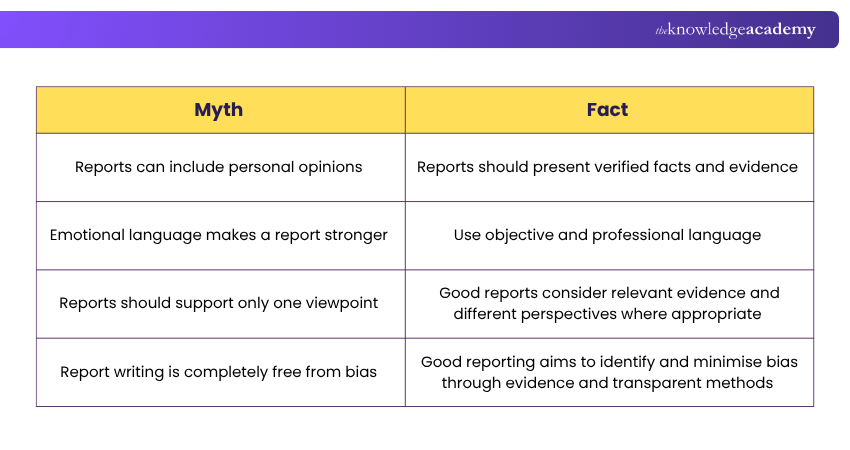
Report writing can help you present facts in a neutral and objective manner. For example, if you are a student, you can write a report to avoid bias or emotion in your writing and use facts and evidence to support your points. If you are a teacher, you can write a report to avoid bias or emotion in your assessment and evaluate your students with proper analysis.
Researchers can write a report to avoid bias or emotion in their research and use suitable evidence to demonstrate their findings. Report writing can help you maintain a professional and ethical tone in your communication.
7) A Managerial Tool
Report writing can help you manage your work or project effectively and efficiently. For example, if you are a student, you can write a report to plan, organise, and monitor your progress or outcomes in a course or a project. If you are a teacher, you can write a report to design, execute, and monitor your activities or objectives in a course or an assignment.
If you are a researcher, you can write a report to plan, implement, and observe your methods or results in a study or an experiment. As a result, report writing can help you set goals, allocate resources, and measure performance.
Unleash your creativity and become a master storyteller with our Creative Writing Training - Start your writing journey now.
8) Quality Control and Accountability
Report writing helps you control your work or project. For example, for a student, it helps them to write a report and check, review, and revise their work or project before submission or presentation. If you are a teacher, you can write a report to evaluate, monitor and analyse the performance of the learners.
If you are a researcher, you can write a report to review, verify and revise your work or project before dissemination or publication. Thus, report writing can help you ensure quality, accuracy, and consistency in your work or project.
9) Professional Advancement
The importance of report writing lies in advancing and developing your professional career. For example, students can write a report to demonstrate their competence, knowledge, and skills. Similarly, a teacher can write a report to show their skills, achievements and proven records.
If you are a researcher, you can write a report to demonstrate your research knowledge, unique ideas, and contributions. Report writing can help you showcase your achievements, contributions, or innovations in your field of interest.
10) Encountering Advanced and Complex Situations
Report writing can help you encounter advanced and complex situations in your work or project. For example, a student can write a report to deal with challenging questions or issues that arise in their curriculum or project. A teacher can also write a report to deal with critical subjects, questions or issues that arise in their classes.
If you are a researcher, you can write a report to deal with difficult findings, confusing formulations or interconnected results of your study or experiment. Report writing can help you solve problems, overcome obstacles, or discover new possibilities in your work or project.
Transform your potential into excellence - Join our Personal Development Training and embark on a journey of self-improvement.
Final Recap
Evaluate → Investigate → Organise → Analyse → Decide → Present → Manage → Review → Develop → Solve
A well-written report helps you evaluate performance, investigate issues, organise information, analyse evidence and make informed decisions. It also enables you to present facts objectively, manage work effectively, review quality, develop professional skills and solve complex problems.

Gaurav Kalita is a Content Writer with 2+ years of experience in content development, research and storytelling. His background in English literature and teaching, combined with his growing interest in AI and Machine Learning, supports his writing across Business Skills and IT and Tech.
View Detail

 If you wish to make any changes to your course, please


