


We may not have the course you’re looking for. If you enquire or give us a call on +34 932716793 and speak to our training experts, we may still be able to help with your training requirements.
Top Features of OOPs: A Detailed Explanation
ByGaurav KalitaLast updated on: 08 October 2026
Explore the key features of OOPs, including classes, objects, inheritance, abstraction, encapsulation, polymorphism, constructors and destructors.

Quick Preview
1. Classes define structures for creating objects with shared attributes and behaviours.2. Encapsulation combines data and methods while controlling access to internal details.3. Inheritance allows classes to reuse and extend behaviour from existing classes.4. Abstraction exposes essential functionality while hiding unnecessary implementation details.5. Polymorphism allows the same interface or operation to behave differently across object types.
Object-Oriented Programming (OOP) provides a structured way to organise software around objects that combine data with related behaviour. Its concepts can support modularity, code reuse, maintainability, and the representation of complex software relationships.
Each OOP feature solves a different design problem, from modelling real-world entities to controlling access and reusing code. Understanding what each one does makes it easier to write programs that are easier to change and extend. Let's look at each feature in turn.
Features of OOPs
Object-oriented programming includes several concepts and language features that support structured, reusable, and maintainable software development. Key features of OOPs include:
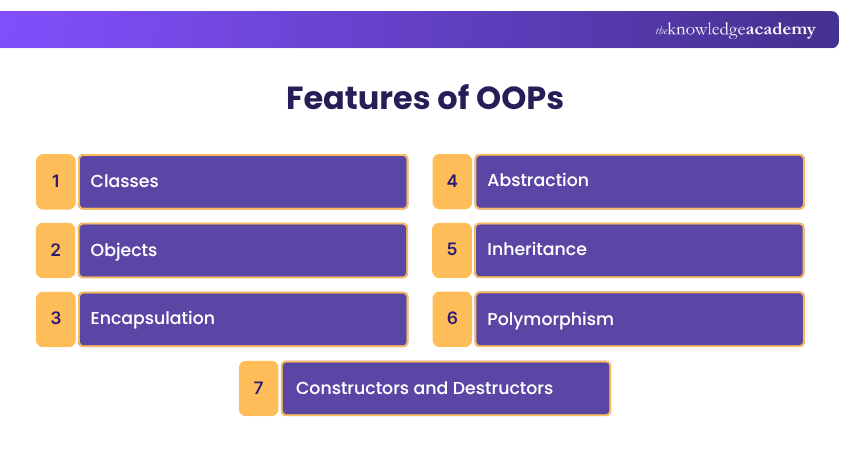
1) Classes
In object-oriented programming, a class defines the structure and behaviour shared by objects created from it. It can specify attributes that represent data and methods that define operations associated with that data.
Classes help organise related functionality into reusable structures and can model both real-world and conceptual entities. This supports modularity and can make software easier to maintain and extend.

2) Objects
An object is an instance of a class that contains data representing its state and can provide behaviour through associated methods. Objects can represent tangible entities, abstract concepts, or other components within a software system.
Objects can interact through methods and defined interfaces, helping separate responsibilities within a program. Because each object holds its own state, several objects created from the same class can behave differently while sharing the same methods.
3) Encapsulation
Encapsulation groups related data and behaviour within an object or class and controls how internal state is accessed or modified. This is usually done by keeping data private and allowing changes only through methods, so the object can check each change before accepting it.
This separation can reduce unintended dependencies, protect internal state from inappropriate modification, and support modular code organisation. Encapsulation contributes to information hiding, but it does not by itself guarantee software security.
Trainer’s Pro Tip
Keep fields private by default and expose them only through methods that validate changes. Controlling how internal state is modified keeps objects consistent and makes code easier to maintain.
4) Abstraction
Abstraction in OOP involves exposing the essential features or operations of an object while hiding unnecessary implementation details. It allows developers to work with clear interfaces without needing to understand every internal process behind them.
By separating what a component does from how it performs the task, abstraction can reduce complexity and make software interfaces easier to understand, use and maintain. Abstraction works at the design level, deciding what an object should offer, while encapsulation, covered above, protects how that is implemented.
5) Inheritance
Inheritance is an OOP concept in which a new class, known as a subclass or derived class, inherits the accessible attributes and methods of an existing class, known as a superclass or base class. This can support code reuse by allowing the derived class to extend or specialise existing behaviour. When used appropriately, inheritance can help organise related classes and reduce duplication.
Strengthen your object-oriented development skills with our C# and .NET Training - Join today.
6) Polymorphism
Polymorphism allows the same interface, method call or operation to produce different behaviour based on the object or type involved. This enables code to work with different implementations through a common interface, reducing the need for type-specific logic.
Polymorphism is commonly achieved through two mechanisms, covered below: method overriding at runtime and, where the language supports it, method overloading at compile time. The exact implementation varies between programming languages.
a) Method Overriding: A subclass overrides a method by providing its own version of an inherited method, specialising behaviour without changing the base class. It is commonly associated with runtime polymorphism, and the exact rules vary by language.
b) Method Overloading: Where a language supports it, method overloading lets multiple methods share one name with different parameter lists, and the right one is chosen by the arguments passed. It is not a universal feature of object-oriented programming and varies across languages.
Remember
Method overloading is not supported in the same way by every OOP language. Always check how the language being used handles multiple methods with the same name and different parameters.
7) Constructors and Destructors
Constructors are special mechanisms used in many object-oriented languages to initialise objects when they are created. They can set initial attribute values, validate inputs, or establish resources required by the object.
Some languages also provide destructors or similar lifecycle mechanisms for releasing resources when objects are no longer required. However, memory and resource management differ between languages, particularly where automatic garbage collection is used.
Build foundational programming skills with our Introduction to Programming with Python and Java Training - Join today.

Gaurav Kalita is a Content Writer with 2+ years of experience in content development, research and storytelling. His background in English literature and teaching, combined with his growing interest in AI and Machine Learning, supports his writing across Business Skills and IT and Tech.
View Detail

 If you wish to make any changes to your course, please


