




We may not have the course you’re looking for. If you enquire or give us a call on + 1-866 272 8822 and speak to our training experts, we may still be able to help with your training requirements.
What is Educational Management? A Complete Overview
ByThe Knowledge AcademyLast updated on: 03 October 2026
This blog explains educational management, including its different types, key principles, benefits, and best practices for managing educational institutions effectively.
How do schools and colleges keep everything running smoothly while ensuring students succeed? The answer lies in educational management. It brings together planning, resources and collaboration to create a learning environment where students and staff can thrive, from developing policies to coordinating people and priorities.
Much of this happens behind the scenes: who's responsible for what, how resources get allocated, how information flows between teachers and leadership. Get these decisions right, and classrooms run smoothly. Get them wrong, and it shows up fast, in missed deadlines and frustrated staff.
What is Educational Management?
Educational management involves organising, planning, and overseeing all the resources and activities needed to reach academic goals. Its main aim is to create policies, develop plans, and build an effective education system that supports a positive environment for both students and staff.
Additionally, it ensures that educational institutions run smoothly and efficiently. By fostering collaboration among teachers, administrators, and students, educational management helps achieve the best possible outcomes, including managing extracurricular activities that enhance student engagement and personal growth.

Types of Educational Management
Here are the types of educational management:
1) Internal and External
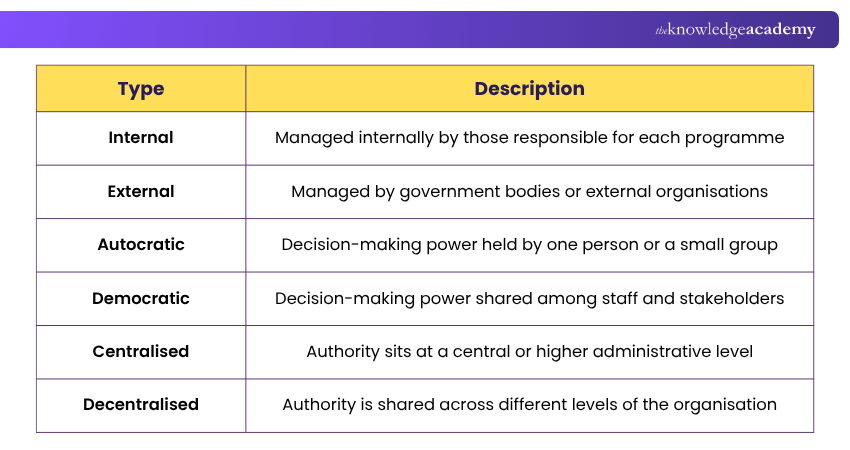
Internal educational management is managed by individuals directly responsible for each educational programme. They handle planning, organising, coordinating, supervising, controlling, administering, and evaluating.
In contrast, external educational management is managed by government bodies or external organisations. They oversee policies, curriculum development, teacher training programmes, and more.
2) Autocratic and Democratic
In autocratic educational management, authority and control are concentrated in the hands of a single individual, group, or institution. This is common in unitary states or authoritarian systems.
On the other hand, in democratic educational management, power and responsibilities are shared among different levels of management. This approach can encourage participation, shared responsibility and collaboration within the education system.
3) Centralised and Decentralised
In centralised educational management, major decision-making authority is concentrated at a central or higher administrative level. Important policies and decisions are made centrally and passed to lower levels for implementation.
In contrast, a decentralised approach involves sharing control and authority from the top level to various levels of management and school administrators. For example, top-level management makes major policies, while middle and lower levels make necessary adjustments.
Key Principles of Educational Management
Let's learn about some of the key principles of educational management below:
a) Equal Division of Work: Responsibilities are evenly divided among all staff members, including principals, directors, and teachers.
b) Authority and Responsibility: Align authority with corresponding responsibilities to ensure an efficient administrative structure. For example, teachers are responsible for student care, not policymaking.
c) Prioritise Organisational Goals: Academic objectives and organisational goals should take precedence over individual interests.
d) Fair Remuneration: Provide fair compensation to employees, ensuring that teachers and staff receive competitive salaries and benefits.
e) Appropriate Resource Allocation: Distribute resources effectively to meet the requirements of both employees and the institution.
f) Collaboration and Innovation: Encourage a culture of innovation and collaboration, where ideas are freely shared to continuously improve the work environment.
Pro Tip
Responsibility should be supported by appropriate authority and resources. If someone is accountable for an outcome but does not have sufficient authority or resources to influence it, effective management becomes more difficult.
Benefits of Educational Management
Here are some of the advantages of educational management:
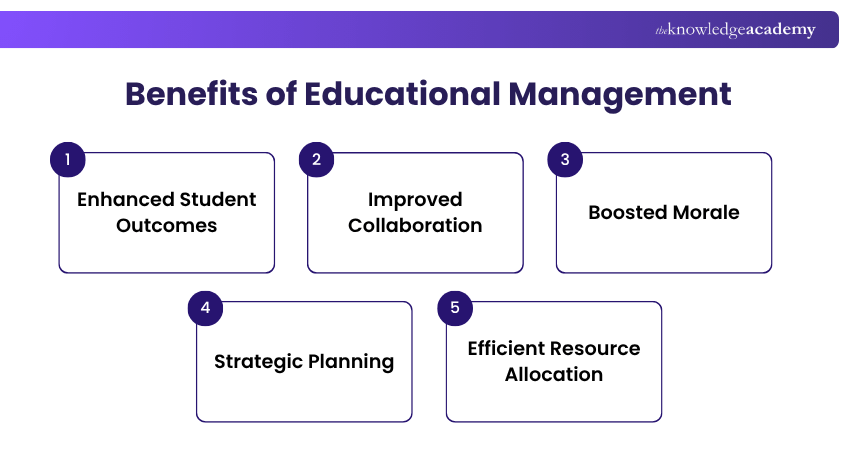
a) Enhanced Student Outcomes: Effective educational management and planning lead to improved student achievement. This is achieved by utilising resources efficiently to support learning.
b) Improved Collaboration: It fosters collaboration and partnerships among stakeholders. This creates a more interconnected education system.
c) Boosted Morale: Effective management increases job satisfaction and morale among educators. This encourages a positive and supportive learning environment.
d) Strategic Planning: It includes planning for the long-term and defining a clear vision for the institution’s future. This includes forecasting trends, anticipating challenges, identifying opportunities for growth, and developing strategies to achieve desired outcomes.
e) Efficient Resource Allocation: By managing resources such as finances, facilities, technology, and human capital effectively, educational institutions ensure proper utilisation. This maximises the impact of these resources.
Develop the fundamentals behind educational excellence by joining the ISO 21001 Foundation Training today!
Best Practices in Educational Management
Educational institutions should use effective management methods to create a productive and encouraging learning environment. They can adapt to changing needs and achieve their educational goals by following these best practices. Let’s learn about them below:
1) Engaging Parents and the Community
Involving parents and the larger community in the educational process can significantly boost student achievement. Active community involvement strengthens the institution’s mission by fostering a positive learning environment.
2) Leveraging Modern Technology
The use of technology in the management and administration of schools can help make information more accessible, simplify administrative work and support the delivery of quality education. Technologies such as data analytics and Learning Management Systems (LMS) can support education administration.
3) Fostering Continuous Professional Development
Investing in professional development ensures that educators stay updated on trends and best practices in education. Ongoing professional development is important for maintaining high standards in both management and instruction.
Pro Tip
Link professional development to identified staff and institutional needs. Training is more useful when there is a clear connection between the skills being developed and the challenges or objectives the institution is working towards.
4) Maintaining Clear Communication Channels
Effective communication within the organisation is essential for good educational management. Clear communication ensures that every stakeholder is aware and aligned with the institution’s goals and objectives.
5) Encouraging a Collaborative Learning Environment
Promoting a collaborative environment motivates teachers and students to actively participate in the learning process. This approach supports educational outcomes and contributes to the institution’s overall development.
Quick Check: How Effective is Your Educational Management?
Ask these five questions:
a) Are institutional objectives clearly defined?b) Do people understand their roles and responsibilities?c) Are resources aligned with institutional priorities?d) Can relevant stakeholders communicate and contribute effectively?e) Are outcomes reviewed and used to improve future decisions?
Lead the change, implement the standard, and elevate education with the ISO 21001 Lead Implementer Training – Sign up now!

The Knowledge Academy develops accessible learning content across Project Management, IT, Cybersecurity, Data Science, Business Analysis, HR, Accounting and Finance, Leadership and Health and Safety. Its resources combine subject research with clear explanations to help professionals build practical knowledge across a wide range of disciplines.
View Detail

 If you wish to make any changes to your course, please


