




We may not have the course you’re looking for. If you enquire or give us a call on 01344203999 and speak to our training experts, we may still be able to help with your training requirements.
Flask vs Django: Which Python Framework Should You Choose?
ByThe Knowledge AcademyLast updated on: 15 July 2026
Django offers a full-featured, high-level framework for complex apps, while Flask is a lightweight, flexible choice ideal for small project and APIs. Learning Flask and Django helps in mastering Python, building projects, following tutorials, practising regularly, and exploring real-world code on GitHub. Read on to the differences!
Web Development in Python almost always comes down to one big decision: Flask vs Django. Both are powerful, battle-tested, and trusted by developers around the world. But they suit different goals. Django is your full-stack powerhouse, loaded with features and ready to handle complex applications from the start. Flask is your lightweight toolkit, simple, flexible, and fully under your control.
This blog breaks down the differences between Django vs Flask with clarity, creativity, and context. We will explore when to use each, what they offer, and how they align with real-world needs, from scalability to SEO. Whether you are building your first website or planning your next big project, this blog will help you choose the right path.
Table of Contents
1) What is Flask?
2) What is Django?
3) Flask vs Django: What's the Difference?
4) Pros and Cons of Using Django
5) Pros and Cons of Using Flask
6) When to Choose Flask?
7) When to Choose Django?
8) Conclusion
What is Flask?
Flask is a lightweight, micro web framework written in Python. Unlike Django, Flask provides the essentials to get a web app running but leaves the rest to the developer, offering more flexibility and control. It is ideal for small projects, APIs, or applications that require custom components.
Features of Flask
Here are the features of Flask:
1) Minimal Core: A small, simple core that allows developers to add extensions as needed.
2) Flexible and Modular: Build your application the way you want with complete control over structure.
3) Integrated Development Server: Comes with a built-in debugger and server for testing.
4) Support for Extensions: Easily add features like database integration or authentication through third-party libraries.
5) RESTful Request Handling: Ideal for creating APIs and lightweight web services.
6) Jinja2 Templating: Use powerful, customisable templates to dynamically render HTML content.

What is Django?
Django is a high-level, open-source web framework written in Python that encourages rapid development and clean, pragmatic design. It comes with a wide range of built-in tools and features, making it ideal for building complex and scalable web applications efficiently.
This makes Django a great choice for building large-scale, data-driven websites and applications, such as social media platforms, content management systems, or e-commerce portals. It also places a strong focus on security, helping developers avoid common issues like SQL injection, cross-site scripting, and clickjacking.
Features of Django
Here are some of the features of Django:
1) Admin Interface: Automatically generated backend for managing application data.
2) Object-Relational Mapping (ORM): Connects database tables with Python objects for easier data handling.
3) Built-in Authentication: Includes user login, registration, and permission systems.
4) Security Features: Protects against common threats like SQL injection, CSRF, and XSS.
5) Scalability: Designed to handle high traffic sites like Instagram.
6) Batteries-included Philosophy: Comes with everything you need to build a full-stack web application.

Flask vs Django: What's the Difference?
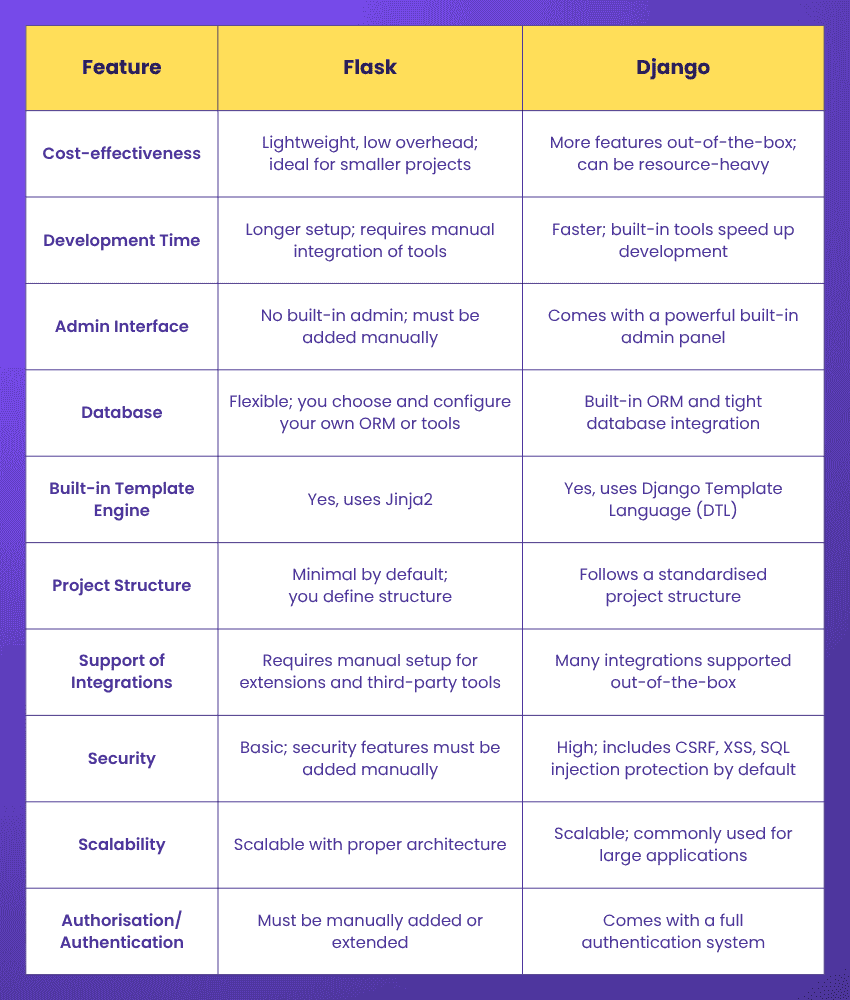
Flask and Django are both powerful Python web frameworks, but they differ greatly in their philosophy, capabilities, and use of cases. Here's a detailed comparison across key factors:
Cost-effectiveness
Django is cost-efficient for large projects due to its built-in tools like admin, auth, and ORM, reducing third-party needs. Flask is cheaper for simple apps but may grow expensive as features are added manually. Django suits complex applications; Flask fits lean startups and minimal viable products (MVPs).
Development Time
Django accelerates development with ready-made features such as ORM, templates, and admin. It’s ideal for full-featured applications with tight deadlines. Flask, offering more flexibility, requires developers to choose and configure tools, which can increase setup time for complex apps but is excellent for fast prototyping and simple APIs.
Admin Interface
Django includes a robust, auto-generated admin interface for managing users and content easily. It’s highly customisable and production ready. Flask lacks a built-in admin and relies on third-party extensions like Flask-Admin, requiring extra setup and code. Django is ideal for apps needing strong backend management from the start.
Dissect Python’s intricacies with our comprehensive Programming Courses - sign up today!
Database
Django has a built-in ORM that simplifies database interaction with Python code, supporting migrations and multiple databases. Flask doesn’t include one by default but works well with SQLAlchemy or other libraries. While Flask offers more flexibility, Django’s integrated approach is quicker and more convenient for standard database operations.
Built-in Template Engine
Django uses a secure, structured template engine suited for building consistent layouts and dynamic pages. Flask relies on Jinja2, which is flexible, developer-friendly, and highly customisable. Django templates are easier for beginners; Flask offers more control for those who want to fine-tune their HTML rendering and logic.
Project Structure
Django enforces a strict project layout, promoting scalability and team collaboration. Its structure suits large and long-term projects. Flask has no fixed layout, offering freedom to organise files and code. This flexibility is ideal for solo developers or small projects but can create inconsistency in larger teams.
Support of Extra Integrations
Django supports a wide range of integrations but can be restrictive with custom setups due to its opinionated structure. Flask, being modular and minimal, is extremely extensible. Developers can easily integrate tools like payment gateways, cloud services, or analytics. Flask is best for unique, highly customised applications.
Security
Django offers strong built-in security measures like CSRF protection, XSS prevention, and secure authentication. It’s ideal for data-sensitive applications. Flask provides basic security but depends on extensions and manual setup for full protection. It allows more control but requires developers to be proactive about implementing best practices.
Scalability
Django scales efficiently and supports high-traffic apps with tools for caching, middleware, and database handling. It suits monolithic, feature-rich platforms. Flask’s lightweight nature and modularity make it perfect for microservices and distributed systems. It gives developers control over performance scaling, especially in cloud-native or serverless environments.
Authorisation/Authentication
Django has a complete authentication system out of the box, including user login, roles, and session handling. It’s ideal for apps requiring secure access control. Flask lacks built-in auth but supports tools like Flask-Login. This approach is flexible but adds extra responsibility for secure implementation and maintenance.
Pros and Cons of Using Django
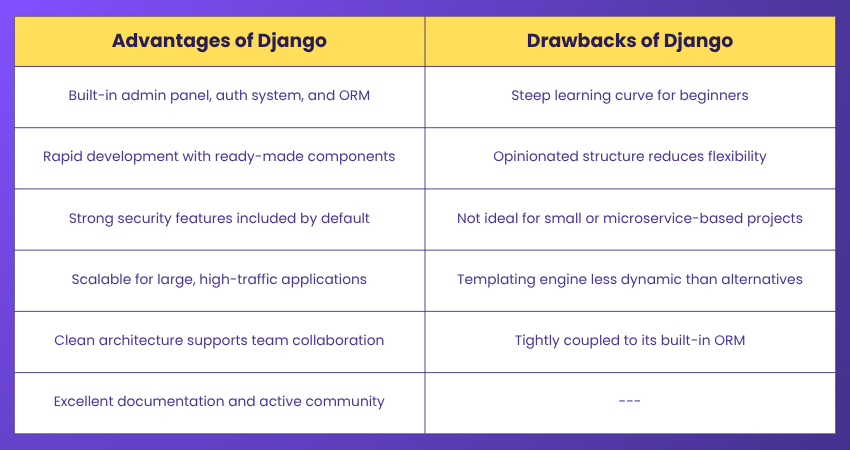
Django is a full-featured framework suited for fast, secure, and scalable development. However, its structure may not fit every use case. Let's discuss its advantages and well as disadvantages below:
Advantages
Django shines with powerful built-in tools and a structured approach that supports rapid, secure development.
1) Comes with admin panel, auth system, and ORM
2) Speeds up development with ready-made components
3) Built-in protections against common security threats
4) Scales well for large, high-traffic apps
5) Clean architecture ideal for teamwork
6) Strong documentation and community support
Code your future boost your career in tech - Join our Python Course and start building now!
Drawbacks
Despite its strengths, Django can be rigid and overwhelming for certain projects.
1) Has a steep learning curve for beginners
2) Less flexible due to its opinionated design
3) Not ideal for lightweight or microservices
4) Templating engine is less dynamic than others
5) Tightly bound to its ORM
Pros and Cons of Using Flask
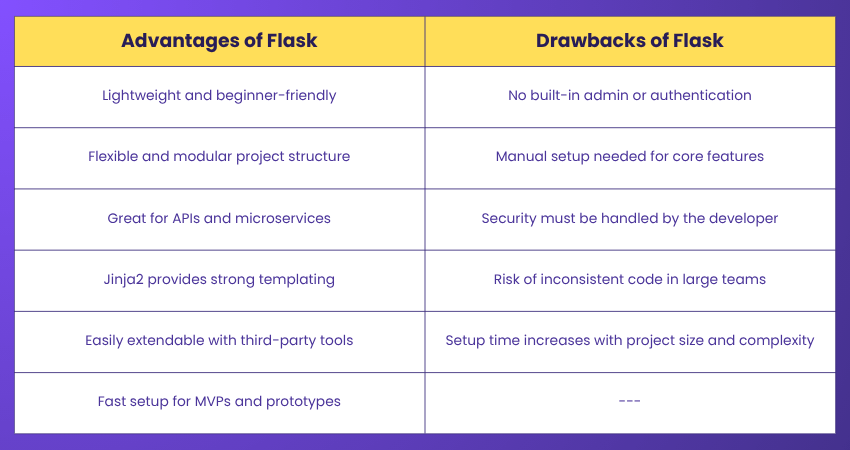
Flask is a minimalist web framework that gives developers the flexibility to build exactly what they need. Here are the advantages and disadvantages below:
Advantages
Flask’s simplicity and modular design make it a top choice for small apps, APIs, and developers who want full control.
1) Lightweight and easy to learn
2) Flexible project structure
3) Ideal for building APIs and microservices
4) Supports Jinja2 for powerful templating
5) Easily extendable with third-party tools
6) Quick setup for MVPs and prototypes
Drawbacks
While Flask offers freedom, it also requires more manual work and careful planning, especially as projects scale.
1) No built-in admin or authentication
2) Requires manual configuration for key features
3) Security setup is developer’s responsibility
4) Can lead to inconsistent code in large teams
5) Setup time increases with complexity
Code the smart way – Our Visual Basic Course is your gateway to software greatness!
When to Choose Flask?
Choose Flask when building lightweight applications, RESTful APIs, or microservices where flexibility and simplicity are key. It’s ideal for quick prototypes, MVPs, and projects needing custom setups. Flask suits solo developers or small teams who want full control over components and minimal framework constraints.
When to Choose Django?
Choose Django for full-featured, scalable web applications that require built-in tools like admin panels, authentication, and ORM. It’s ideal for complex, data-driven platforms with tight deadlines. Django suits larger teams and long-term projects that benefit from structure, security, and rapid development capabilities out of the box.
Conclusion
Choosing the right web framework is more than a tech decision, but a strategic move. Whether you go with Django’s all-in-one power or Flask’s flexible simplicity, the right choice depends on your project goals and team strengths. This Flask vs Django journey can be your blueprint for smarter development. Choose wisely, build boldly, and let the right framework fuel your next big idea.
From idea to application – Register for Swift Training and create the next big thing!

The Knowledge Academy is a world-leading provider of professional training courses, offering globally recognised qualifications across a wide range of subjects. With expert trainers, up-to-date course material, and flexible learning options, we aim to empower professionals and organisations to achieve their goals through continuous learning.


 If you wish to make any changes to your course, please


