


We may not have the course you’re looking for. If you enquire or give us a call on 01344203999 and speak to our training experts, we may still be able to help with your training requirements.
Discrete Mathematics: Examples and Key Topics Explained
ByNaveena VenkatesanLast updated on: 15 October 2026
Discrete mathematics explores distinct mathematical structures, including sets, graphs, logic and integers. This blog explains its importance, fundamental topics, practical applications and examples, highlighting its role in computer science, engineering and problem-solving.
Quick Overview
1. Core Concepts: Understand the fundamental principles and scope of discrete mathematics.2. Why It Matters: Discover how discrete mathematics strengthens analytical thinking and mathematical reasoning.3. Key Topics: Explore essential mathematical areas, from set theory and logic to graph theory and discrete probability.4. Practical Applications: Learn how discrete mathematics contributes to computing, cybersecurity, AI and logistics.5. Examples: See how mathematical concepts help solve problems involving collections, connections and logical conditions.
Ever wondered how Google Maps finds efficient routes or how computers process complex instructions using binary logic? Behind these technologies lies a fascinating branch of mathematics called discrete mathematics.
From analysing networks to understanding logical relationships, discrete mathematics provides tools for solving problems involving distinct elements and structures. Its concepts play an important role in computer science, cybersecurity and modern technological applications.
Understanding Discrete Mathematics
Discrete mathematics is a branch of mathematics that studies distinct, countable structures rather than continuously varying quantities. It includes topics such as sets, integers, logic, graphs and combinatorics, covering both finite and countably infinite structures. It provides a mathematical foundation for computer science, information technology and several engineering fields, particularly those involving algorithms, digital systems and network analysis.
For example, graph theory uses vertices and edges to represent connections between locations or devices. These structures help solve problems involving network connectivity, route planning and communication systems.

The Importance of Discrete Mathematics
Discrete mathematics plays a fundamental role in developing mathematical understanding and analytical abilities. It provides a structured approach to reasoning, evaluating information and solving problems involving distinct elements. Here are the key reasons why discrete mathematics is important:
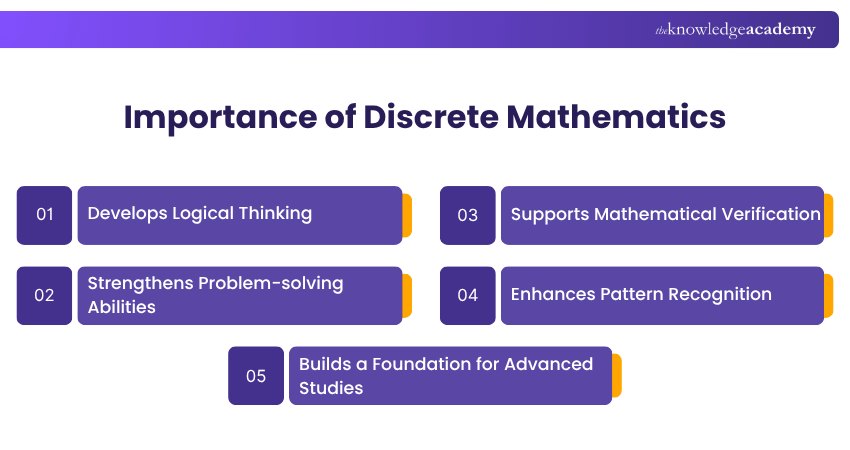
a) Develops Logical Thinking: Discrete mathematics helps individuals evaluate statements, identify valid arguments and draw conclusions based on established rules. This strengthens clarity and precision in reasoning.
b) Strengthens Problem-solving Abilities: It encourages breaking complex problems into smaller, manageable parts. This systematic approach makes it easier to analyse challenges and determine appropriate solutions.
c) Supports Mathematical Verification: Discrete mathematics introduces proof techniques for establishing the validity of mathematical statements. These techniques help distinguish logically justified conclusions from unsupported assumptions.
d) Enhances Pattern Recognition: It helps identify recurring structures, sequences and relationships within information. Recognising these patterns supports a deeper understanding of mathematical behaviour.
e) Builds a Foundation for Advanced Studies: Discrete mathematics provides essential knowledge for understanding advanced subjects such as computational complexity, theoretical computer science and algorithm analysis.
Pro Tip: Look for Counterexamples
When a mathematical statement appears correct, try finding a case where it fails. A single valid counterexample is enough to disprove a universal statement.
Key Topics in Discrete Mathematics
Discrete mathematics covers several mathematical concepts used in computer science, engineering and problem-solving. The following are its major topics:
1) Permutations and Combinations
Permutations count arrangements where order matters, such as arranging books on a shelf. Combinations count selections where order does not matter, such as choosing committee members. Both concepts are widely used in counting and probability problems.
2) Set Theory
Set theory focuses on collections of distinct objects known as sets. It explores concepts such as subsets, unions, intersections, and set differences. These principles help establish relationships between groups of elements and form a foundation for other mathematical concepts.
3) Relations and Functions
Relations describe connections between elements of sets, while functions assign each element of a domain to exactly one element of a codomain. This topic covers equivalence relations, order relations, injective functions and surjective functions. It helps explain how mathematical elements are associated and organised.
4) Graph Theory Concepts
Graph theory studies structures consisting of vertices (nodes) and edges (connections) between them. It is crucial for modelling networks like the internet, social media, and transportation systems. Key concepts in graph theory include planar graphs, Eulerian paths, and Hamiltonian cycles.
5) Principles of Logic
Logic in discrete mathematics deals with formal reasoning and is essential in computer science for algorithm design, programming, and AI. Propositional and predicate logic support mathematical proofs, algorithm design and formal verification of correctness under specified assumptions. Logical operators such as AND, OR and NOT are also used in programming conditions, search algorithms and database queries.
6) Number Theory
Number theory examines the properties and relationships of integers. It covers divisibility, prime numbers, greatest common divisors, congruences and modular arithmetic. These concepts help explain numerical patterns and establish important properties of integers.
7) Discrete Probability
Discrete probability studies the likelihood of outcomes within finite or countably infinite sample spaces. It covers probability distributions, conditional probability, random variables, and expected values. These concepts provide a mathematical framework for analysing uncertainty and calculating the probabilities of distinct outcomes.
Achieve project milestones with advanced planning- join our Effective Planning And Scheduling Course today.
Applications of Discrete Mathematics
Discrete mathematics not only supports computer science but is also integral in understanding biological systems and DNA sequencing. Listed below are some of the other applications of discrete mathematics:
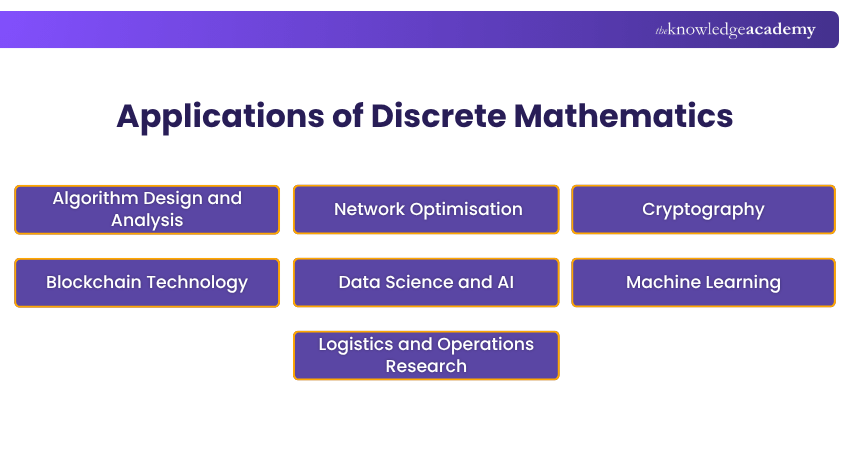
1) Algorithm Design and Analysis: Discrete mathematics provides mathematical tools for designing and analysing algorithms, evaluating their efficiency and proving their correctness under specified assumptions. These tools support the development of systematic solutions to computational problems.
2) Network Optimisation: Graph theory, a branch of discrete mathematics, is used to model and optimise network structures like the internet or telecommunication systems. The Minimum Spanning Tree (MST) problem helps connect all vertices in a connected, weighted, undirected graph while minimising the total edge weight, which may represent cable length or installation cost.
3) Cryptography: Cryptographic algorithms such as RSA use number theory and modular arithmetic to support secure communication and digital signatures. Cryptography helps protect sensitive information through encryption, authentication and integrity mechanisms, depending on the algorithm and its application.
4) Blockchain Technology: Discrete mathematics contributes to blockchain technology through cryptographic algorithms, hash functions and data structures. These mathematical techniques help verify transactions and protect data integrity, alongside the system's consensus and security mechanisms.
5) Data Science and AI: Discrete mathematics supports data science and Artificial Intelligence (AI) through logic, probability, graph theory and combinatorics. These concepts are used in areas such as data modelling, search algorithms, knowledge representation and probabilistic reasoning.
6) Machine Learning: Machine learning uses discrete mathematical concepts in methods such as decision trees, graph-based learning and combinatorial optimisation. These methods can identify patterns, classify information and support predictions based on data.
7) Logistics and Operations Research: Graph theory helps solve logistics-based problems, such as optimising delivery routes, reducing travel time, and minimising costs.
Examples of Discrete Mathematics
The concepts of discrete mathematics can be understood through simple calculations and logical problems. The following examples demonstrate how set operations, graph theory and propositional logic work in practice:
1) Set Theory
Set theory deals with collections of distinct objects and the relationships between them. In relational databases, operations such as union, intersection and difference can be used to combine or compare query results, provided the relevant operations' requirements are satisfied.
Consider two sets: A = {1, 2, 3} and B = {3, 4, 5}. Their union is A ∪ B = {1, 2, 3, 4, 5}, while their intersection is A ∩ B = {3}. These operations help illustrate how distinct collections can be combined and compared.
2) Graph Theory
Graph theory is widely used to model relationships in various domains. It consists of vertices (nodes) and edges (connections), representing networks. Applications include designing and optimising communication networks, such as the internet, and solving problems like the shortest path in GPS navigation systems.
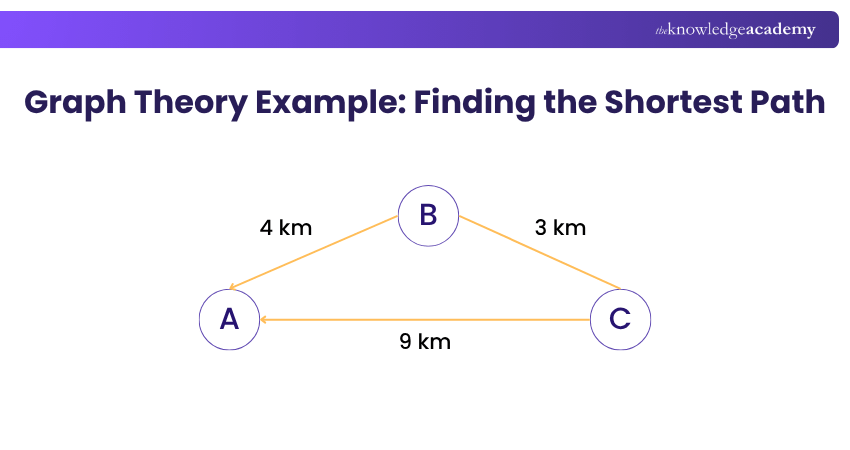
Suppose three locations, A, B and C, are connected by two-way routes. The distance from A to B is 4 km, B to C is 3 km and A to C is 9 km. Travelling from A to C through B covers 7 km, making it shorter than the direct 9 km route.
3) Logic and Reasoning
Logic and reasoning form the backbone of many algorithms in computer science. Propositional and predicate logic help in designing algorithms and formally verifying their correctness, which is particularly useful in programming where decisions and conditions are based on logical statements.
Consider two statements: P = "The user enters the correct password" and Q = "The user provides a valid verification code". The expression P ∧ Q is true only when both conditions are satisfied. This demonstrates how logical operators represent access rules in a simplified authentication system.
Transform goals into actionable strategies with our Strategic Planning And Thinking Course – fuel your journey today.

Naveena Venkatesan is a Content Editor with 2+ years of experience in content writing, editing and linguistic quality assurance. Her research, fact-checking and editorial experience enable her to develop accurate, accessible resources across Business Skills, Human Resources, and Accounting and Finance.
View Detail

 If you wish to make any changes to your course, please


