




We may not have the course you’re looking for. If you enquire or give us a call on 01344203999 and speak to our training experts, we may still be able to help with your training requirements.
IPv4 vs IPv6: The Ultimate Comparison Guide
ByThe Knowledge AcademyLast updated on: 05 October 2026
IPv4 and IPv6 are Internet Protocol versions used to address and route network traffic. IPv4 uses 32-bit addresses, while IPv6 uses 128-bit addresses, providing a vastly larger address space alongside features such as SLAAC, multicast, anycast, extension headers, and flow label support.
The internet is evolving rapidly, and the way devices connect is changing just as fast. Understanding the differences between IPv4 vs IPv6 is essential to grasp how modern networks handle growing demands, security, and scalability in a connected world.
As more devices come online, the limitations of IPv4's address space become increasingly apparent. This blog compares the differences between IPv4 and IPv6 in terms of addressing, packet delivery, scalability, configuration, and other networking requirements. Let's get started!
What is IPv4 (Internet Protocol Version 4)?
IPv4, or Internet Protocol Version 4, is a network-layer protocol that uses 32-bit addresses to identify interfaces and route packets between networks. Its address space provides approximately 4.3 billion possible addresses. Although technologies such as Network Address Translation (NAT) have extended its usefulness, IPv4's limited address capacity contributed to the development and adoption of IPv6.

What is IPv6 (Internet Protocol Version 6)?
IPv6, or Internet Protocol Version 6, is the successor to IPv4. It uses 128-bit addresses, providing approximately 3.4 × 10³⁸ possible addresses to support the continued growth of internet-connected devices and networks.
IPv6 also supports features such as a simplified base header, extension headers, Stateless Address Autoconfiguration (SLAAC), multicast, anycast, and Flow Label capability.
How Do IPv4 and IPv6 Work?
IPv4 and IPv6 both enable devices to communicate across networks, but they handle addressing and packet delivery differently. Here’s how each protocol works in practice:
1) How Does IPv4 Work?
Here’s how IPv4 handles addressing and communication across networks:
1) Network-layer Operation: IPv4 operates at the network layer, using IP addresses to identify interfaces and route packets between networks.
2) Addressing: IPv4 uses 32-bit addresses written in dotted-decimal notation. Modern networks generally use CIDR prefixes rather than the older class-based addressing model.
3) Broadcast: IPv4 supports broadcast communication for certain local-network functions, alongside unicast and multicast.
4) Address Resolution: IPv4 commonly uses Address Resolution Protocol (ARP) to map IPv4 addresses to link-layer addresses.
2) How Does IPv6 Work?
Here’s how IPv6 handles addressing and communication using its modern network capabilities:
1) Network-layer Operation: IPv6 also operates at the network layer, using 128-bit addresses to identify interfaces and route packets.
2) Addressing: IPv6 addresses are commonly represented as eight groups of hexadecimal digits separated by colons.
3) Multicast: IPv6 does not use broadcast addresses. Multicast performs many functions that broadcast serves in IPv4.
4) Address Resolution: IPv6 uses Neighbour Discovery (ND) instead of ARP for functions including link-layer address resolution.
5) Automatic Configuration: IPv6 supports SLAAC, allowing hosts to configure addresses using locally available information and router advertisements.
6) Dual-stack Operation: IPv4 and IPv6 can operate simultaneously in a dual-stack environment, allowing networks to support both protocols during migration.
Bonus Tip
When working in a dual-stack network, test IPv4 and IPv6 connectivity separately. This makes it easier to identify whether an issue relates to addressing, DNS, routing, or protocol configuration.
Strengthen your IPv6 addressing and configuration skills with the IPv6 Basics Training - Join now!
IPv4 vs IPv6
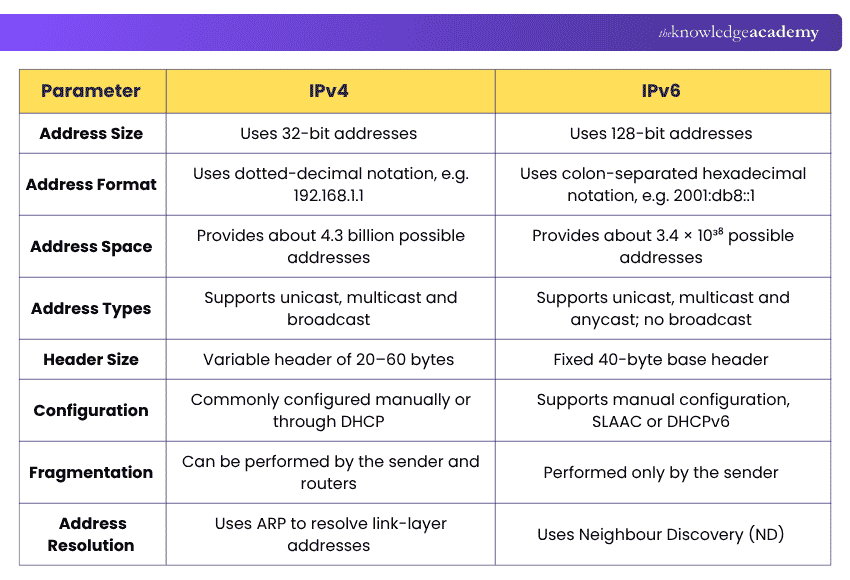
Grasping the contrasts between IPv4 and IPv6 is a necessity for modern networking. The following table brings out the most important differences between IPv4 vs IPv6 in terms of addressing, structure, and scalability. Let's look at them below:
Benefits of IPv4 and IPv6
Both protocols offer practical advantages, although they are suited to different networking needs and stages of internet development.
1) Benefits of IPv4
1) Wide Compatibility: Supported by most existing networks, devices, and applications.
2) Mature Infrastructure: Backed by well-established tools, systems, and operational practices.
3) Extensive Expertise: Network professionals have decades of experience configuring and troubleshooting IPv4.
4) Simple Address Format: Its dotted-decimal notation is relatively short and easy to recognise.
2) Benefits of IPv6
1) Larger Address Space: Uses 128-bit addressing to support a vast number of devices.
2) Reduced Dependence on NAT: Allows wider use of globally unique addresses.
3) Automatic Configuration: Supports SLAAC for easier address configuration.
4) Modern Network Features: Supports multicast, anycast, extension headers, and Flow Labels.
Build practical networking knowledge across IPv4 and IPv6 with the CCNA Certification Training - Register now!
Drawbacks and Limitations of IPv4 and IPv6
Both protocols also have limitations that affect scalability, compatibility, and network management.
1) Limitations of IPv4
1) Limited Address Space: Its 32-bit design provides around 4.3 billion possible addresses.
2) Greater NAT Dependence: Address shortages have increased reliance on Network Address Translation.
3) Broadcast Traffic: Broadcast communication can create additional local network traffic.
4) Limited Long-term Scalability: Growing device numbers make IPv4 address management increasingly difficult.
2) Limitations of IPv6
1) Compatibility Challenges: IPv4-only and IPv6-only systems cannot communicate natively with each other and require translation mechanisms for interoperability.
2) Migration Complexity: Dual-stack environments require both protocols to be managed simultaneously.
3) Infrastructure Updates: Older hardware and software may require upgrades or configuration changes.
4) Skills Requirements: Teams may need additional knowledge to deploy, secure, and troubleshoot IPv6.
Choose the Right Approach
Which option best fits each networking need?1. Supporting older, IPv4-only systems → IPv42. Expanding address capacity for new devices → IPv63. Maintaining compatibility during migration → Dual-stack4. Using SLAAC for address configuration → IPv65. Operating an established IPv4-based environment → IPv4
IPv4 or IPv6: Which Should You Use?
The choice depends on the network environment and compatibility requirements. IPv4 remains useful where legacy systems and existing infrastructure depend on it, while IPv6 is better suited to networks requiring greater address scalability and modern IP capabilities.
In practice, many networks support both protocols through dual-stack operation. This allows IPv6 adoption while maintaining IPv4 connectivity for systems and services that still depend on it.
Keep This in Mind:
1. IPv4 uses 32-bit addressing; IPv6 uses 128-bit addressing.2. IPv6 provides a vastly larger address space.3. IPv4 and IPv6 can operate together using dual-stack.4. IPv6 supports SLAAC for automatic address configuration.5. IPv6 removes broadcast addressing and uses multicast instead.6. Protocol choice depends on compatibility and network requirements.

The Knowledge Academy develops accessible learning content across Project Management, IT, Cybersecurity, Data Science, Business Analysis, HR, Accounting and Finance, Leadership and Health and Safety. Its resources combine subject research with clear explanations to help professionals build practical knowledge across a wide range of disciplines.
View Detail

 If you wish to make any changes to your course, please


