


 Top Rated Course

We may not have the course you’re looking for. If you enquire or give us a call on 01344203999 and speak to our training experts, we may still be able to help with your training requirements.
Data Wrangling: A Complete Guide
Lily Turner 16 July 2026Data Wrangling is the process of cleaning, organising, and transforming raw data into a reliable format for analysis, visualisation, or Machine Learning. It helps remove errors, handle missing values, and structure data properly. This ensures accurate insights, better decision-making, and reliable outcomes across businesses and projects.

Training Outcomes Within Your Budget!
We ensure quality, budget-alignment, and timely delivery by our expert instructors.
Table of Contents

Just think for a minute. Are your business decisions built on reliable data or on information that is incomplete and full of errors? In many situations, data is collected from multiple systems, teams, and tools, often without a clear structure or standard. As a result, what looks like useful information can easily hide inconsistencies, gaps, and inaccuracies.
This is where Data Wrangling plays a key role. It turns scattered and unreliable data into clear, trustworthy information that supports meaningful analysis. In this blog, we’ll discover what Data Wrangling is, its key functions, processes, and why it matters. Read on!
Table of Contents
1) What is Data Wrangling?
2) The Importance of Data Wrangling
3) The Data Wrangling Process
4) Benefits of Data Wrangling
5) Data Wrangling vs ETL
6) Career Opportunities in Data Wrangling
7) Conclusion
What is Data Wrangling?
Data Wrangling, also known as data cleaning or data munging, is the process of converting raw data into a usable and organised format for analysis. It involves collecting, cleaning, organising, and improving raw data into a structured, accurate, and reliable dataset that can be easily analysed and used for informed decision-making.
So, basically, Data Wrangling involves examining anomalies, correcting errors, handling missing values, standardising formats, and reshaping data structures based on analytical needs. Once data is wrangled, it becomes suitable for reports, dashboards, and advanced analysis.

The Importance of Data Wrangling
The importance of Data Wrangling has grown significantly due to the rapid increase in the volume and variety of data. When data contains errors or missing information, analysis results become unreliable. This can cause organisations to make wrong choices based on incorrect insights. Here is why it is important:
1) Manages large volumes and varied data from Social Media, Internet of Things (IoT) devices, and online platforms.
2) Prepares clean and structured data for advanced analytics, Artificial Intelligence (AI), and Machine Learning (ML) models.
3) Speeds up analysis by reducing time spent fixing data issues.
4) Supports regulatory compliance and strong data governance practices.
5) Improves data quality, accuracy, and consistency.
The Data Wrangling Process
The Data Wrangling process includes several steps that prepare data for use. These steps may vary slightly depending on the project, but they usually follow a similar pattern. Let’s discuss the process in detail:
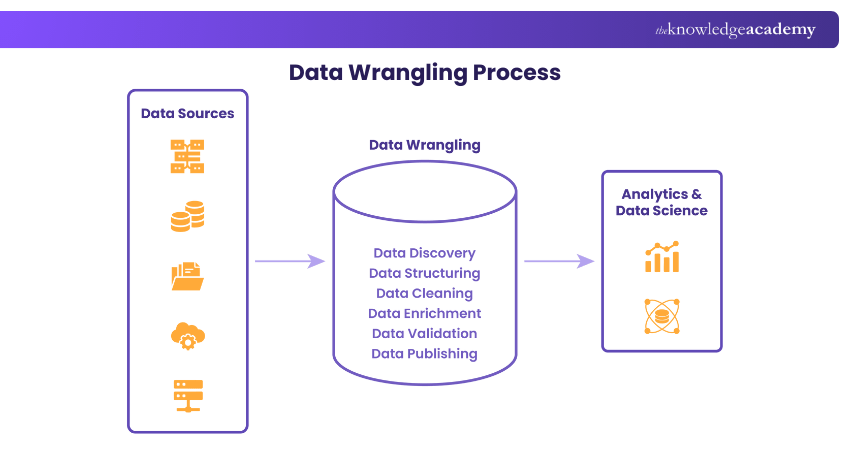
1) Data Discovery
Data discovery is the step where Analysts explore the dataset to understand its contents. This includes checking patterns, finding unusual values, and identifying gaps. This step helps uncover hidden issues that may not be obvious during cleaning. It also helps Analysts understand what the data represents and how it should be interpreted.
Key Features:
1) Identifies patterns and trends in the data
2) Highlights gaps or missing information
3) Improves understanding of data context
4) Supports better interpretation of results
2) Data Structuring
Data structuring organises data into a clear and usable format. Many datasets start as unstructured or semi-structured data, such as text files or logs. These formats are difficult to analyse directly. Thus, data is arranged into tables with rows and columns. Proper structuring allows analysis tools to process data efficiently.
Key Features:
1) Organises data into rows, columns, and tables
2) Defines clear relationships between data fields
3) Improves compatibility with analytical tools
4) Enhances data readability and usability
3) Data Cleaning
The data cleaning process focuses on fixing errors in the dataset. This includes removing duplicate records, correcting incorrect values, and fixing formatting issues. Missing data is another common issue. Some missing values can be filled using averages or previous values, while others may need to be removed.
Key Features:
1) Removes duplicate and unnecessary records
2) Corrects incorrect or inconsistent values
3) Handles missing or incomplete data
4) Improves overall data accuracy and reliability
4) Data Enrichment
Data enrichment enhances existing data by adding additional information from internal or external sources. This helps provide more context and depth, making the data more valuable for analysis and decision-making. It also allows you to gain a more complete and accurate view of your data.
Key Features:
1) Adds additional attributes or context to data
2) Combines data from multiple sources
3) Improves data completeness and relevance
4) Enhances analytical depth and insights
5) Supports better business understanding
5) Data Validation
Data validation checks whether the data follows defined rules. This includes checking ranges, formats, and logical relationships between fields. For example, a person’s age should not be negative, and a transaction date should not be in the future. Validation helps catch errors that could affect the results of an analysis.
Key Features:
1) Checks logical consistency between fields
2) Validates data types and value ranges
3) Reduces errors in analysis and reporting
4) Improves trust in data outputs
Learn how to forecast trends and outcomes with our Predictive Analytics Course – Register today!
6) Data Publishing
Once the data is prepared, it needs to be shared with users. Data publishing makes data available to dashboards, reports, and analytical tools. This also includes setting up access controls, so that only authorised users can access or edit the data. Proper publishing ensures that teams use the correct version of the dataset.
Key Features:
1) Makes data accessible for reporting and analysis
2) Supports dashboards and visualisation tools
3) Controls user access and permissions
4) Ensures consistent use of datasets
Benefits of Data Wrangling
Data Wrangling provides many benefits that improve how organisations work with data. Here are those benefits:
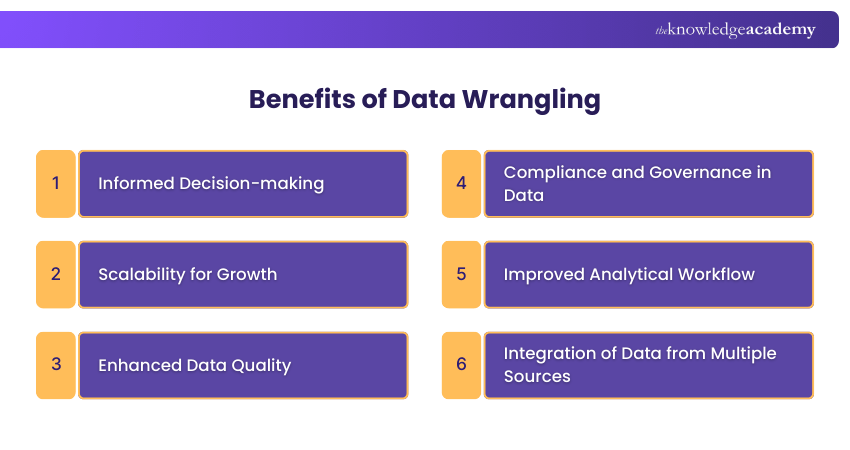
1) Informed Decision-making
1) Ensures decisions are based on accurate and reliable data
2) Reduces the risk of errors due to incomplete or incorrect information
3) Helps leaders clearly understand trends and patterns
4) Builds confidence in reports and dashboards
5) Supports fact-based strategic planning
2) Scalability for Growth
1) Handles increasing data volumes efficiently
2) Supports data coming from multiple new sources
3) Prepares data for advanced analytics and automation
4) Reduces rework as data grows over time
5) Creates a strong foundation for future data initiatives
3) Enhanced Data Quality
1) Removes duplicate and inconsistent data
2) Corrects errors and standardises formats
3) Improves completeness and accuracy of datasets
4) Ensures data is reliable for analysis and reporting
5) Increases trust in analytical outcomes
4) Compliance and Governance in Data
1) Helps meet regulatory requirements like General Data Protection Regulation (GDPR)
2) Maintains clear data ownership and traceability
3) Supports audit readiness and reporting standards
4) Ensures consistent data handling practices
5) Reduces legal and compliance risks
5) Improved Analytical Workflow
1) Reduces time spent fixing data issues
2) Speeds up reporting and analysis processes
3) Improves collaboration between data teams
4) Enables faster delivery of insights
5) Focusses on interpretation rather than preparation
6) Integration of Data from Multiple Sources
1) Aligns data formats across systems
2) Enables easier comparison of datasets
3) Supports unified reporting and analysis
4) Reduces integration errors
5) Improves visibility across business operations
Analyse real datasets and industry-relevant projects with our Data Science with R Training – Sign up soon!
Data Wrangling vs ETL
Data wrangling and ETL are related but different. ETL stands for Extract, Transform, and Load. It focuses on moving data between systems in an automated way. On the other hand, Data Wrangling focuses more on preparing data for analysis. It involves understanding the data, fixing issues, and refining it for specific use cases.
ETL is usually system-driven, while Data Wrangling is more flexible and often guided by analysts. Both are important and often used together in data projects. Here is the difference between them:

Career Opportunities in Data Wrangling
Data Wrangling skills are useful in many careers. Here are the roles that can benefit from it:
1) Data Analyst: Uses Data Wrangling to prepare clean data for accurate analysis and reporting.
2) Data Scientist: Relies on wrangled data to build reliable ML and predictive models.
3) Business Intelligence Analyst: Combines and cleans data from multiple sources to create dashboards and insights.
4) Data Engineer: Ensures data pipelines deliver consistent, high-quality data.
5) Product Analyst: Uses clean data to analyse user behaviour and product performance.
6) Marketing Analyst: Prepares campaign data to measure performance and optimise strategies.
Conclusion
We hope this blog has helped you understand how Data Wrangling transforms raw, unstructured data into meaningful and reliable information. It is the unseen work that ensures even the most advanced analytics tools deliver accurate results. By cleaning, structuring, validating, and documenting data, organisations can build a strong foundation for trustworthy insights and confident, data-driven decision-making.
Gain hands-on experience with Data Analysis with our Data Science Courses – Begin your journey now!
Frequently Asked Questions
Is Data Wrangling Same as Data Cleaning?

No, data cleaning is only one part of Data Wrangling. While cleaning focuses on correcting errors and inconsistencies, Data Wrangling includes additional steps such as structuring, transformation, validation, and documentation to prepare data fully for analysis.
How to Handle Missing or Corrupted Data in a Dataset?
Handling missing or corrupted data starts with understanding why it is missing. It includes removing affected records, imputing values using appropriate methods, flagging missing entries, or sourcing replacement data. The decisions might always align with analytical goals and data integrity requirements.

Lily Turner


Senior AI/ML Engineer and Data Science Author
Lily Turner is a data science professional with over 10 years of experience in artificial intelligence, machine learning, and big data analytics. Her work bridges academic research and industry innovation, with a focus on solving real-world problems using data-driven approaches. Lily’s content empowers aspiring data scientists to build practical, scalable models using the latest tools and techniques.
View Detail

 If you wish to make any changes to your course, please


