




We may not have the course you’re looking for. If you enquire or give us a call on 01344203999 and speak to our training experts, we may still be able to help with your training requirements.
Data Types R Programming: A Complete Guide
ByVishnu SankarLast updated on: 22 September 2026
Data Types in R Programming define how data is stored and processed in R, including numeric, integer, character, logical, and types used in Data Analysis. Along with the core types, it includes structures, such as vectors, factors, lists, matrices, and data frames, which are essential for ensuring accurate results.

Data Types in R Programming play a fundamental role in how data is represented, stored, and manipulated within the language. As a versatile tool for Statistical Computing and Data Analysis, R supports various data types that enable users to handle diverse datasets efficiently. Understanding these data types is essential for performing accurate computations, conducting statistical analyses, and creating visualisations.
According to Statista, 4.9% of Developers worldwide use the R Programming Language which highlights its significance in the highly competitive world of Programming. In this blog, we will explain the different data types supported by R, exploring their unique characteristics and how they affect memory usage. So read on and learn how each data type unlocks new possibilities for transforming raw numbers into meaningful insights!
An Overview of R Programming Language
R Programming Language is a versatile, open-source tool used for Statistical Computing, Data Analysis, and visualisation. It provides powerful functions for data manipulation, modelling, and high-quality graphics. Along with it, there is a strong community support and a vast package ecosystem making, R a preferred choice for Data Scientists, Statisticians, and Researchers.
R Programming Language focuses on reproducibility and seamless integration with other R Programming Tools. R has found applications in diverse fields, including academia, finance, healthcare, and marketing. It’s flexibility and user-friendly interface make it an essential language for anyone dealing with data analysis and research-driven decision-making.

What are Data Types in R Programming Language?
Data Types in R play a crucial role in determining how data is stored in memory and how operations are performed on them. R supports several basic data types, each serving specific purposes in Data Analysis and manipulation.
Numeric or Double
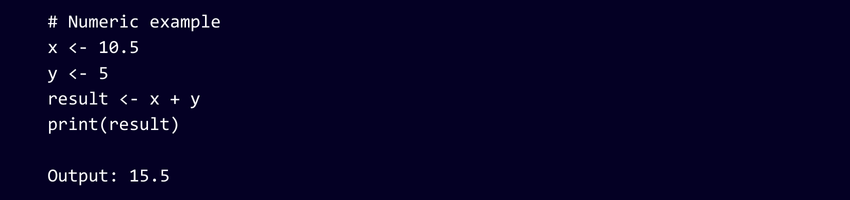
The numeric data type represents real numbers, including integers and floating-point numbers. It is the most used data type for performing mathematical computations and statistical analysis. For example, R Programming Variables storing continuous measurements like height, weight, or temperature are represented as numeric. Here’s an example:
2) Integer
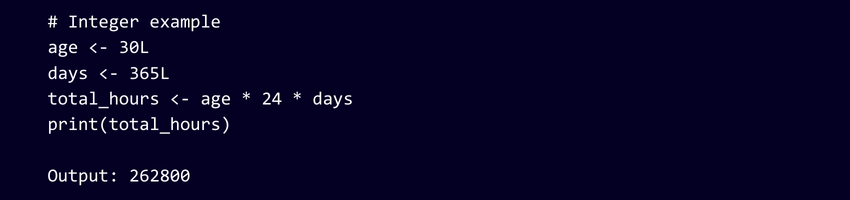
The integer Data Types in R represents whole numbers without any decimal point. Unlike numeric, integers do not have fractional parts. In R, integers are typically used for counting or indexing purposes. Here’s an example:
3) Logical or Boolean
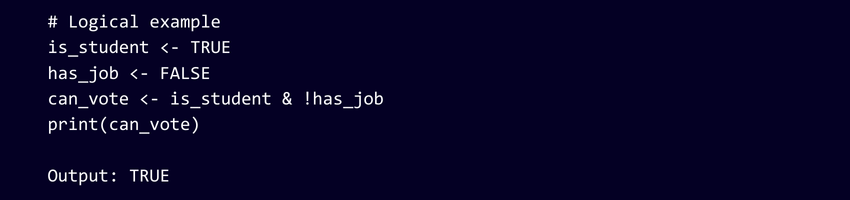
The logical Data Types in R represents binary values, TRUE or FALSE. Logical data is used in conditional statements, filtering data, and creating logical expressions. For instance, when evaluating conditions, logical data determines the outcome of the expression. Here’s an example:
4) Character or String
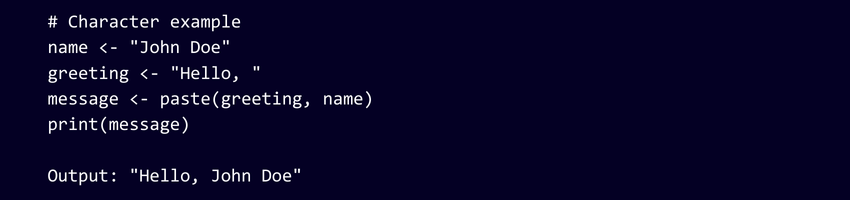
The character data type represents text and is denoted by enclosing the text in single or double quotes. Character data is commonly used to store names, labels, and categorical information. For instance, storing names of individuals or categories like "Male" and "Female." Here’s an example:
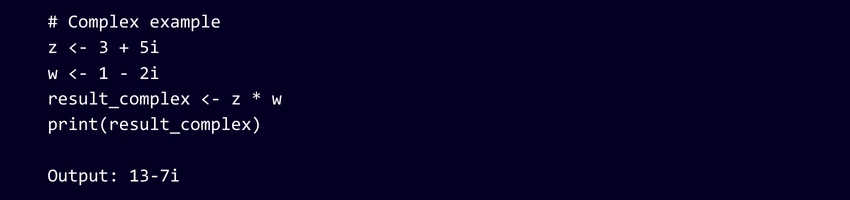
5) Complex
The complex data type represents numbers with real and imaginary components. Complex numbers are less commonly used in data analysis but are essential for specific mathematical calculations and simulations. Here’s an example:
6) Vectors
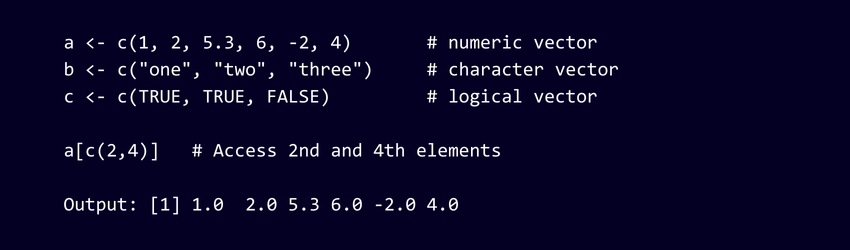
Vectors Data Types in R store values of the same data type, such as numeric, character, or logical. It is created using the “c()” function and are widely used for calculations and data handling. Here’s an example:
7) Matrices
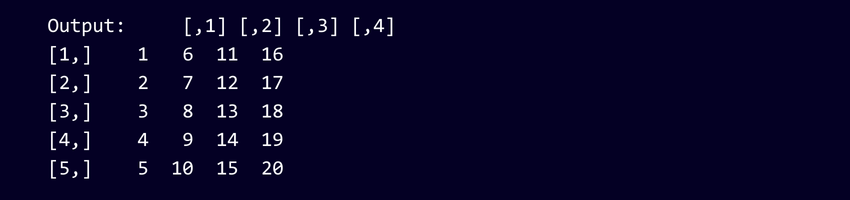
Matrices Data Types in R store data in a two-dimensional format with rows and columns. All values in a matrix must be of the same data type and length. It is useful for mathematical and statistical operations. Here’s an example:
8) Arrays
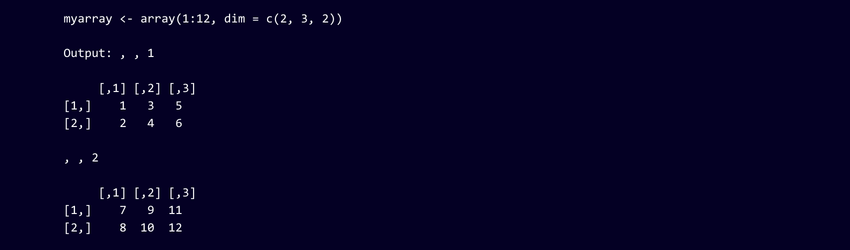
Arrays are an extension of matrices and can store data in more than two dimensions. All elements in an array must be of the same data type. It is mainly used for complex Data Analysis tasks involving multi-dimensional data. Here’s an example:
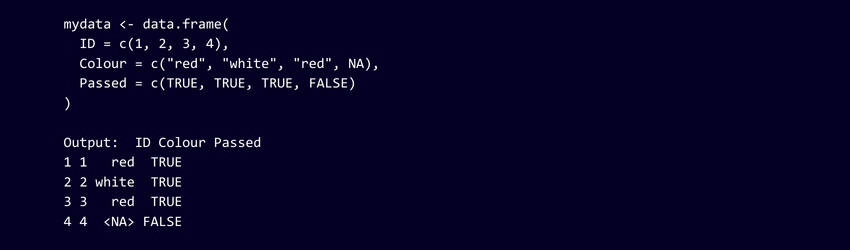
9) Data Frames
Data frames are common Data Types in R. They are like tables and enable different data types in each column, such as numeric, character, and logical values. This makes data frames ideal for real-world datasets. Here’s an example:
What is an Ordered Factor in R?
An ordered factor in R is a special type of factor used when the levels of a variable have a clear ranking or order. But the exact numerical difference between those levels is unknown. This is created using the “ordered()” function.
They are useful when working with ranked categories, such as low, medium, high or poor, average, good, and excellent. While the order matters, R does not assume how much one level differs from another.
Create dynamic and efficient Web Apps with React Course – Register today!
Do Different Data Types Affect Memory Usage in R?
Yes, different Data Types in R do affect memory usage. R stores data based on its type, and some types are more memory efficient than others. For example, integers are a specific form of numeric data used to represent whole numbers without decimal values. Since they do not store fractional components, they use less memory than standard numeric data types.
Learn the essentials of Python and create real projects with the Python Course today!

Vishnu Sankar is a Senior Content Writer with 5+ years of experience across content development, software development, web development and system administration. His technical background and professional training support his expertise in IT and Tech, while his extensive research and writing experience covers Project Management and Health and Safety.
View Detail

 If you wish to make any changes to your course, please


