




We may not have the course you’re looking for. If you enquire or give us a call on + 800 908601 and speak to our training experts, we may still be able to help with your training requirements.
What is a Customer Journey: Everything You Need to Know
ByScarlett AdamsLast updated on: 18 August 2026
This blog explores what a Customer Journey is, the five stages customers typically move through, and how it differs from a Customer Journey Map.
Key Takeaways
1. A Customer Journey covers every interaction a customer has with a brand, from first discovering it to purchase and beyond.2. Most customers move through five stages: awareness, consideration, purchase, retention, and advocacy.3. A single journey can involve many touchpoints across both online and offline channels.4. A Customer Journey Map is a visualising tool used to understand the journey, distinct from the journey itself.5. Mapping the journey helps businesses identify friction points and opportunities to improve customer experience.
Think about the last time you bought something. You probably did not decide instantly. You may have searched online, compared options, read reviews, visited a website, or asked for recommendations before making your choice.
Each of these moments formed part of your Customer Journey. And importantly, that journey did not necessarily end when you clicked “Buy”.
Understanding What is Customer Journey helps businesses see their brand from the customer's perspective, recognise what influences decisions, identify friction, and discover where the overall experience can be improved.
What is a Customer Journey?
A Customer Journey represents the overall experience a customer has when interacting with a brand, from becoming aware of a need or offering through consideration, purchase, post-purchase experience, and potential advocacy. It includes how customers discover, evaluate, choose, use, and continue interacting with a product or service.
A Customer Journey can involve online and offline touchpoints, including websites, emails, social media, reviews, customer support, mobile apps, and physical stores. Some interactions may even happen outside the organisation's direct control but still influence customer perceptions and decisions.
Customer Journey in One Line
Need → Discover → Explore → Decide → Buy → Experience → Return or RecommendThe important part is that the journey represents the customer's perspective, not simply the process a business expects them to follow.

Why is the Customer Journey Important?
The Customer Journey matters because it shapes whether a customer continues, comes back, or moves on to a competitor at every stage. Here's why it matters:
a) Reveals Where Customers Drop Off: Mapping the journey shows exactly which stage or touchpoint causes customers to lose interest or leave.
b) Identifies Friction Points: It highlights where expectations are not met, such as a confusing website, a slow checkout, or unclear information.
c) Improves Decision-Making: Businesses can prioritise fixes and investments based on where they have the greatest impact on the customer's experience.
d) Supports Better Cross-Team Alignment: Since the journey spans multiple departments, understanding it helps marketing, sales, and support work towards a consistent customer experience.
e) Helps Predict Customer Behaviour: Understanding the journey shows exactly which stage or touchpoint causes customers to lose interest or leave.
What are the Stages of a Customer Journey?
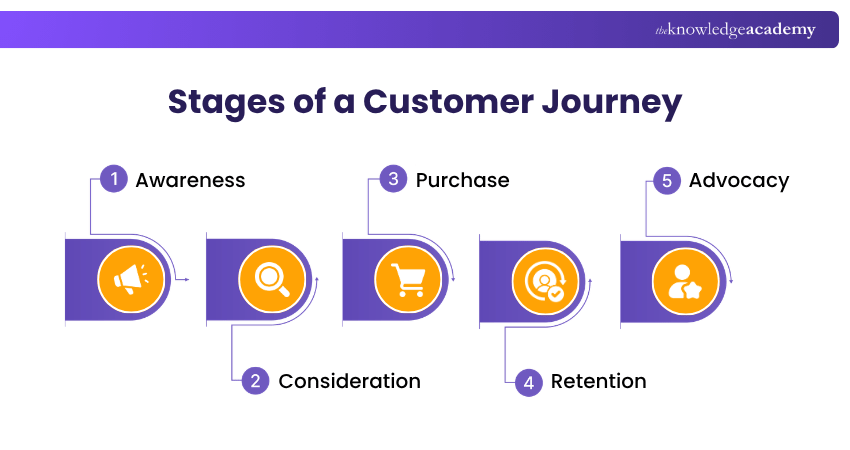
A Customer Journey does not follow exactly the same path for every customer. People may skip stages, revisit earlier ones, switch between channels, or leave the journey altogether. However, the following five stages provide a useful way to understand how a customer typically moves from discovering an offering to becoming a repeat customer or advocate.
1) Awareness
The journey begins when a customer recognises a need or problem and becomes aware of a brand, product or service. They might discover an organisation through search results, advertising, social media, recommendations, events, or word-of-mouth.
Customer Mindset: “I have a need. Could this solve my problem?”
2) Consideration
The customer starts exploring and comparing their options. They may look at features, prices, reviews, benefits, alternatives, or recommendations to decide which option best fits their needs.
Customer Mindset: “Is this the right option for me?”
3) Purchase
The customer decides whether to take action. A clear offer, straightforward checkout, suitable payment options, availability, sales support, and confidence in the purchase can all influence this stage.
Customer Mindset: “Am I confident enough to choose this?”
4) Retention
The journey continues after the purchase. The customer's experience with the product or service, onboarding, delivery, support, follow-up communication, renewals, and ongoing value can influence whether they return.
Customer Mindset: “Did I make the right choice?”
5) Advocacy
When customers have a positive experience, they may recommend the organisation, leave a review, make a referral, or share their experience with others. Advocacy can therefore become another route through which new customers discover the brand.
Customer Mindset: “Would I recommend this to someone else?”
Remember: These stages are a pattern, not a fixed route. A customer might move backwards, repeat a stage, skip one entirely, or stop before reaching a purchase.
What are Customer Journey Touchpoints?
Customer Journey touchpoints are the moments when a customer encounters, interacts with, or forms an impression of a brand. They can happen across websites, social media, stores, sales conversations, customer service, reviews, and other online or offline channels.
A single journey can contain many touchpoints. For example, a customer might see an advertisement, visit a website, read reviews, speak to a salesperson, make a purchase, receive the product, and later contact customer support. Each is a touchpoint; together, they shape the Customer Journey.
Key Insight: A touchpoint is a single interaction. The Customer Journey is the experience created by all those interactions.
This is why businesses should not evaluate touchpoints in isolation. A smooth checkout cannot fully compensate for confusing product information, just as excellent customer support may not fix a difficult purchasing process. What matters is how the touchpoints connect to create a consistent experience.
Create connections that support long-term business success with Building Business Relationships Training - Join now!
Customer Journey vs Customer Journey Map
A Customer Journey and a Customer Journey Map are closely connected, but they describe two different things.
A Customer Journey is the actual experience a customer has while interacting with a brand. It includes the stages they move through, the touchpoints they encounter, and how their needs, expectations, and perceptions change along the way.
A Customer Journey Map is a visual representation of that experience. It brings together the customer's actions, touchpoints, thoughts, emotions and pain points, along with opportunities for the organisation to improve, to help understand the journey from the customer's perspective.
One Experience, Two Perspectives
Customer Journey → The customer's experienceCustomer Journey Map → The organisation's view of that experience
What Does a Customer Journey Map Include?
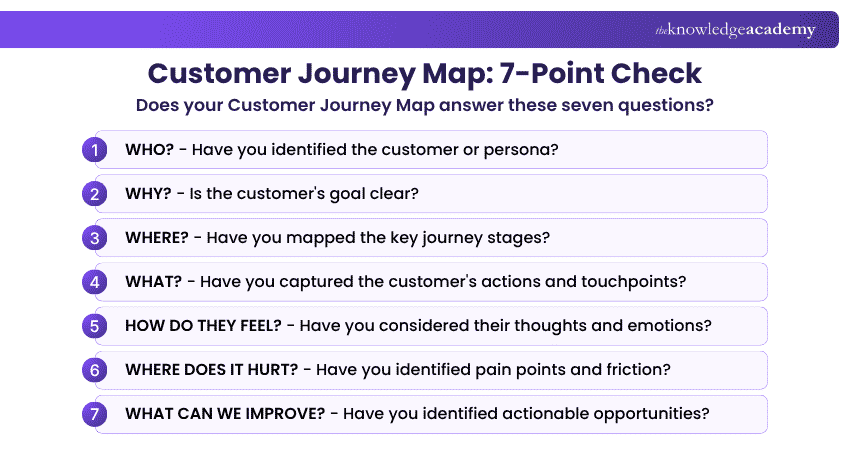
A useful Customer Journey Map goes beyond listing the channels a customer uses. It brings together information that explains what customers are trying to achieve, what they experience, and where improvements may be needed.
1) Customer or Persona: Identifies whose journey is being mapped so the map remains focused on a specific customer group or situation.
2) Customer Goal: Defines what the customer is ultimately trying to accomplish through the journey.
3) Journey Stages: Breaks the journey into meaningful phases that show how the customer's relationship with the organisation develops.
4) Actions and Touchpoints: Shows what customers do and where they interact with the organisation throughout the journey.
5) Thoughts and Emotions: Captures what customers may be thinking or feeling at important moments.
6) Pain Points: Highlights areas where customers experience difficulty, uncertainty, delay, or frustration.
7) Opportunities: Identifies where the organisation could reduce friction or improve the customer experience.
Quick Test:
If your map only shows stages and touchpoints, it is showing what happens. A stronger map also captures why it happens, how the customer feels, where the experience breaks down, and what can be improved.
Conclusion
A Customer Journey is the complete experience a customer has with a brand, from discovery and evaluation to purchase and beyond. Understanding What is Customer Journey helps organisations connect touchpoints, identify friction, and see the experience from the customer's perspective. This insight into how customers actually move through the journey allows businesses to make more meaningful improvements.
Turn customer insights into smarter business decisions with Strategic Planning and Thinking Course - Sign Up!

 If you wish to make any changes to your course, please


