




We may not have the course you’re looking for. If you enquire or give us a call on 01344203999 and speak to our training experts, we may still be able to help with your training requirements.
Top Creative Writing Examples: Explained
ByAishwarya UnniLast updated on: 02 October 2026
Writing is a great way to share ideas, express creativity, and connect with others in meaningful ways. It can inspire your readers and leave a lasting impact on their minds. Read this blog to explore the top Creative Writing Examples that go beyond the traditional, bringing thoughts, emotions, and ideas to life through powerful words.
Writing gives us a way to turn thoughts into something others can see, feel and imagine. A single sentence can introduce a new world, capture a powerful memory or make readers experience an emotion they have never considered before.
That freedom of expression lies at the heart of creative writing. It can appear in many forms, from novels and poetry to scripts and personal narratives. In this blog, we'll explore some of the top creative writing examples and see how different forms bring stories, experiences and ideas to life.
Top Creative Writing Examples
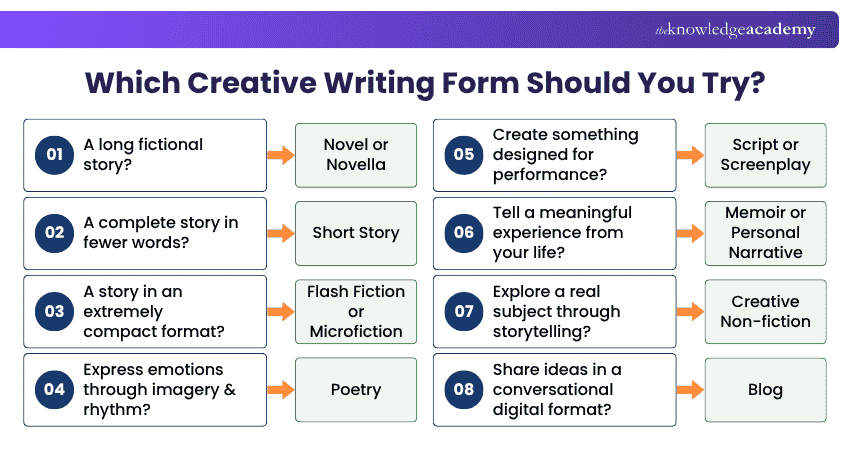
Creative writing allows writers to express ideas, emotions, and experiences in imaginative and engaging ways. From short stories and poetry to scripts, memoirs, and descriptive pieces, different forms of creative writing use storytelling techniques to connect with readers.
Exploring strong examples can help you understand how creativity, structure, voice, and language come together to create memorable writing.
1) Novels and Novellas
Inspiring novel writing examples can come from anywhere in a story. It might be the first paragraph, the back cover description, or even a random passage. Here are two examples for you:
From To Kill a Mockingbird by Harper Lee
“When he was nearly thirteen, my brother Jem got his arm badly broken at the elbow.”
This intriguing start hints at an important event while drawing readers into the narrator’s childhood memories.
From The Great Gatsby by F. Scott Fitzgerald
“In my younger and more vulnerable years, my father gave me some advice that I’ve been turning over in my mind ever since. ‘Whenever you feel like criticising anyone,’ he told me, ‘just remember that all the people in this world haven’t had the advantages that you’ve had.’”
These examples capture a unique voice and set the tone for the story. They show how words can draw readers in and leave a lasting impression.
2) Short Stories
In a short story, every word matters. Make sure each sentence or phrase adds to the message and impact of your story. Explore these examples:
From "The Snows of Kilimanjaro" by Ernest Hemingway
“It was not so much that he lied as that there was no truth to tell. He had had his life and it was over and then he went on living it again with different people and more money, with the best of the same places, and some new ones.”
From "A Good Man is Hard to Find" by Flannery O'Connor
“She would've been a good woman," said The Misfit, "if it had been somebody there to shoot her every minute of her life.”
Pro Tip
Your opening does not need to explain everything. Introduce enough character, conflict or curiosity to give readers a reason to continue.
3) Flash Fiction and Microfiction
Flash fiction and microfiction are forms of very short creative writing that tell a story using a limited number of words. Despite their brevity, they can still include characters, conflict, atmosphere and a meaningful ending. Here are some examples to get you started:
Flash Fiction Example
"Every morning, Mira left a cup of tea beside the empty chair across from her. One rainy Tuesday, she finally packed the chair away. The next morning, she made only one cup and, for the first time in months, opened the curtains."
Microfiction Example
"He spent years searching for home. When he finally returned, someone else answered the door."
4) Poetry
Poetry and song lyrics use rhythm, imagery, emotion and carefully chosen words to express ideas in a memorable way. Examples are listed below:
“The Road Not Taken” by Robert Frost
Two roads diverged in a yellow wood,
And sorry I could not travel both
And be one traveller, long I stood
And looked down one as far as I could
To where it...
“Still I Rise” by Maya Angelou
You may write me down in history
With your bitter, twisted lies,
You may trod me in the very dirt
But still, like dust, I'll rise.
Just like moons and like suns,
With the certainty of tides,
Just like hopes springing high,
Still I'll rise.
5) Scripts for Plays, TV Shows, and Movies
If you like writing dialogue and creating settings, take a look at these two very different screenplay excerpts. Afterwards, jot down some ideas for your own scene or screenplay.
1) Oppenheimer (2023)
Here's a strong excerpt from the screenplay's closing exchange in Christopher Nolan's biopic:
OPPENHEIMER: “I believe we did.”
The line comes as Oppenheimer reflects with Einstein on their earlier fear that the atomic bomb might trigger a chain reaction destroying the world. The screenplay then moves into images of expanding nuclear arsenals.
Pro Tip
Let characters reveal themselves through their words and actions. Avoid using dialogue merely to explain information that could be demonstrated through behaviour.
Everything Everywhere All at Once (2022)
Here's a concise line from the movie:
Alpha Waymond: “Every rejection, every disappointment has led you to this moment.”
Alpha Waymond says this to Evelyn, who believes she has failed at many things in her life. Within the film's multiverse concept, however, those unrealised goals and unsuccessful choices have created numerous alternative paths. This makes Evelyn unusually capable of connecting with different versions of herself.
Turn your imagination into page-turning fiction with the Fiction Writing Course – Sign up now!
6) Memoirs / Autobiographical Narratives
Sharing stories from your life can feel really good. It helps you let things out and reflect. Plus, your experiences can inspire, teach, or even just entertain others.
From Wild by Cheryl Strayed
"Fear, to a great extent, is born of a story we tell ourselves, and so I chose to tell myself a different story from the one women are told. I decided I was safe. I was strong. I was brave. Nothing could vanquish me. Insisting on this story was a form of mind control, but for the most part, it worked."
From The Glass Castle by Jeannette Walls
"When Dad wasn’t telling us about all the amazing things he was going to do, he was as likely as not to be telling us about all the amazing things he had already done. He was a dramatic storyteller. He always started out slow with lots of pauses. ‘You probably won’t believe this,’ he’d say. And then he’d tell us whatever wild and incredible thing he had done, like how he’d wrestled a pack of wild dogs to the ground with his bare hands or gone ten rounds with a heavyweight boxing champ."
7) Speeches
Most speeches aim to inform, inspire, or persuade. Think about the last time you gave a speech. How did you grab your listeners' attention right from the start?
Here's an example from “The Fringe Benefits of Failure, and the Importance of Imagination” by J.K. Rowling (Harvard Commencement Address, 2008)
"You might never fail on the scale I did, but some failure in life is inevitable. It is impossible to live without failing at something unless you live so cautiously that you might as well not have lived at all, in which case, you fail by default.
Failure gave me an inner security that I had never attained by passing examinations. Failure taught me things about myself that I could have learned no other way. I discovered that I had a strong will and more discipline than I had suspected."
From “The Crazy Ones” by Steve Jobs (Apple’s “Think Different” Campaign, 1997)
"Here's to the crazy ones. The misfits. The rebels. The troublemakers. The round pegs in the square holes. The ones who see things differently. They’re not fond of rules. And they have no respect for the status quo.
You can quote them, disagree with them, glorify or vilify them. About the only thing you can’t do is ignore them. Because they change things. They push the human race forward."
Creative Writing Checklist
Before you begin, check whether you have:
□ A clear central idea□ A suitable writing form□ An intended audience□ A distinctive voice□ Relevant descriptive details or imagery□ Characters or subjects readers can connect with□ A logical structure or narrative flow□ An engaging opening□ A purposeful ending□ Time to revise and refine your draft
8) Personal and Creative Essays
Essays are all about sharing your point of view and backing it up with solid evidence. Think of an issue that really excites or frustrates you. What would you write to make a strong case for your argument?
From “The Sense of Style: The Thinking Person’s Guide to Writing in the 21st Century” by Steven Pinker
“A classic is a book that everyone wants to read, and nobody wants to read. Good writing makes the reader feel smarter. Bad writing makes the reader feel dumber. Writing, I think, is a better teacher than learning. Write to discover. Write to learn.”
From “Why I Write” by George Orwell
“All writers are vain, selfish, and lazy, and at the very bottom of their motives, there lies a mystery. Writing a book is a horrible, exhausting struggle, like a long bout of some painful illness. One would never undertake such a thing if one were not driven on by some demon whom one can neither resist nor understand.”
From “Bird by Bird: Some Instructions on Writing and Life” by Anne Lamott
“Almost all good writing begins with terrible first efforts. You need to start somewhere. Start by getting something, anything, down on paper. A friend of mine says that the first draft is the down draft, you just get it down. The second draft is the up draft, you fix it up. You try to say what you have to say more accurately.”
9) Journalism / Newspaper Articles
Imagine yourself as an experienced journalist, full of ideas for your next big story. Or think about an article you’ve read that made you go, “Wow, they really nailed it!” The examples below can spark your creativity and help you craft content worthy of the front page.
Here's an excerpt from “Record heatwaves bring Britain’s second-best butterfly season in 16 years” (The Guardian: September 2026)
"The record-breaking heat of 2026 delivered the second-best British butterfly season of the past 16 years, according to the Big Butterfly Count.
The largest insect count in the world, in which more than 100,000 volunteers counted almost 1.4m common butterflies and day-flying moths, confirmed what many people experienced – a noticeable profusion of butterflies during the five-heatwave summer.
Particularly numerous were painted ladies, a migratory species which arrives in Britain each summer via a relay of several generations flying from sub-Saharan Africa."
10) Blogs
Starting a blog doesn’t have to cost a penny, especially if you love sharing your stories, ideas, and unique perspective with others online. Take a look at the examples below:
How to Write a Short Story: A Step-by-Step Guide
"If you’re a literature enthusiast, chances are you’ve encountered masterpieces like The Metamorphosis by Franz Kafka, Animal Farm by George Orwell, Birthday Girl by Haruki Murakami, or The Selfish Giant by Oscar Wilde. What do these stories have in common? They leave a lasting impact, resonating with us long after we’ve turned the final page.
These powerful narratives have the ability to transform our perspectives and reshape our understanding of the world. If you aspire to craft such memorable stories, welcome to our blog! In this blog, we’ll explore the art of writing Short Stories, guiding you on your journey to becoming a beloved writer."
How to Write a Novel in 10 Steps: A Beginner’s Guide
"Imagine sitting in your favourite cosy spot, daydreaming about the characters and worlds you could create. Have you ever wondered how to turn those daydreams into a novel that captivates readers? You’re not alone! Every great storyteller began with a spark of inspiration. This blog on how to write a novel is your guide, lighting the way from your initial idea to a polished manuscript.
Starting a novel can feel daunting but breaking it into steps makes the process manageable as well as enjoyable. Each section of this blog on how to write a novel provides the tools and confidence you need to bring your unique story to life. So, grab your pen, unleash your imagination, and let’s embark on this exciting adventure together!"
5-minute Creative Writing Challenge
Want to put these ideas into practice?Choose an ordinary object near you and write 100 words about it without naming it directly. Use sensory details, imagery and emotion to help the reader work out what the object is.The Challenge: Can you make something ordinary feel extraordinary?
11) Dating Profiles and Wanted Ads
Dating profiles and wanted ads are a great way to get creative with your writing. Picture yourself or a friend setting up a profile on a dating app, or imagine you're searching for a job, a roommate, or something else to improve your life. These are opportunities to have fun and express yourself!
Dating Profile Example
Headline: “Book-loving introvert, 27, looking for a fellow dreamer.”
"I spend most of my days lost in novels or crafting stories of my own, but I’m ready to step out of my fictional worlds to find someone special. I’m based in Manchester and love rainy days, cosy cafés, and vinyl records. If you’re into quiet nights, deep conversations, and spontaneous trips to the Lake District, let’s see where this takes us!"
Wanted Ad Example for a Tutor
"Looking for a patient and experienced Maths Tutor for my 12-year-old son, who’s struggling with pre-algebra. We’re located in Surrey, and sessions would need to be twice a week after school (around 4 pm). Pay is £25 an hour, and I’ll provide all the materials. If you’re great with children and can make maths less intimidating, please email me at [email address]."
Great writing is only half the journey. Learn to polish and perfect your words with the Writing and Editing Course – Sign up now!
12) Creative Messages and Greeting Cards
There are so many types of greeting cards, and it’s impossible to list all of them. Instead, here’s a cheerful example to spark some ideas. Use it to craft a birthday message for someone special, or even to write the kind of note you’d love to receive yourself!
Happy 30th Birthday Card
"Happy 30th! Welcome to a decade where you’re old enough to know better but young enough to do it anyway. I know this year will bring you amazing adventures, laughter, and maybe a little wisdom (but not too much, don’t worry).
You’re an inspiration to everyone around you, always striving, always caring, always finding joy in the little things. Here’s to celebrating you today and every day!"
Happy Friendship Day Card
"Happy Friendship Day to someone who makes life brighter in every way. Thank you for being the kind of friend who shows up, lifts me up, and always makes me laugh.
You mean the world to me, and I’m so lucky to have you by my side. Here’s to more shared moments, silly memories, and endless laughs ahead!"
Thinking of You Card
"Just wanted to let you know you’ve been on my mind lately. Whether you’re celebrating a victory, working through a challenge, or just taking it one day at a time, I’m here cheering you on. You’re stronger, braver, and more incredible than you realise. Don’t forget to take a moment to breathe, smile, and know how loved you are."
Quick Recap
1. Creative writing uses originality, imagination and expressive language to communicate ideas and emotions.2. It includes forms such as fiction, poetry, drama and memoir.3. Different creative writing forms use different approaches to structure, voice, length and storytelling.4. Vivid imagery, evocative language and a distinctive voice can make creative writing more engaging.5. Exploring different examples can help writers discover techniques and styles for their own work.

Aishwarya Unni is a Copywriter with 2+ years of experience in reporting, web content, blogs, email marketing, and case studies. Her journalism background, combined with her research and writing experience across Business Skills and Human Resources, helps her create clear, engaging content for different audiences.
View Detail

 If you wish to make any changes to your course, please


