




We may not have the course you’re looking for. If you enquire or give us a call on 01344203999 and speak to our training experts, we may still be able to help with your training requirements.
What is Corporate Entrepreneurship: Importance & Types
BySubiksha ArulprakashLast updated on: 02 October 2026
This blog explores what corporate entrepreneurship is, its key types and models, real-world examples, and how established businesses can build a culture that supports innovation.

At a Glance
1. Corporate entrepreneurship applies entrepreneurial thinking and innovation within established organisations.2. It can support new products, services, business models and organisational transformation.3. Different types of corporate entrepreneurship serve different strategic innovation goals.4. Leadership support, resources, collaboration and experimentation help promising ideas progress.5. Corporate entrepreneurship can support growth and adaptability, but organisations must also manage cultural, resource and implementation challenges.
Imagine a well-established company launching a game-changing product with the speed and agility of a startup, moving fast, taking risks, and building something new from within. This is what corporate entrepreneurship looks like in practice. At its core, it's about fostering innovation, encouraging risk-taking, and building a startup mindset within large organisations.
Companies that embrace this approach don't just keep up with change, they drive it. This isn't limited to tech giants either. Traditional businesses use the same principles to reinvent themselves and stay relevant as their industries shift. The real question is how organisations actually build this kind of culture, and what they stand to gain from doing so.
What is Corporate Entrepreneurship?
Corporate entrepreneurship, also called intrapreneurship, is a term that describes a blend of entrepreneurial perspectives within the bounds of an established corporation. It is a method that involves adopting startup-like activity within an established corporation, aiming to bring forth new business models, products, or services that further the firm's significant growth and innovation.
Corporate entrepreneurship is all about making use of a company's resources, market position, and capabilities in the pursuit of risky but possibly rewarding opportunities. It's one of the main ways companies stay relevant in a constantly shifting business environment, since it fuels creativity and agility.

Importance of Corporate Entrepreneurship
Corporate entrepreneurship encourages employees to think and act like entrepreneurs within the corporate structure. It helps organisations stay adaptable as markets, technologies and customer expectations shift around them.
Beyond innovation, it shapes how people experience their work. Employees given room to pursue ideas often feel more invested in the company's direction, which shows up in how teams collaborate and respond to change.
Myth vs Reality
Myth: Corporate entrepreneurship just means asking employees for creative ideas, running the occasional brainstorm or setting up a suggestion box.Reality: Ideas are only the starting point. Without evaluation, resources and leadership support, most never go anywhere.
Types of Corporate Entrepreneurship
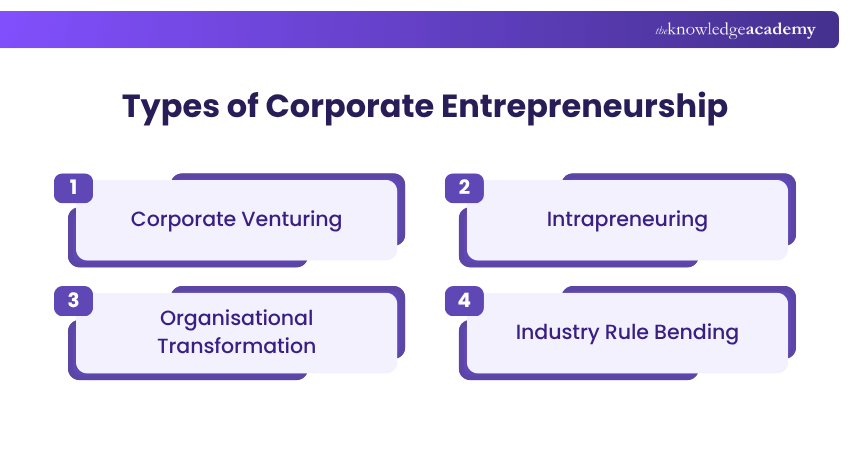
Corporate entrepreneurship can be structured and implemented in various ways, depending on the organisation’s goals and resources. Here are the four primary types of corporate entrepreneurship:
1) Corporate Venturing
Corporate venturing involves new business creation within an existing organisation. It is undertaken by a company to meet the objectives of new market entry or product development but outside regular operations. Investment in innovative ventures provides companies with the agility and creativity of a startup company along with the resources and capabilities of a well-established parent company.
2) Intrapreneuring
Intrapreneuring, in other words, refers to internal entrepreneurship. It provides a way for an employee in a corporation to act as an entrepreneur. It encourages employees to develop their ideas and turn them into projects that can help the company, with support and, in some cases, a budget. It allows employees to innovate, stay motivated, and bring an entrepreneurial mindset to their work, even within the structure of a large organisation.
3) Organisational Transformation
This type radically transforms the way an organisation operates, its culture, and its mindset toward the development of sustainable growth and innovation. Organisational transformation means the combination of holistic change management, which may lead to possible restructuring and new strategic directions, with the inclusion of new technologies. This type is critical for those organisations that require an entire overhaul to remain relevant and competitive.
4) Industry Rule Bending
Industry rule bending involves innovating in ways that challenge and reshape industry standards and practices. Companies taking this approach push back against the status quo, introducing products or business models that redefine existing categories rather than simply competing within them. This is most common in industries ripe for disruption, where established methods have grown outdated or no longer serve customers well.
Boost your workplace efficiency with our Organisational Skills Course– join today!
Four Models of Corporate Entrepreneurship
An established organisation can achieve innovation and new business development through corporate entrepreneurship models. Corporate entrepreneurship includes four main models, each shaped by its own structure, support systems and implementation approach. Here are the four models:
1) Opportunist
Under the opportunist model, employees search for new business opportunities through spontaneous action since the organisation lacks established structures for innovation. Corporate innovation happens spontaneously, and single individuals steer through internal procedures to achieve their innovative goals.
Ordinary creativity flourishes in this model but its ability to expand depends on insufficient structured support and funding systems.
2) Enabler
Through its enabler model, the company gives employees the necessary tools and financial support, along with instructions, to develop innovative ideas while sustaining decentralisation. Company leadership supports employee entrepreneurial behaviours through organised programmes that include funding opportunities and speed competitions.
The enabler model gives employees both independence and support, but it only works well with genuine leadership buy-in and an organisational culture that's genuinely open to new ideas.
Trainer’s Insight
More structure is not automatically better. The appropriate corporate entrepreneurship model depends on factors such as innovation goals, available resources, leadership involvement and how frequently new ventures are pursued.
3) Advocate
In the advocate model, a dedicated team or department champions and facilitates innovation across the organisation, without directly running the projects themselves. This support group helps employees access resources, secure funding through established channels, and build the internal connections needed to move an idea forward.
The advocate model keeps innovation aligned with broader organisational goals, but it can face resistance from more traditional departments and depends on strong internal support to succeed.
4) Producer
The producer model organises new business development through an innovation unit that both drives and executes corporate ventures. Specific programmes such as incubators, accelerators, and corporate venture capital receive heavy financial commitments from businesses.
Sustained innovation is supported through this model, yet it demands substantial funding commitments and potentially results in an innovation division distancing itself from mainstream business operations.
Learn how to maximise your potential with Personal Development Courses - Join now!
How to Promote Corporate Entrepreneurship?
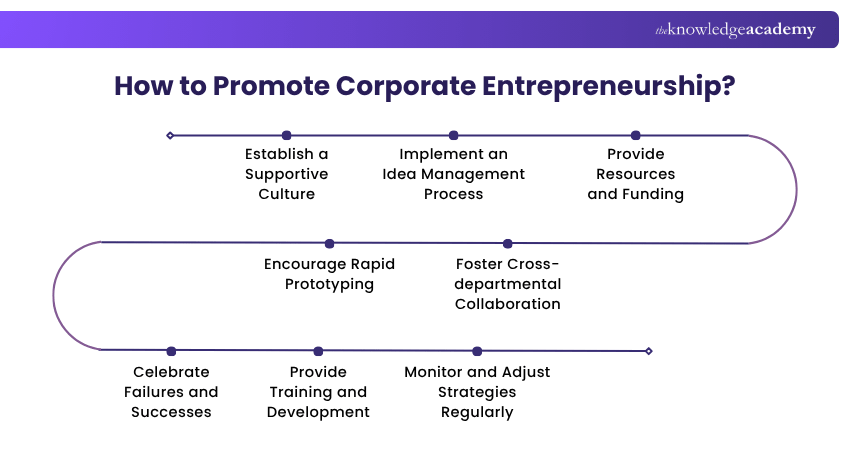
Here are the ways to promote corporate entrepreneurship:
1) Establish a Supportive Culture
A culture that supports entrepreneurial thinking really is top-down. The leadership has to be committed to creating an environment in which new ideas are welcome, and taking risks is not only fine but encouraged. This kind of support includes resources and the freedom to experiment for employees.
2) Implement an Idea Management Process
To effectively capture and evaluate innovative ideas, establish a structured process that encourages employees to submit their proposals. This should include clear criteria for assessment and a transparent process for how ideas are reviewed and progressed.
3) Provide Resources and Funding
For corporate entrepreneurship to thrive, businesses need to provide not just moral support but also financial backing and resources. This could be in the form of a dedicated budget for developing new ideas or access to expert advice and tools necessary for bringing an idea to fruition.
4) Foster Cross-departmental Collaboration
Encourage collaboration across different departments to break down silos and enhance creativity. This can lead to unexpected innovations as diverse perspectives and skills merge to create unique solutions.
5) Encourage Rapid Prototyping
Speed is crucial in innovation. Encourage teams to develop prototypes and iterate quickly based on feedback. This approach helps refine ideas and quickly determine their viability without substantial upfront investment.
6) Celebrate Failures and Successes
A critical aspect of promoting entrepreneurship within a company is to remove the stigma around failure. Celebrate both successes and learning experiences from failed projects. This will reinforce a culture of experimentation without fear of repercussions.
7) Provide Training and Development
Invest in training sessions that enhance your employees' entrepreneurial skills, such as creative thinking, problem-solving, and risk management. Regular workshops and seminars can keep the entrepreneurial spirit alive and kicking.
8) Monitor and Adjust Strategies Regularly
Finally, keep a close eye on the outcomes of your corporate entrepreneurship efforts. Regularly monitor and adjust strategies to ensure they are yielding the desired results and make changes where necessary.
Corporate Innovation Funnel
Generate Ideas↓Screen Opportunities↓Develop Prototype↓Test and Gather Feedback↓Scale, Revise or Stop
Benefits and Drawbacks of Corporate Entrepreneurship
Corporate entrepreneurship isn't without trade-offs, it can drive real growth and engagement, but it also introduces genuine risks and challenges that organisations need to manage carefully. Weighing both sides helps set realistic expectations before committing resources to new ventures. The following are the benefits and drawbacks of corporate entrepreneurship:
1) Benefits of Corporate Entrepreneurship
a) Growth Through Innovation: Encourages innovation as employees are given a chance to implement new ideas that can lead to breakthrough products and services.
b) Employee Engagement: By providing employees with more opportunities to be creative and take initiative, they tend to feel more engaged and motivated. This leads to increased job satisfaction and a reduction in the rate of turnover.
c) Agility: The entrepreneurial practices in the corporation enable it to become agile in adaptation and respond quickly to market and opportunity changes.
d) Risk Mitigation: Through corporate entrepreneurship, the companies can go for new ventures with a balanced risk approach, as failures can really be absorbed by the broader organisation without much effect.
Enhance your relationship-building skills with our Building Business Relationship Course – join today!
2) Drawbacks of Corporate Entrepreneurship
a) Resource Allocation: Allocating needed resources to a new venture strains a company's budget, especially when the new project does not bring the expected return in a timely manner.
b) Cultural Resistance: Within the organisation, especially in culturally designed ones, change might face scepticism in innovation initiatives.
c) Management Challenges: The effective management of core business activities, as well as innovation attempts, requires a balancing act that does not cause a deficit.
d) Failure Rates: Not all entrepreneurship projects are successful. The rates of failure sometimes escalate, so ensuring that morale is kept high and that failures are learned from is really important.
Quick Check
Before launching an initiative, consider:
□ Is there visible leadership support?□ Can employees submit ideas easily?□ Are resources available for promising concepts?□ Can teams collaborate across departments?□ Is experimentation supported?□ Are outcomes and lessons measured?□ Is there a clear process for scaling successful initiatives?
Corporate Entrepreneurship Examples
Big companies can use their current operating framework to nurture innovation, which results in launching new ventures or market transformations. Several well-known companies have put corporate entrepreneurship into practice across different sectors, as the examples below show.
1) Google: “20% Time” & Google X
Through its "20% Time" policy, Google enables staff members to devote work hours toward different projects outside their standard responsibilities. Through this initiative, developers created successful projects, including Gmail and Google Maps.
Google X maintains operation under its current name, X, the Moonshot Factory, to serve as an internal incubator which developed technologies such as Waymo's self-driving cars and Google Glass.
2) Amazon: AWS & Alexa
The original internal improvement project at Amazon Web Services (AWS) eventually grew into a leading cloud computing business model. Amazon adopted voice technology to develop the smart home device revolutionising platform known as Alexa.
Within its corporate infrastructure, Amazon promotes entrepreneurial innovation, which serves as a mechanism to launch new business segments.
3) Apple: App Store & Wearables
Apple demonstrates its entrepreneurial mindset through activities that enhance its product development programme. Through the App Store, Apple enabled third-party developers to build and sell iOS apps, creating an applications ecosystem that has generated billions in revenue. The Apple Watch, along with AirPods, showcases how Apple transforms itself while entering fresh market opportunities.
4) Tesla: Gigafactories & Energy Solutions
Corporate entrepreneurship exemplifies Tesla as the company extends its presence from electric cars to renewable energy sector development. Through its Gigafactories, Tesla revolutionised the way batteries are made and energy is stored. The company demonstrates industry-breaking capabilities by uniting various markets through its intrapreneurial developments, which include Solar Roof and Powerwall.

Subiksha Arulprakash is a Copywriter with 5+ years of experience in content writing, editing, content development and digital marketing. Her experience researching and writing about Business Skills, ISO standards and compliance enables her to produce clear, accessible content for different audiences.
View Detail

 If you wish to make any changes to your course, please


