




We may not have the course you’re looking for. If you enquire or give us a call on 01344203999 and speak to our training experts, we may still be able to help with your training requirements.
What is Cognitive Threat Analytics: An Overview
ByThe Knowledge AcademyLast updated on: 14 October 2026
Cognitive threat analytics was Cisco’s cloud-based threat detection technology that used machine learning and behavioural analytics to identify suspicious network activity. The capability later evolved through Cisco’s cognitive intelligence naming and became associated with global threat alerts.

At a Glance
1. Cognitive threat analytics was a Cisco cloud-based breach detection technology.2. It used machine learning, behavioural analysis, and anomaly detection.3. CTA focused on suspicious behaviour rather than relying only on known signatures.4. The capability later evolved through Cisco’s cognitive intelligence naming and became associated with global threat alerts.
In today's digital landscape, where cybersecurity threats continue to evolve and become more sophisticated, organisations need stronger security capabilities to safeguard confidential information and infrastructure. One such technology was Cisco Cognitive Threat Analytics, or CTA, a cloud-based breach detection capability designed to identify suspicious activity that had bypassed perimeter defences.
But how did cognitive threat analytics detect sophisticated threats, and what made its approach different from traditional security tools? This blog explores its key features, advantages, and its place in Cisco’s security technology evolution.
What is Cognitive Threat Analytics?
Cisco cognitive threat analytics was a cloud-based breach detection and analytics technology that used statistical modelling, behavioural analysis, anomaly detection, and machine learning to identify suspicious network activity. It was designed to detect threats that had already bypassed perimeter security controls.
Unlike security approaches that relied heavily on predefined signatures or manually maintained rules, CTA used behavioural analytics and machine learning to recognise potentially malicious behaviour.

Key Features of Cisco Cognitive Threat Analytics
The following are key features of Cisco cognitive threat analytics:
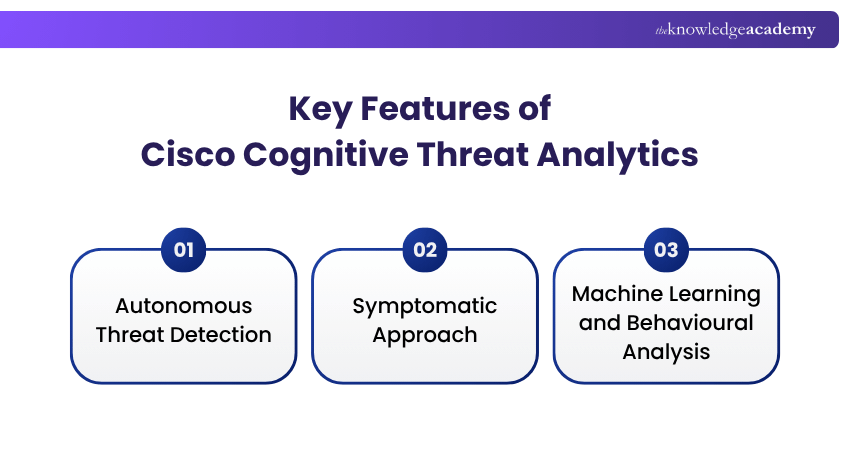
1) Autonomous Threat Detection
CTA could automatically identify suspicious behaviour without relying on manually created rule sets. Its machine learning models analysed network activity and highlighted behaviour that required investigation. Once enabled, the system could begin analysing activity without requiring teams to configure detection rules manually.
By analysing behavioural patterns, CTA could help security teams detect suspicious activity earlier and prioritise threats for investigation. This supported faster investigation of potential breaches and improved visibility into emerging threats.
2) Symptomatic Approach
CTA focused on behavioural symptoms of infection rather than relying solely on known attack methods or signatures. It analysed user behaviour and network activity to establish a baseline of normal behaviour and identify anomalies.
This approach helped detect suspicious activity even when the specific malware or attack technique was previously unknown.
Trainer's Pro Tip
When reviewing anomalous activity, assess behaviour in context rather than treating every deviation as a threat. Comparing patterns across users and network activity can help security teams prioritise events that need closer investigation.
3) Machine Learning and Behavioural Analysis
CTA used advanced statistical models and machine learning to analyse large volumes of network traffic and identify behavioural patterns associated with malicious activity. Its models could learn from observed data and adapt over time, helping security teams identify emerging threats and prioritise investigations.
Advantages of Cognitive Threat Analytics
These are the advantages of cognitive threat analytics:
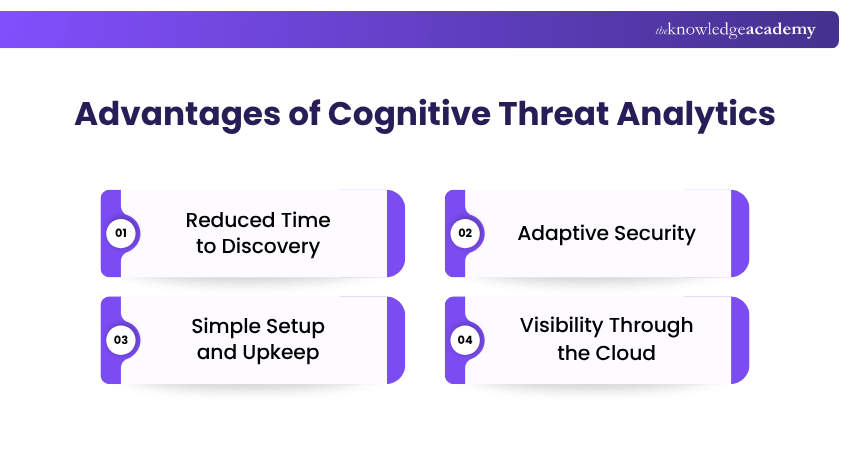
1) Reduced Time to Discovery
Reduced time to discovery was one of the key advantages of cognitive threat analytics. By continuously analysing network activity for behavioural anomalies, CTA helped identify suspicious activity more quickly and reduce the time between compromise and discovery.
Faster discovery gave security teams more time to investigate and respond to potential breaches, helping reduce the period during which malicious activity could remain undetected.
2) Adaptive Security
CTA used machine learning models that could learn from observed network activity and adapt over time. This helped the system recognise changing behavioural patterns without depending solely on manually updated rules and supported earlier identification of emerging threats.
3) Simple Setup and Upkeep
CTA was designed to reduce setup and maintenance requirements because its analytics operated in the cloud and did not depend on manually maintained detection rule sets. Cisco originally offered CTA as an add-on capability for its Cloud Web Security service.
This approach allowed security teams to focus more on investigating detected threats rather than maintaining complex analytics infrastructure.
4) Visibility Through the Cloud
CTA used cloud-based analytics to provide broader visibility into web traffic, including activity involving roaming users, branch offices, and corporate environments. Centralised analysis helped security teams identify suspicious behaviour across distributed network activity.
Quick Check
Which CTA capability helped security teams identify suspicious behaviour across distributed environments? Its cloud-based analytics provided broader visibility into activity across users, branches, and corporate networks.
Gain hands-on experience using Cisco security tools in real-world scenarios with the CCNP Security Training – Join now!

The Knowledge Academy develops accessible learning content across Project Management, IT, Cybersecurity, Data Science, Business Analysis, HR, Accounting and Finance, Leadership and Health and Safety. Its resources combine subject research with clear explanations to help professionals build practical knowledge across a wide range of disciplines.
View Detail

 If you wish to make any changes to your course, please


