




We may not have the course you’re looking for. If you enquire or give us a call on 01344203999 and speak to our training experts, we may still be able to help with your training requirements.
Brainstorming in Design Thinking - Explained
ByWilliam BrownLast updated on: 10 October 2026
Brainstorming in Design Thinking is a pivotal creative process that fuels innovation and problem-solving. This blog covers the principles and techniques of Brainstorming in Design Thinking, offering practical insights to help you harness its potential. Explore how this collaborative method empowers designers to generate fresh ideas and foster user-centric solutions.
Brainstorming is a cornerstone of the Design Thinking Process, acting as a conduit for innovation and creative problem-solving. By tapping into the collective intelligence of a group, it propels the creation of a multitude of ideas, thereby providing diverse solutions to design challenges. In this blog, we will enumerate the importance of Brainstorming in Design Thinking and how it can be effectively harnessed. Read more to find out!
What is Brainstorming in Design Thinking?
Brainstorming is a creative technique that involves generating and recording many ideas from a group of people who work together to solve a problem. A leader or a facilitator guides the Brainstorming process and encourages the participants to share their thoughts without any criticism or judgment. Brainstorming can help to produce a large number of ideas that might not be possible by working individually. By interacting with each other, listening to each other, and building on each other’s ideas, Brainstorming aims to enhance the group’s collective thinking.
Brainstorming in Design Thinking helps to explore different possibilities and perspectives and to generate insights and solutions that are desirable, feasible, and viable. Brainstorming in Design Thinking also fosters collaboration and empathy among the team members, as well as with the users and stakeholders.

Role of Brainstorming in Design Thinking
Brainstorming is an invaluable cog within the Design Thinking machinery. By creating an open environment where multiple ideas are encouraged and heard, Brainstorming facilitates the progression of the Design Thinking process. Below, we delve deeper into its essential roles
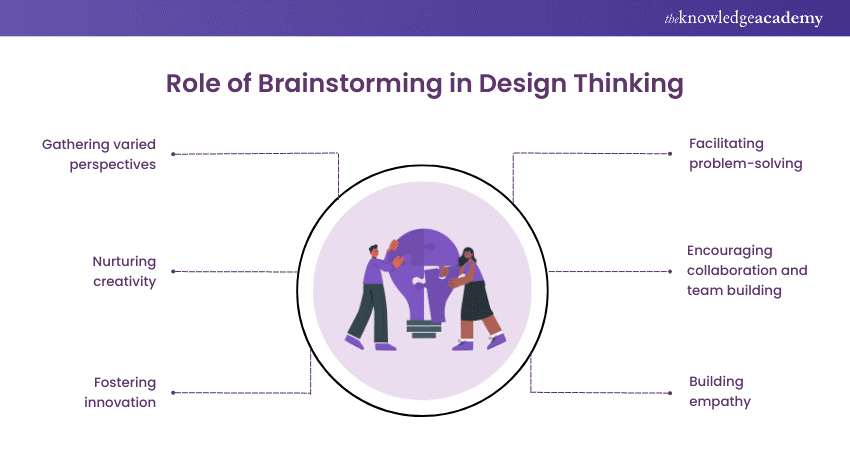
Gathering varied perspectives
Design Thinking is inherently a collaborative process. It involves pulling together insights from a wide variety of sources, including different stakeholders such as customers, employees, and external experts. Brainstorming, in this context, is essential for gathering these varied perspectives.
By involving a diverse group of individuals with different backgrounds and experiences, Brainstorming allows for a broad range of ideas to be considered. This diversity is a driving force for innovation, as it allows the team to explore many possible solutions and choose the ones that best address the needs and challenges that were identified in the earlier stages of the Design Thinking process.
Nurturing creativity
Creativity is at the heart of the Design Thinking Process, and Brainstorming plays a pivotal role in nurturing it. By creating an environment where every idea is welcomed and considered, no matter how outlandish it may seem, Brainstorming encourages participants to think outside the box. This freedom to explore and express any and all ideas often results in the emergence of truly unique and innovative solutions.
Moreover, the active engagement of all participants in a Brainstorming session creates a sense of ownership and involvement, which further encourages creative thinking. The creative energy within the group often builds on itself, as one idea can inspire others, leading to a cascade of ideas that might not have been generated in a less collaborative setting.
Fostering innovation
Brainstorming plays a crucial role in fostering innovation within the Design Thinking process. The absence of restrictions during a Brainstorming session encourages participants to take risks, allowing for the free exploration of ideas. This creates an atmosphere conducive to innovation, where even the most ambitious ideas can be considered and explored.
In the context of Design Thinking, this can be particularly impactful. During the Brainstorming phase, teams can take the insights they have gathered about users' needs and challenges and transform them into an array of potential solutions. This abundance of ideas lays the groundwork for the latter stages of the Design Thinking process, where ideas are prototyped and tested, ultimately leading to innovative solutions that are deeply aligned with users' needs.
Building empathy
An often-overlooked aspect of Brainstorming in Design Thinking is its role in building empathy. By allowing participants to freely share their thoughts and ideas, Brainstorming sessions can lead to a deeper understanding of different perspectives, including those of the end-users. This is especially crucial in Design Thinking, where understanding the user's perspective is at the heart of the process.
Brainstorming allows team members to put themselves in the users' shoes and view the problem from their perspective. By encouraging such empathy, Brainstorming helps generate solutions that are more aligned with users' needs and experiences.
Encouraging collaboration and team building
Brainstorming also plays a significant role in encouraging collaboration and team building within the Design Thinking process. During a Brainstorming session, everyone's ideas are valued, promoting a sense of equality among team members. This helps break down any hierarchical or departmental silos and fosters a more collaborative work environment.
Moreover, Brainstorming sessions can also serve as team-building exercises. As team members share, discuss, and build upon each other's ideas, they learn to communicate more effectively, respect different perspectives, and work together towards a common goal, thereby strengthening team cohesion.
Facilitating problem-solving
Brainstorming is also a powerful tool for problem-solving within the Design Thinking framework. It encourages the flow of ideas and makes problem-solving a more creative and engaging process. By not limiting the thought process, Brainstorming allows for the exploration of diverse solutions to the problem at hand.
The Brainstorming stage in Design Thinking often leads to a shift in perspective, enabling the team to view the problem from a new angle. This can lead to the identification of solutions that may not have been apparent in a more constrained thinking environment.
Unlock your creative potential with our Design Thinking Course– join now to transform your problem-solving approach and drive innovation in your organisation!
Guidelines for effective Brainstorming in Design Thinking
Maximising the potential of Brainstorming in Design Thinking requires creating the right conditions for ideation to flourish. Here, we expand further on some fundamental guidelines to facilitate this:
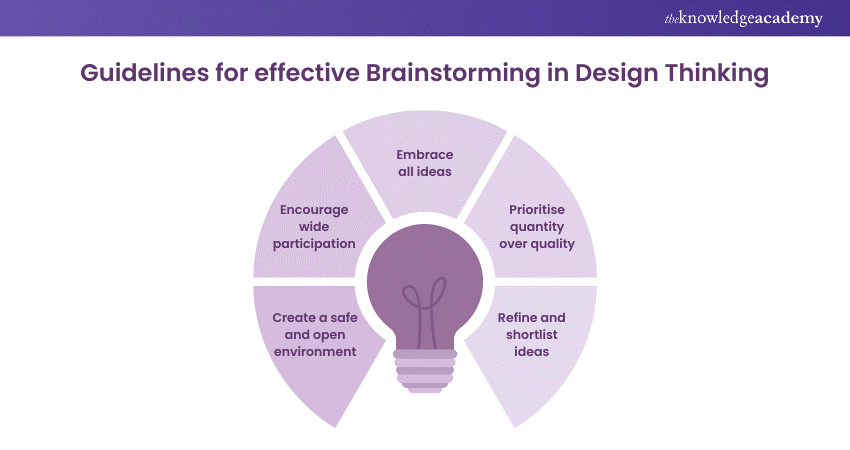
Create a safe and open environment
To effectively cultivate a safe and open environment, ground rules should be established at the outset. These rules might include respecting everyone's input, no idea being deemed "silly", and avoiding criticism or judgment during the ideation phase.
Facilitators should constantly encourage positive reinforcement and actively discourage negative feedback during the Brainstorming session. Also, the physical environment can impact the session's success. A comfortable, bright, and stimulating space can help put people at ease and encourage creative thinking.
Encourage wide participation
For wide participation, consider diverse representation from different departments, job roles, and even external stakeholders such as customers or users. Each person will bring a different perspective, enhancing the richness of the idea pool. Remember, it's not just about having people in the room, it's crucial they all feel empowered to contribute. To ensure quieter members are heard, techniques such as round-robin (where everyone takes turns to speak), or using sticky notes for anonymous idea submission can be employed.
Embrace all ideas
Fostering a culture that embraces all ideas involves acknowledging every contribution and ensuring all ideas are documented. A visual record of the ideas (using whiteboards, flip charts, or digital tools) can help facilitate this. It's also valuable to encourage the building of ideas - one person's thought might spark an idea in someone else, leading to even more innovative solutions. Remember, some ideas that initially appear offbeat or outlandish might, upon further reflection, hold the seed of an innovative solution.
Prioritise quantity over quality
The goal of a Brainstorming session should be to generate a high volume of ideas. Encourage rapid-fire thoughts and discourage lengthy debates over the merits of each idea during the ideation phase. The more ideas generated, the higher the chances of finding truly innovative solutions. Tools like setting a timer for idea generation or creating a goal of a specific number of ideas can aid in maintaining focus on quantity.
Refine and shortlist ideas
Once the Brainstorming session concludes and a large pool of ideas is created, it's time for refinement. This stage is about critically analysing each idea for its feasibility, alignment with user needs, and potential impact. Encourage open discussions and debates at this stage.
Various techniques can be used for this purpose, including voting (where each participant gets to vote for their top ideas), the 'Impact vs. Feasibility' matrix, or the 'Six Thinking Hats' method by Edward de Bono for a balanced evaluation of ideas. This helps in shortlisting the most promising ideas for further development and testing.
Unleash your potential with our Creative and Analytical Thinking Training – your pathway to innovative solutions and exceptional leadership. Sign up today!
Brainstorming tools and techniques
Brainstorming is a cornerstone of the Design Thinking process, and various tools and techniques can be used to facilitate this creative exploration. Here, we will take a look at some of the most effective methods that can enhance your Brainstorming sessions:
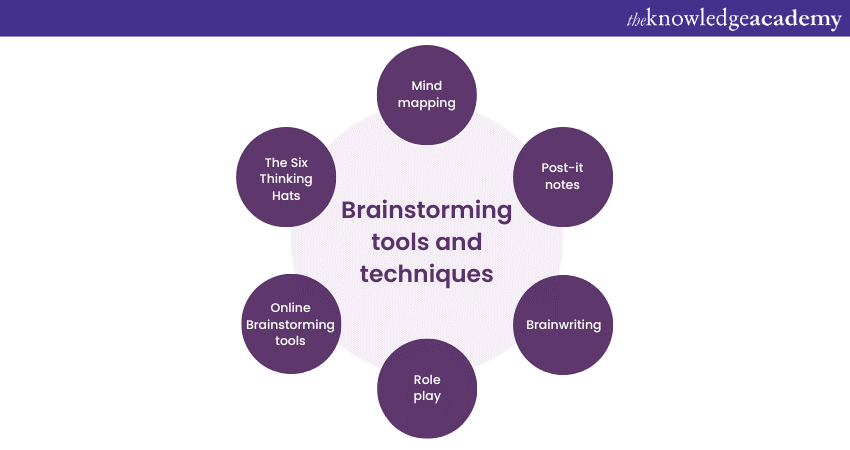
Mind mapping
Mind Mapping in Design Thinking is a highly visual tool that encourages participants to make connections between different ideas. It starts with a central concept and then branches out to related subtopics, creating a web of related ideas. This technique encourages lateral thinking and highlights the benefits of Mind Mapping by helping the team visualise the relationships between different concepts, fostering a deeper understanding of the problem at hand.
Post-it notes
Post-it notes are a simple yet incredibly effective tool for Brainstorming. They allow for quick, discrete idea generation and can be easily moved around to group or categorise ideas. This technique allows everyone to contribute, and the colourful notes can make the process more engaging and visual. Post-its can also be used in combination with other techniques, such as affinity diagrams, where similar ideas are grouped together to identify patterns or themes.
Brainwriting
Brainwriting is a variation of traditional Brainstorming, where instead of voicing ideas aloud, participants write down their ideas. This can be useful when dealing with larger groups or in situations where some participants might be hesitant to share their ideas in a group setting. Once the ideas have been written down, they can be shared with the group for further discussion.
Role play
Role play is a powerful tool for empathy building in the Design Thinking process. By stepping into the shoes of the end-user, participants can get a deeper understanding of their needs and challenges. Role-playing different scenarios can spark new insights and ideas that may not have surfaced through traditional Brainstorming techniques.
Online Brainstorming tools
With the rise of remote working, various online tools have been developed to facilitate Brainstorming in a virtual setting. These digital platforms, like Miro, MURAL, or Stormboard, offer virtual whiteboards where participants can add, organise and collaborate on ideas in real time, regardless of their location. These tools often include features such as voting, timers, and templates that can enhance the Brainstorming process.
The Six Thinking Hats
Developed by Edward de Bono, this technique encourages participants to think from different perspectives. Each 'hat' represents a separate way of thinking, such as focusing on facts, emotions, creativity, etc. By 'wearing' each hat in turn, participants can explore the problem and potential solutions from various angles, leading to a more comprehensive Brainstorming session
Take your Leadership skills to the next level by signing up for our Leadership Training today!

William Brown creates structured resources that help professionals identify business needs, evaluate operational problems and recommend appropriate improvements. His content explains how analytical methods can support better processes, decisions.
View Detail

 If you wish to make any changes to your course, please


