




We may not have the course you’re looking for. If you enquire or give us a call on 01344203999 and speak to our training experts, we may still be able to help with your training requirements.
Behavioural Theory of Leadership: Origins, Strengths, and Weaknesses
ByThe Knowledge AcademyLast updated on: 03 October 2026
Curious about the behavioural theory of leadership? This theory suggests that leadership effectiveness is determined by learned behaviours rather than innate qualities. In this blog, we will discuss how mastering these behaviours can enhance your leadership skills and effectiveness.

The Rundown
1. Behavioural leadership theory emphasises the actions and behaviours of leaders rather than their inherent traits or characteristics.2. Leadership behaviours can be observed, practised and developed.3. Early research explored both task-focused and people-focused leadership behaviours.4. Leadership effectiveness cannot always be explained by behaviour alone because situations and team needs also matter.5. Leaders can use behavioural principles to evaluate and improve their everyday actions.
Who wouldn’t prefer working with a manager who consistently motivates their team, achieves targets, and maintains a positive work environment? Have you ever wondered what makes these leaders so effective? The answer might lie in the behavioural theory of leadership. This theory focuses on the specific behaviours that distinguish successful leaders.
The behavioural theory of leadership suggests that anyone can become an effective leader through learned behaviours. Exploring this theory’s origins, strengths, and weaknesses provides valuable insights into developing and applying leadership skills across various fields. So, without further delay, let’s dive into this blog and uncover the secrets of this leadership theory.
What is Behavioural Theory of Leadership?
Behavioural Theory of Leadership is an approach to understanding leadership that focuses on what leaders actually do, their observable actions and behaviours, rather than fixed personality traits or characteristics they were born with. It holds that a leader's workplace behaviour, not their innate qualities, is what determines their success.
This approach involves observing and evaluating a leader's actions in response to specific situations, based on the idea that leadership skills are learned rather than innate. Proponents of this theory believe that anyone can become an effective leader by understanding and implementing certain behaviours.

Origins of the Behavioural Theory of Leadership
Behavioural approaches to leadership became particularly influential during the mid-20th century as researchers began paying greater attention to what effective leaders actually did. Two important research programmes associated with this development were the Ohio State Leadership Studies and the University of Michigan Leadership Studies:
1) Ohio State Leadership Studies
The Ohio State research examined different dimensions of leader behaviour. Researchers used instruments including the Leader Behaviour Description Questionnaire (LBDQ) to study how followers perceived their leaders’ behaviour. Two major dimensions became particularly influential:
a) Initiating Structure: This concerns the extent to which leaders organise work, define roles, establish expectations and focus on accomplishing tasks.
b) Consideration: This concerns behaviours related to mutual trust, respect, support and positive relationships between leaders and team members.
These dimensions helped showcase that leadership could be studied through observable patterns of behaviour rather than only through personal traits.
2) University of Michigan Leadership Studies
Research at the University of Michigan also explored leadership behaviour, with particular attention to employee-oriented and production-oriented approaches. Employee-oriented leadership places greater emphasis on relationships, employee needs and interpersonal aspects of work.
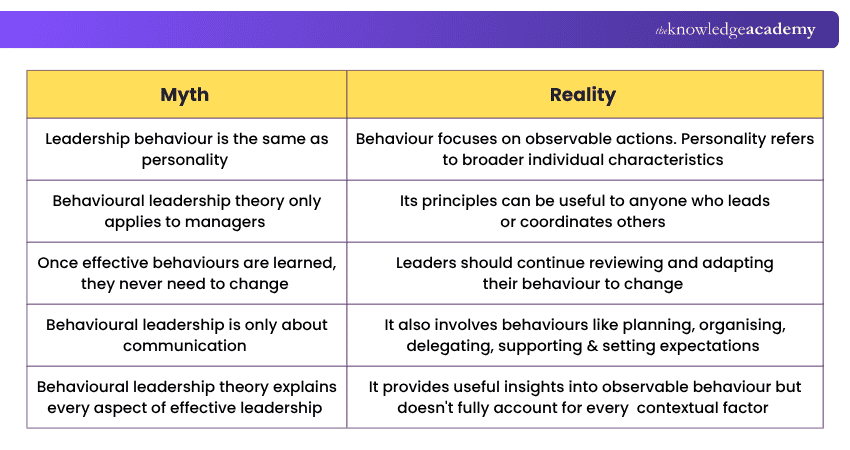
Production-oriented leadership focuses more strongly on technical and task-related aspects of getting work completed. Together, these research programmes helped shift leadership research towards understanding how leaders behave. Here are some myths related to behavioural theory of leadership to watch out for:
Key Behaviours in Behavioural Leadership Theory
Rather than treating behavioural leadership as a fixed set of personality-based leadership types, it is more useful to examine the broad patterns of behaviour identified through behavioural leadership research.
1) Task-oriented Behaviour
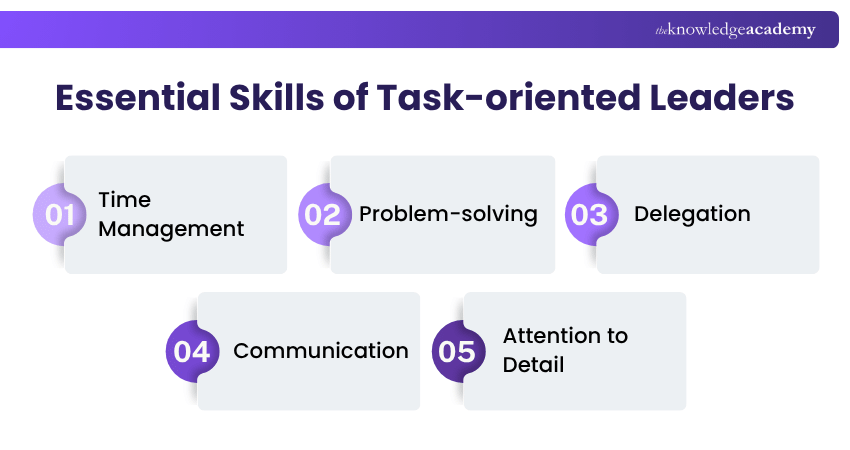
Task-oriented behaviour focuses on achieving objectives, organising work and ensuring that responsibilities are clearly understood. Leaders displaying strong task-oriented behaviour may establish goals, define roles, coordinate activities, monitor progress and clarify expectations. Here are the essential skills for a task-oriented leader:
These behaviours can be especially valuable when teams require structure or when deadlines and responsibilities must be carefully managed. However, concentrating too heavily on tasks without considering people can affect communication, motivation and working relationships.
Pro Tip
If deadlines are repeatedly missed, examine your task-oriented behaviours. Check whether responsibilities, priorities and expectations are genuinely clear to everyone before assuming that performance is the problem.
Learn how to inspire and effectively motivate your team - join our Leadership Courses now!
2) People-oriented Behaviour
People-oriented behaviour focuses on relationships, communication and the needs of team members. Leaders using these behaviours may listen to employees, provide encouragement, recognise achievements and support professional development.
Strong people-oriented behaviour can help build trust and encourage collaboration. It can also help leaders understand individual concerns and create an environment where team members feel supported. However, maintaining positive relationships should not come at the expense of clear expectations and organisational objectives.
Pro Tip
Ask team members for feedback on specific leadership behaviours rather than simply asking, “Am I a good leader?” Questions about communication, support and delegation are easier to translate into meaningful improvements.
3) Balancing Task and Relationship Behaviours
Task-oriented and people-oriented behaviours do not necessarily have to be treated as opposites. Leaders may display elements of both depending on what their teams and responsibilities require. Balancing the two well often means knowing which behaviour a specific moment calls for, rather than defaulting to the same approach regardless of the situation.
For example, a manager approaching an important deadline may need to establish clear responsibilities and monitor progress while still listening to concerns and providing support.
Strengths and Weaknesses of Behavioural Theory of Leadership
Behavioural theory of leadership has clear practical value, since focusing on observable actions makes leadership something people can actually learn, practise and improve. At the same time, behaviour alone doesn't capture the full picture of what makes a leader effective. Let’s discuss the key strengths and weaknesses:
Strength 1: Leadership Behaviours Can Be Developed
Behavioural theory of leadership argues that anyone can become an effective leader with the right training, challenging the idea that leaders are born, not made. This approach allows companies to train internal candidates, reducing the need for costly recruitment processes.
Additionally, this theory boosts confidence among aspiring leaders, knowing they can develop and enhance essential leadership skills. It promotes the belief that with proper guidance, anyone can help a company achieve its organisational goals.
Strength 2: Focuses on Observable Actions
Behaviour is easier to observe and discuss than abstract personality characteristics. For example, instead of telling a manager that they need to become “more leadership-oriented”, feedback can identify specific actions, such as providing clearer instructions, listening more carefully or recognising team achievements. This provides leaders with practical areas they can work on.
Weakness 1: Doesn't Account for Follower Readiness or Task Complexity
The same leadership behaviour doesn't work equally well for every team or task. A highly structured, task-oriented approach may suit a new or inexperienced team, but the same behaviour could feel restrictive or unnecessary for an experienced team capable of working independently.
Because behavioural theory focuses on the leader's actions rather than the follower's readiness or the complexity of the task at hand, it offers limited guidance on when to apply a given behaviour, this gap is part of what later led to situational and contingency leadership models.
Weakness 2: Behaviour Alone Doesn't Explain Leadership Effectiveness
Behavioural theories provide useful insight into what leaders do, but leadership effectiveness can depend on more than observable actions. Organisational culture, team experience, working conditions and other contextual factors may influence whether particular leadership behaviours produce the desired result.
Behavioural Leadership Checklist
Before putting the theory into practice, ask yourself:
□ Have I clearly communicated goals and expectations?□ Do team members understand their responsibilities?□ Am I listening to employee concerns and feedback?□ Do I provide appropriate support and recognition?□ Am I delegating responsibilities effectively?□ Do I balance task requirements with team needs?□ Do I regularly ask for feedback about my leadership behaviour?□ Am I adapting my behaviour when circumstances change?

The Knowledge Academy develops accessible learning content across Project Management, IT, Cybersecurity, Data Science, Business Analysis, HR, Accounting and Finance, Leadership and Health and Safety. Its resources combine subject research with clear explanations to help professionals build practical knowledge across a wide range of disciplines.
View Detail

 If you wish to make any changes to your course, please


