




We may not have the course you’re looking for. If you enquire or give us a call on 01344203999 and speak to our training experts, we may still be able to help with your training requirements.
12 Best Research-Worthy Artificial Intelligence Topics in 2026
ByVishnu SankarLast updated on: 18 September 2026
Explore 12 artificial intelligence topics for research in 2026, covering established and emerging areas across AI development, applications and responsible innovation. Discover promising research directions and gain insights to help you choose a relevant AI research topic.

Key Topics Covered
1. Language and Vision: NLP, computer vision and intelligent content interpretation.2. Learning and Decision-making: Reinforcement learning, autonomous systems and adaptive decision-making.3. Trustworthy AI: Explainability, fairness, bias mitigation and ethical AI development.4. AI Applications: Healthcare, robotics, education, autonomous vehicles and social impact.5. Future Research: AGI, multimodal and foundation models, agentic AI and emerging AI capabilities.
Artificial Intelligence (AI) continues to evolve rapidly, creating new opportunities for research while raising important questions around reliability, safety, fairness and real-world applications. As researchers explore these possibilities and challenges, choosing a focused and relevant research area becomes increasingly important.
The following topics provide a starting point for exploring different directions in AI research, from established technologies and practical applications to emerging capabilities that could shape its future.
Top Artificial Intelligence Topics for Research
This section of the blog will expand on some of the best artificial intelligence topics for research.
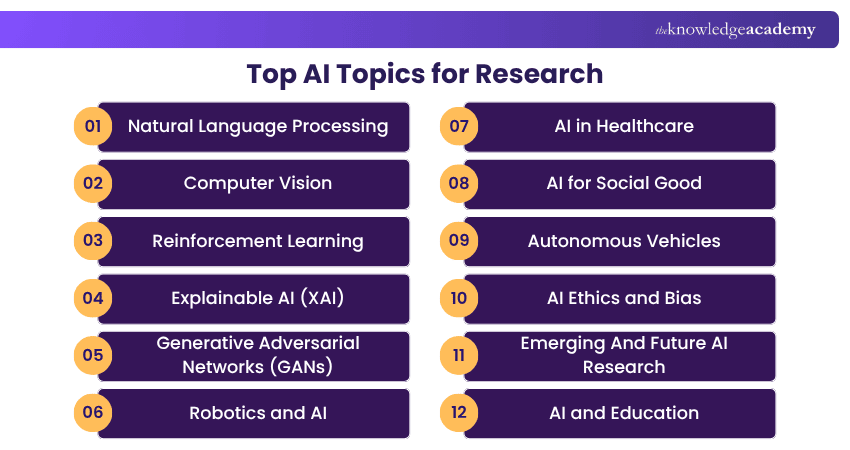
1) Natural Language Processing
Natural Language Processing (NLP) is centred around empowering machines to comprehend, interpret, and even generate human language. Within this domain, three distinctive research avenues beckon:
1) Sentiment Analysis: This entails studying methods for identifying opinions, attitudes and sentiment expressed in textual content. Understanding sentiment is valuable in applications ranging from brand perception analysis to social media insights.
2) Language Generation: Generating coherent and contextually apt text is an ongoing pursuit. Investigating mechanisms that allow machines to produce human-like narratives and responses holds immense potential across sectors.
3) Question Answering Systems: Constructing systems that can grasp the nuances of natural language questions and provide accurate, coherent responses is a cornerstone of NLP research. This facet has implications for knowledge dissemination, customer support, and more.

2) Computer Vision
Computer vision, a discipline that bestows machines with the ability to interpret visual data, is replete with intriguing avenues for research:
1) Object Detection and Tracking: The development of algorithms capable of identifying and tracking objects within images and videos finds relevance in surveillance, automotive safety, and beyond.
2) Image Captioning: Bridging the gap between visual and textual comprehension, this research area focuses on generating descriptive captions for images, supporting accessibility for people with visual impairments and enhancing multimedia indexing.
3) Facial Recognition: Advancements in facial recognition technology hold implications for security, personalisation, and accessibility, necessitating ongoing research into accuracy and ethical considerations.
3) Reinforcement Learning
Reinforcement Learning (RL) enables agents to learn decision-making strategies by interacting with an environment and receiving feedback through rewards or penalties. Research spans robotics, autonomous systems, gaming, resource optimisation and other sequential decision-making problems.
1) Reinforcement Learning for Autonomous Systems: Research explores how reinforcement learning can enable autonomous systems to learn decision-making strategies in dynamic environments, with applications in robotics, navigation and adaptive control.
2) Deep Q-Networks (DQN): Deep Q-Networks, a class of reinforcement learning algorithms, remain under active research for refining value-based decision-making in complex scenarios.
3) Policy Gradient Methods: These methods, aiming to optimise policies directly, play a crucial role in fine-tuning decision-making processes across domains like gaming, finance, and robotics.

4) Explainable AI (XAI)
The pursuit of Explainable AI seeks to make the decision-making processes of AI systems more understandable. Key research areas include:
1) Model Interpretability: Unravelling the inner workings of complex models to elucidate the factors influencing their outputs, thus fostering transparency and accountability.
2) Visualising Neural Networks: Transforming abstract neural network structures into visual representations aids in comprehending their functionality and behaviour.
3) Counterfactual Explanations: Research explores explanations that show how changes to specific inputs could alter an AI system's output, helping users better understand individual predictions and decisions.
5) Generative Adversarial Networks (GANs)
The captivating world of Generative Adversarial Networks (GANs) uses an adversarial training framework in which a generator creates synthetic data while a discriminator attempts to distinguish generated data from real data:
1) Image Generation: Generating realistic synthetic images showcases the creative potential of GANs, with applications spanning art, design and data augmentation.
2) Style Transfer: GAN-based approaches can transfer visual characteristics between image domains, supporting research into creative image generation and transformation.
3) Anomaly Detection: GAN-based approaches can support anomaly detection by modelling normal data patterns and helping identify unusual observations, with potential applications in areas such as fraud detection and quality control.
6) Robotics and AI
The synergy between robotics and AI is a fertile ground for exploration, with artificial intelligence topics such as:
1) Human-Robot Collaboration: Research in this area explores effective and safe collaboration between humans and robots, with the potential to support productivity, efficiency and task performance in industrial and other settings.
2) Robot Learning: By enabling robots to learn and adapt from experience, researchers aim to improve their autonomy and ability to handle diverse tasks.
3) Ethical Considerations: Delving into the ethical implications surrounding AI-powered robots helps establish responsible guidelines for their deployment.
Start creating efficient automated workflows with our Robotic Process Automation Training - Register now!
7) AI in Healthcare
AI presents transformative potential within healthcare, spurring research into areas such as those explored in the artificial intelligence in healthcare guide:
1) Medical Diagnosis: AI can support medical diagnosis and early detection by helping healthcare professionals analyse medical images, clinical data and other patient information.
2) Drug Discovery: Leveraging AI can help identify and prioritise potential drug candidates, supporting research across different stages of drug discovery.
3) Personalised Treatment: Research explores how AI can support the tailoring of medical interventions to individual patient characteristics, with the aim of improving treatment decisions and outcomes.
Did You Know?
The FDA is exploring ways to identify AI-enabled medical devices that incorporate foundation models, including Large Language Models (LLMs) and multimodal architectures, to improve transparency for healthcare professionals and patients.
8) AI for Social Good
Harnessing the prowess of AI for social good entails addressing pressing global challenges:
1) Environmental Monitoring: AI-powered solutions can help analyse environmental data and monitor ecological changes, supporting conservation and sustainable practices.
2) Disaster Response: Research in this area bolsters disaster response efforts by employing AI to analyse data and optimise resource allocation.
3) Poverty Alleviation: Researchers explore how AI can support poverty mapping, resource allocation, financial inclusion and humanitarian programmes aimed at addressing socioeconomic challenges.
9) Autonomous Vehicles
Autonomous vehicles represent a realm brimming with potential and complexities, necessitating research in artificial intelligence topics such as:
1) Sensor Fusion: Integrating data from multiple sensors can improve the robustness and accuracy of environmental perception, supporting safer autonomous navigation.
2) Path Planning: Developing advanced algorithms for path planning helps autonomous vehicles identify efficient routes while meeting safety and operational constraints.
3) Safety and Ethics: Research explores how autonomous vehicles can manage risk and uncertainty, protect road users and make safe decisions in complex environments. It also examines accountability and ethical considerations surrounding automated driving decisions.
10) AI Ethics and Bias
Ethical underpinnings in AI drive research efforts in these directions:
1) Fairness in AI: Research explores methods for identifying, measuring and mitigating unfair bias across different groups and contexts.
2) Bias Detection and Mitigation: Identifying and reducing biases in AI models can help support fairer and more equitable outcomes.
3) Ethical Decision-making: Developing frameworks that help align AI-assisted decisions with ethical principles, human values and societal expectations.
Develop practical expertise to create predictive models and turn data into actionable insights with our Machine Learning Course - Join now!
11) Emerging And Future AI Research
Emerging AI research continues to explore new capabilities, architectures and approaches, including:
1) Artificial General Intelligence (AGI): Research explores the possibility, requirements, risks and implications of developing AI systems with broader and more general capabilities.
2) Multimodal and Foundation Models: Researchers are investigating foundation models and multimodal AI systems capable of working with one or more forms of data, including text, images, audio and video, while exploring ways to improve their reasoning, efficiency, reliability and safety.
3) Agentic AI and Autonomous AI Systems: Research examines AI systems designed to perform capabilities such as planning, using tools, completing multi-step tasks and operating with varying degrees of autonomy.
Trainer’s Insight
When choosing an AI research topic, do not focus only on the newest technology. Strong research often comes from identifying a specific problem, selecting suitable AI methods and evaluating factors such as accuracy, explainability, safety, fairness and real-world usefulness.
12) AI and Education
The intersection of AI and Education opens doors to innovative learning paradigms:
1) Personalised Learning: Developing AI systems that adapt educational content based on learners’ progress, performance, needs and pace.
2) Intelligent Tutoring Systems: Creating AI-driven tutoring systems that provide targeted support to students.
3) Educational Data Mining: Applying AI to analyse educational data for insights into learning patterns and trends.
Decode human language with Natural Language Processing (NLP) Fundamentals With Python Training – Join now!

Vishnu Sankar is a Senior Content Writer with 5+ years of experience across content development, software development, web development and system administration. His technical background and professional training support his expertise in IT and Tech, while his extensive research and writing experience covers Project Management and Health and Safety.
View Detail

 If you wish to make any changes to your course, please


