




We may not have the course you’re looking for. If you enquire or give us a call on 01344203999 and speak to our training experts, we may still be able to help with your training requirements.
Artificial Intelligence Techniques: Explained in Detail
ByLily TurnerLast updated on: 19 September 2026
Dive deep into the world of artificial intelligence techniques with our comprehensive blog. Understand the fundamentals of AI techniques, from the different types, including supervised, unsupervised, reinforcement, deep learning, Natural Language Processing (NLP), and computer vision, to how they shape the AI landscape.
The Rundown
1. Core Concepts: Understand the fundamental ideas and processes behind artificial intelligence techniques.2. Learning Approaches: Explore how supervised, unsupervised and reinforcement learning work with different types of data.3. Key AI Areas: Discover how deep learning, NLP and computer vision support different AI applications.4. Popular Techniques: Learn about linear regression, random forest, CNNs, transformers, GANs and other widely used techniques.5. Real-world Uses: See how AI Techniques support tasks such as prediction, classification, pattern discovery, language processing and visual analysis.
Artificial intelligence techniques spark major changes in many areas of life and work. They empower data-driven decision-making, automate tasks, and personalise experiences, enhancing efficiency and precision. In healthcare, AI aids in diagnosis and drug discovery, while natural language understanding and computer vision technologies revolutionise communication and visual data interpretation.
AI also catalyses scientific discoveries, benefits the financial sector, aids in environmental conservation, and supports greater accessibility. It fortifies cybersecurity, revolutionises education, and sparks creativity in various fields. In this blog, we'll explore how artificial intelligence techniques significantly impact innovation and shape our future in profound and transformative ways.
Understanding Artificial Intelligence Techniques
Understanding AI techniques is crucial for grasping the inner workings of AI systems, which use computational methods to perform tasks associated with learning, reasoning, perception and decision-making. In the realm of artificial intelligence, these techniques reveal several fundamental aspects, each playing a significant role in AI's capacity to learn, reason, and process human language.
Learning is the bedrock of AI. It is the process by which AI systems accumulate knowledge from data and experiences. Through learning, AI systems discern patterns and relationships within data, allowing them to independently predict outcomes and make decisions.
Reasoning is the cognitive process in which AI systems employ logical thinking to draw conclusions, make inferences, and solve complex problems. This aspect allows AI to make informed decisions based on available information, much like human thought processes.
Problem-solving is a critical facet of AI techniques. AI employs algorithms, mathematical procedures, and computational methods to tackle specific challenges efficiently. Whether optimising delivery vehicle routes or solving intricate mathematical equations, AI's problem-solving capabilities are instrumental in many applications.
Perception equips AI systems with the ability to interpret their environment. Through various sensors and data sources, AI perceives the world around it. This sensory input is vital for tasks such as image recognition, where AI processes visual data to identify objects, and speech recognition, where it processes audio to identify or transcribe spoken language.
Language understanding, often achieved through Natural Language Processing (NLP) techniques, is pivotal for effective human-computer interaction. AI systems equipped with NLP can analyse and generate human language, although their ability to handle nuance, context and sentiment varies by system and task. This enables applications such as chatbots, virtual assistants and language translation.
Trainer Insight
AI techniques rarely operate in complete isolation. A real-world AI system may combine multiple approaches. For example, a computer vision application may use deep learning for image analysis alongside other techniques for classification or decision-making.

Types of Artificial Intelligence Techniques
AI techniques include different learning paradigms, modelling approaches and application areas. By grouping these techniques, we can better understand how AI systems work and influence the world around us.
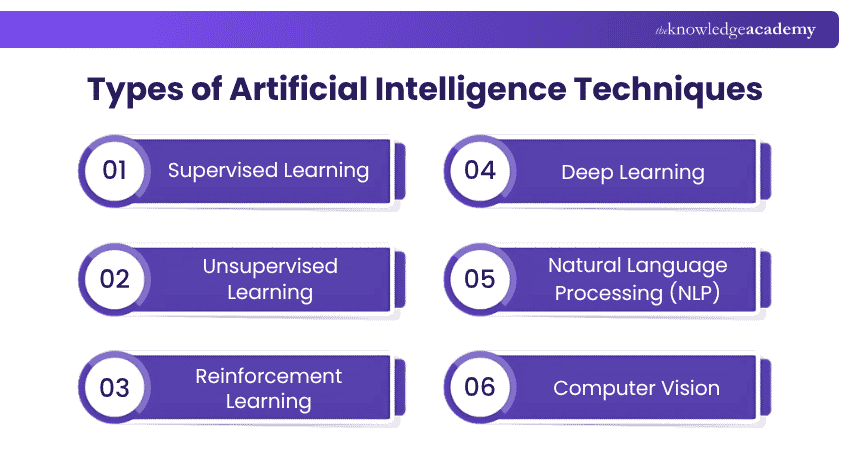
1) Supervised Learning
Supervised learning is a foundational machine learning technique used for tasks requiring prediction or classification. In this method, AI systems learn from labelled data, where each example is paired with a known output. The system identifies patterns and relationships in the training data to predict the appropriate output for new inputs.
Supervised learning is used widely in applications such as image classification, speech recognition and certain recommendation systems. For example, it helps email spam filters identify whether incoming messages are spam or legitimate based on learned patterns.
2) Unsupervised Learning
Unsupervised learning takes a different approach from supervised learning. In this one, AI systems analyse unlabelled data without predefined target labels. The objective is to uncover underlying basic patterns or structures within the data.
Clustering and dimensionality reduction are common unsupervised learning techniques. For example, clustering can group customers with similar behaviours to help identify distinct customer segments for targeted marketing.
3) Reinforcement Learning
Reinforcement learning is an approach where an agent learns to make decisions by interacting with an environment. Instead of learning from labelled examples, the agent takes actions and receives rewards or other feedback based on their outcomes.
The agent learns from trial and error, gradually developing a policy that aims to maximise long-term rewards. Reinforcement learning is commonly applied to areas such as robotics, game-playing and sequential decision-making.
4) Deep Learning
Deep learning utilises neural networks with multiple layers to identify complex patterns and learn representations from data. The impact of deep learning can be seen in image and speech recognition. It has also been combined with approaches such as reinforcement learning and search in AI systems designed to play games like chess.
Pro Tip
Deep learning can be effective for complex tasks involving images, audio and language, but it may require substantial training data and computational resources. A simpler machine learning method may be more appropriate for smaller or structured datasets.
Get practical experience in implementing deep learning models with our Deep Learning Course – Register now!
5) Natural Language Processing (NLP)
Natural Language Processing (NLP) focuses on enabling machines to process, interpret and generate human language. It allows AI systems to work with text and speech for tasks such as chatbots, machine translation, sentiment analysis and virtual assistants. NLP helps make interactions between people and computers more natural and accessible.
6) Computer Vision
Computer vision is a field of AI that allows machines to analyse and interpret visual information from images and videos. It can be used to identify objects, people, patterns and scenes. Common applications include autonomous driving systems, facial recognition and manufacturing inspection systems that detect product defects.
Real-world Example
In manufacturing, a computer vision system can analyse product images and flag visible defects for further inspection.
Understand how AI and machine learning power cognitive computing systems with our Cognitive Computing Training – Join today!
Exploring the Landscape of AI Techniques
In this section, we will talk about various AI techniques, each with distinct characteristics and practical applications:
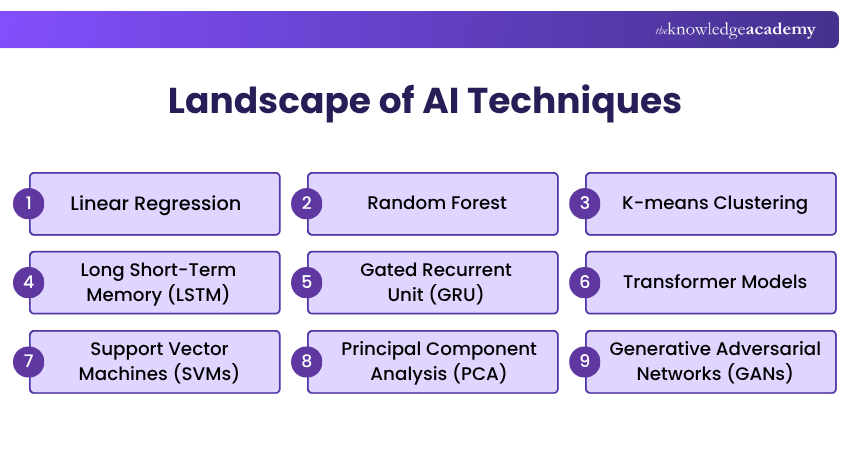
a) Linear Regression: A supervised learning method for predicting continuous outcomes, widely used in fields such as economics for trend prediction and healthcare for estimating patient outcomes.
b) Random Forest: An ensemble learning technique widely used for classification and regression tasks. It finds applications in finance for credit risk assessment and ecology for species classification.
c) K-means Clustering: An unsupervised learning approach that groups similar data points. It is employed in customer segmentation strategies and image compression.
d) Q-learning: A reinforcement learning algorithm that enables agents to learn which actions to take in different states through interaction with an environment and reward feedback. It is instrumental in robotics path planning and game-playing agents.
e) Convolutional Neural Networks (CNNs): These deep learning models are tailored for image and video analysis and are widely used in applications like facial recognition, autonomous vehicles, and medical image analysis.
f) Recurrent Neural Networks (RNNs): RNNs are designed for managing sequential data such as time series. They can be used for tasks such as time-series analysis and sequence modelling.
g) Long Short-Term Memory (LSTM): An RNN variant designed to capture long-term dependencies in data sequences, normally used in applications like speech recognition and machine translation.
h) Gated Recurrent Unit (GRU): Another RNN variant built to capture dependencies in sequential data while using a simpler gating structure than LSTMs. It is used in tasks such as time-series forecasting, speech processing and other sequence-modelling applications.
i) Transformer Models: These are widely used neural network architectures that underpin many modern language and generative AI systems, with well-known examples including BERT and the GPT family. They power applications like chatbots, language translation, and content summarisation.
j) Support Vector Machines (SVMs): They are supervised learning techniques used to classification and regression problems. They are employed in various fields, such as stock market prediction and disease classification.
k) Principal Component Analysis (PCA): This is an unsupervised technique for dimensionality reduction, commonly used in applications such as image compression and data visualisation.
l) Generative Adversarial Networks (GANs): These deep learning models are used for generating synthetic data, image-to-image translation, and more. GANs use an adversarial training process involving a generator and a discriminator. They can be used to build synthetic images and data for research or training, as well as manipulated media such as deepfakes.
Quick Checklist: Before Choosing an AI Technique
What problem are you trying to solve? What type and amount of data do you have? Is the data labelled or unlabelled? Are you predicting, grouping, generating or analysing? What computing resources are available? How will you evaluate the model's performance? What accuracy, interpretability and deployment constraints matter?
Analyse data and generate insights using natural language AI analysis with our AI Productivity Foundation And Practitioner (The Users) Training – Join now!

Lily Turner transforms complex data concepts into structured resources for aspiring and established data professionals. Her writing demonstrates how analytical methods and emerging technologies can be used to investigate problems, generate insights and support informed decisions.
View Detail

 If you wish to make any changes to your course, please


