




We may not have the course you’re looking for. If you enquire or give us a call on 01344203999 and speak to our training experts, we may still be able to help with your training requirements.
AI in Cyber Security: A Complete Guide
ByNilotpal SarmahLast updated on: 07 October 2026
This blog explains artificial intelligence in cyber security by exploring how AI integrates into cyber security and its benefits. Explore how AI in cyber security helps detect threats, automate responses, strengthen data protection, and improve risk management for modern organisations and digital systems.
The Gist
1. AI helps cyber security systems analyse large volumes of security data and identify suspicious patterns.2. Common applications include anomaly detection, phishing detection, malware analysis, identity security and incident response.3. AI can support faster threat detection, prioritisation and automated security workflows.4. Its effectiveness depends on reliable data, suitable models, monitoring and security controls.5. Human expertise remains important for investigating complex threats and making high-impact security decisions.
Artificial Intelligence (AI) in cyber security is transforming how organisations can detect and respond to cyber threats in an increasingly connected digital world. As cyberattacks become more advanced and data sharing continues to grow rapidly, businesses are relying on AI and machine learning technologies to bolster security, identify unusual behaviour, and automate threat response.
AI-powered cyber security systems can analyse patterns, monitor online activities, and detect potential risks before attacks occur, helping organisations reduce vulnerabilities and improve resilience against cyber threats. With the AI in cyber security market projected to reach £647.9 billion by 2035, AI continues to play a critical role in protecting modern digital environments. Read this blog to understand what artificial intelligence in cyber security is and more.
What is AI in Cyber Security?
AI in cyber security defines the use of artificial intelligence techniques to support the detection, analysis, prioritisation and response to cyber threats. AI-powered security systems can analyse vast volumes of security data, identify patterns and detect behaviour that may indicate malicious activity.
They can also help security teams prioritise alerts and automate selected response processes. Rather than replacing existing cyber security controls, AI can complement technologies, processes and human expertise to strengthen an organisation's overall security capabilities.
AI in Action: Suspicious Login Detection
Imagine an employee normally accesses organisational systems during regular working hours using a familiar device. Suddenly, the account attempts to access sensitive information from an unfamiliar device or unusual location.
Login Event↓AI Analyses User Behaviour↓Activity Differs from Expected Pattern↓Risk Level Assessed↓Security Alert Generated↓Additional Authentication or Analyst Review
This shows how AI can support detection while keeping appropriate security controls and human judgement within the process.
Benefits of Incorporating Artificial Intelligence in Cyber Security
AI can strengthen cyber security operations by helping organisations process large amounts of information and identify potentially important security events. Here are the key benefits:
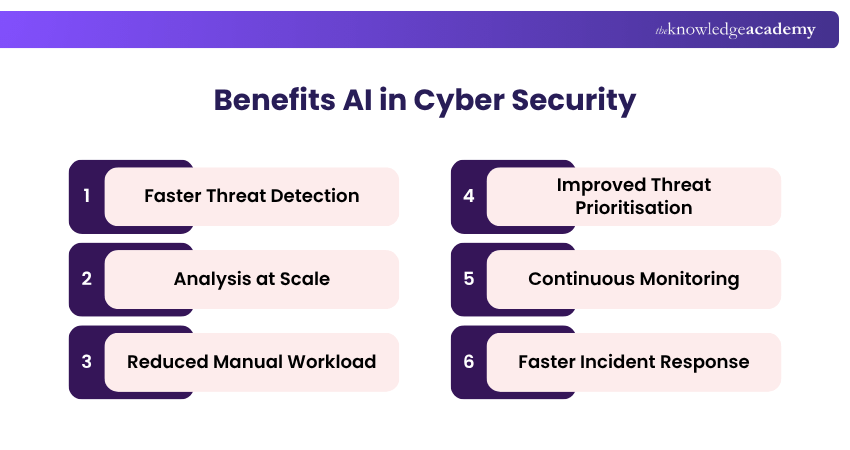
1) Faster Threat Detection
AI systems can continuously analyse security activity and identify suspicious patterns. Faster detection can give security teams more time to investigate and respond to potential threats.
2) Analysis at Scale
Modern organisations can generate enormous amounts of security data. AI can assist with analysing this information at a scale that would be difficult to handle entirely through manual review. AI can help security teams analyse large volumes of network traffic and security data more efficiently.
3) Reduced Manual Workload
AI and automation can handle selected repetitive analytical tasks. This can allow security professionals to spend more time investigating complex threats and making higher-value decisions.
4) Improved Threat Prioritisation
Not every security event carries the same level of risk. AI can help analyse available context and support the prioritisation of events that may require more immediate investigation.
5) Continuous Monitoring
AI-powered systems can analyse security activity continuously rather than relying solely on periodic manual reviews. This can help organisations maintain visibility across changing environments.
6) Faster Incident Response
AI can provide security teams with additional context about incidents and automate selected response actions.
Pro Tip
Effective anomaly detection starts with understanding normal behaviour. A reliable baseline makes it easier to assess unusual login activity, network traffic or user behaviour meaningfully.
Learn the fundamentals of artificial intelligence. Sign up for our AI Course For Beginners now!
How is Artificial Intelligence Used in Cyber Security?
As cyber security threats become more advanced and connected devices continue to grow, AI helps organisations detect and respond to attacks faster than traditional security methods. AI-powered systems analyse large volumes of data, identify unusual activity, and automate threat detection and response. They can also alert IT teams, reduce security risks, and support recovery from cyberattacks such as ransomware incidents.
AI technology is used in various cyber security aspects, such as:
1) Security Posture Analysis
AI can help organisations analyse security data across systems to identify weaknesses, misconfigurations, unusual activity, and areas that require further investigation. This can support better visibility into an organisation’s overall security posture.
2) Threat Exposure
Hackers keep up with the newest hacking trends and tactics. As a result, their attacking strategies alter in accordance with the trends. Companies can gain knowledge of the various global cyber threats and attacks with the help of AI-based cyber systems. This allows them to make significant decisions based not only on the threat that could attack the organisation but also on which threats are more likely to attack the organisation.
3) Reducing False Positives
With the increase in false positives, time that could be spent on actual problems is being taken away. However, with the application of AI in cyber security, the number of false positives can be minimised, resulting in less time and less wastage of resources.
AI can swiftly analyse a wide range of security threats and events, including identifying risky behaviour and malware that might lead to the release of sensitive data.
4) IT Asset Discovery and Monitoring
AI-assisted security tools can help identify devices, applications, users, and other digital assets across an organisation’s environment. This supports asset visibility, helps identify unmanaged or unusual assets, and can strengthen monitoring across complex IT environments.
5) Incident Response
AI-based systems can provide context for security alerts, assist with prioritisation, automate selected response actions, and support investigation into possible causes of incidents.
Trainer Insight
AI works best as an extra layer of cyber security rather than a replacement for security professionals. It can analyse patterns and prioritise signals at scale, while human expertise remains important for investigation and judgement.
Master the fundamentals of machine learning and artificial intelligence. Sign up for the Machine Learning Course now!
Ways in Which Artificial Intelligence Can Prevent Cyber Attacks
As the number of cyber-attacks grows, AI can support organisations of different sizes by helping detect suspicious activity, identify anomalies, and automate selected security controls. Here's how AI can help prevent cyber-attacks:
1) Detecting Spam or Impersonation
Cyber attackers will try to imitate a corporation to deceive their target, a common occurrence that many organisations face. On the other hand, companies can sift through a plethora of information to develop algorithms that detect patterns and comprehend behaviour, allowing anomalies to be identified. AI can spot spam and impersonation emails with this algorithm by paying close attention to the message content and issuing warning signals when required.
2) Keeping DNS Data Secure
AI can help analyse DNS traffic for unusual domains, abnormal query patterns, and other indicators associated with phishing, malware, command-and-control activity, or domain abuse. Security teams can use these insights alongside DNS filtering and other controls to block or investigate suspicious destinations.
3) Identity and Access Protection
Authentication is one of the most important aspects of cyber security, and artificial intelligence helps strengthen it by continuously detecting and responding to potential threats. As cyber threats evolve, AI improves security by identifying unusual user behaviour and suspicious access attempts.
For example, AI can trigger additional identity verification if a user logs in from a new location, uses an unfamiliar device, or attempts to access sensitive data unexpectedly. It also provides real-time monitoring of login activities to reduce security risks and improve protection.
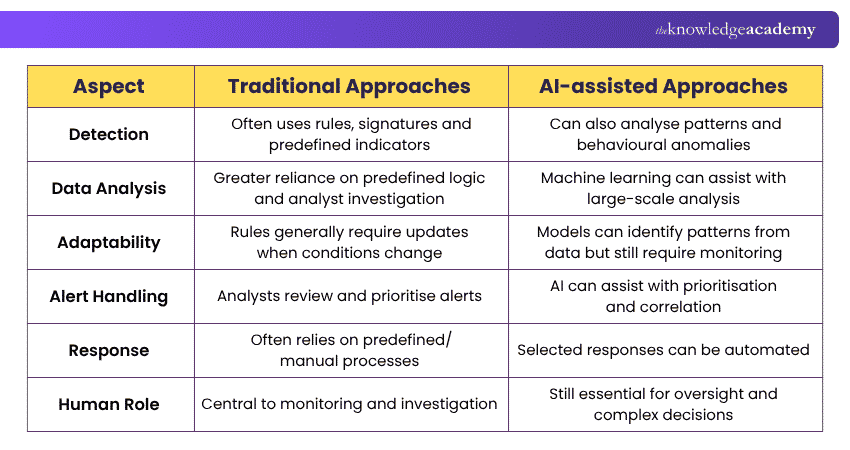
Here’s how AI in cyber security differs from traditional approaches:
Real-world Examples of Artificial Intelligence in Cyber Security
Artificial intelligence is already being used across major cyber security platforms to help security teams investigate incidents, analyse behaviour, prioritise threats, and respond more efficiently. Here are some current real-world examples:
1) Microsoft Security Copilot
Microsoft uses AI across its security ecosystem to help analysts investigate incidents, interpret security signals, and understand activity across services such as Microsoft Defender, Sentinel, and Purview. AI-assisted capabilities can help teams bring together scattered telemetry and build a clearer picture of what happened during an incident.
2) CrowdStrike Charlotte AI
CrowdStrike’s Charlotte AI is designed to support modern Security Operations Centre (SOC) teams by bringing together cross-domain security context, coordinating investigations, and assisting with governed response actions. It can help analysts review threats faster while keeping human control over important security decisions.
3) Darktrace
Darktrace uses Adaptive AI and behavioural analysis to understand how users, infrastructure, and AI systems normally behave. It can then identify meaningful deviations from expected patterns, helping security teams detect unusual activity, investigate incidents, and prioritise potential threats.
4) Google Security Operations
Google Security Operations uses AI-assisted security capabilities to help organisations monitor, detect, and respond to threats. Its newer agentic security features can support activities such as threat hunting, detection engineering, prioritisation, and contextual analysis across security environments.
5) Palo Alto Networks Precision AI
Palo Alto Networks uses Precision AI across its cyber security platform to support threat detection, analysis, prevention, and response. The approach combines machine learning, deep learning, and generative AI to help security teams analyse large volumes of security data and streamline investigation and response workflows.
Here are some myths related to AI in cyber security to watch out for:
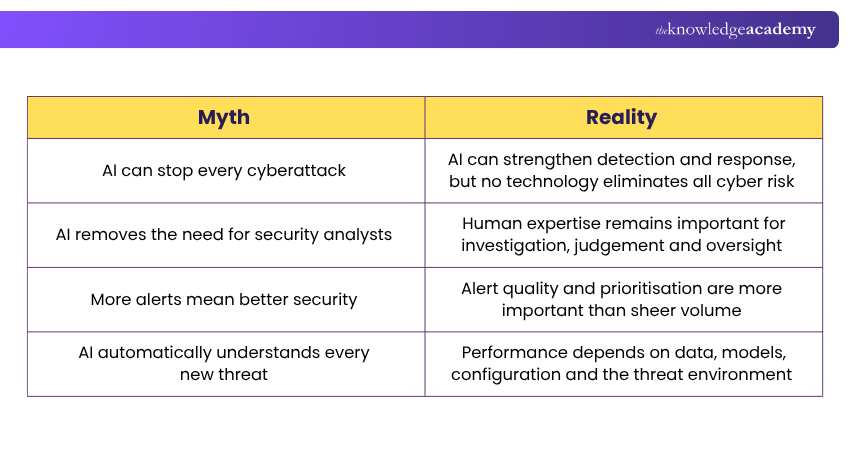
AI is becoming an important capability within modern cyber security. It can help organisations analyse security data, detect unusual behaviour, prioritise potential threats and automate selected response activities at scale. However, AI is most effective when combined with established security controls and human expertise. By managing data quality, model performance, privacy, governance and automation carefully, organisations can use AI to strengthen cyber defence without becoming overly dependent on it.
AI Cyber Security Checklist
Before relying on an AI-enabled security process, check:
□ Is there a clearly defined cyber security objective?
□ Is the input data reliable and relevant?
□ Are false positives and false negatives monitored?
□ Are high-impact actions appropriately controlled?
□ Is sensitive security data protected?
□ Are AI models and supporting systems monitored?
□ Is human escalation available when needed?
Learn how artificial intelligence can boost your business analysis game. Sign up for our Artificial Intelligence (AI) for Business Analysts course now!

Nilotpal Sarmah is a Senior Content Writer with 11+ years of overall experience spanning engineering, operations and content development. His technical knowledge and extensive writing experience enable him to simplify specialised topics across IT and Tech, Business Skills, Project Management, Health and Safety, and ISO and Compliance.
View Detail

 If you wish to make any changes to your course, please


