




We may not have the course you’re looking for. If you enquire or give us a call on +27 800 780004 and speak to our training experts, we may still be able to help with your training requirements.
Artificial Intelligence in Business: A Complete Guide
ByNilotpal SarmahLast updated on: 10 October 2026
Explore the realm of Artificial Intelligence in Business. Gain a comprehensive understanding of what AI means in the corporate world and its implications. Dive into the applications of AI in business and uncover the benefits it offers to enterprises. Additionally, discover the challenges that AI can pose in a corporate setting.
Quick Overview
Artificial Intelligence is becoming a practical part of how organisations operate, compete, and adapt to changing customer and market needs. Its growing role is encouraging businesses to rethink how decisions are made, how work is organised, and where human expertise can create the most value. At the same time, successful AI adoption depends on more than simply introducing new technology. Businesses also need the right data, skills, governance, and oversight to use AI responsibly and effectively.
Artificial Intelligence (AI) has changed the business landscape dramatically. Almost every business uses AI tools, such as ChatGPT and others, to simplify and enhance operations. Today, artificial intelligence in Business plays a pivotal role in controlling and managing companies' operations and optimising them to improve overall performance.
This shift is also changing what organisations expect from their people, processes, and technology. Using AI effectively requires more than access to powerful tools; it also requires clear goals, responsible adoption, and informed decision-making.
What is Artificial Intelligence in Business?
Artificial intelligence in Business refers to using AI technologies and techniques within the corporate environment to enhance operational efficiency, decision-making processes, and overall business performance. AI systems simulate human intelligence by analysing vast amounts of data, recognising patterns, and making intelligent predictions or recommendations.
In the business context, AI can be applied to various areas such as customer service, marketing, sales, supply chain management, finance, and human resources. It enables organisations to automate tasks, gain valuable insights from data, personalise customer experiences, optimise processes, and ultimately drive innovation and competitive advantage. AI in Business represents a transformative force that revolutionises traditional practices and unlocks new opportunities for growth and success.

Applications of Artificial Intelligence in Business
Below are a few applications for artificial intelligence in business.
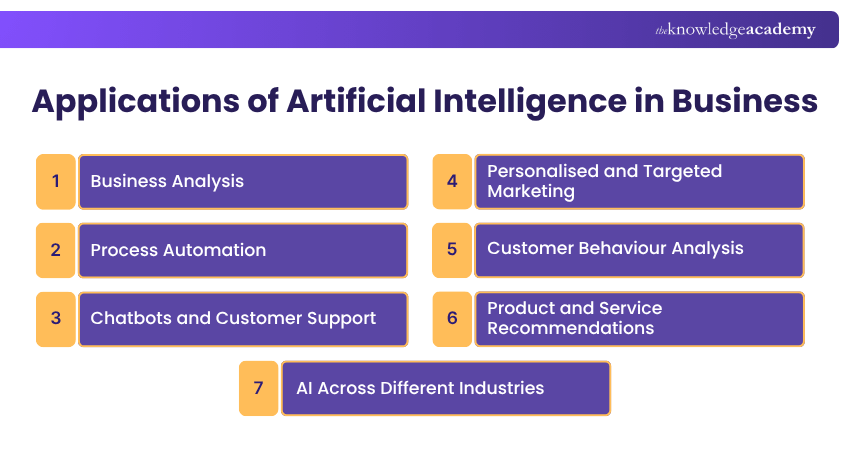
1) Business Analysis
AI plays an important role in Business Analysis by helping organisations gather and analyse data more efficiently. It can identify patterns, generate insights, and support better business decision-making.
These capabilities support more informed decision-making and help businesses better understand performance, customer behaviour, and emerging opportunities.
2) Process Automation
AI is increasingly used in process automation to streamline business activities and reduce the need for manual intervention. This allows employees to focus on more important and productive tasks.
Robotic Process Automation (RPA) is commonly used to automate repetitive, rule-based processes. AI can also be integrated with RPA to handle more complex tasks and changing inputs.
3) Chatbots and Customer Support
Businesses use chatbots to answer customer queries and provide faster support. AI-powered chatbots can use Natural Language Processing (NLP) and conversational AI to understand customer requests and provide more personalised responses.
They can also handle common enquiries around the clock, guide users to relevant information, and escalate more complex issues to human support teams when needed.
4) Personalised and Targeted Marketing
Businesses use AI to recommend products and services based on customer interests and behaviour. This is especially useful for e-commerce companies, as AI can analyse customer data and suggest relevant products.
AI can also help businesses segment customers based on characteristics such as age, location, interests, and purchasing behaviour.
5) Customer Behaviour Analysis
Companies use AI to analyse customer behaviour, feedback, reviews, and satisfaction data. These insights can help organisations identify customer preferences and improve their products, services, and overall performance.
These insights can support more informed decisions around product development, service enhancements, and customer engagement strategies.
6) Product and Service Recommendations
AI-powered recommendation systems analyse customer interests and previous interactions to suggest relevant products or services.
This helps businesses improve product discovery, make customer journeys more relevant, and create more personalised experiences across digital platforms.
7) AI Across Different Industries
AI is widely used in sectors such as entertainment, education, software development, and healthcare. It can support the creation of text, images, music, code, and other digital content.
In healthcare, AI is also used to support research, data analysis, medical imaging, drug discovery, and the development of new healthcare technologies.
Benefits of Artificial Intelligence in Businesses
Artificial intelligence offers several benefits that can help businesses work smarter, respond faster, and deliver greater value across their operations. Below are some of the benefits of artificial Intelligence in business.
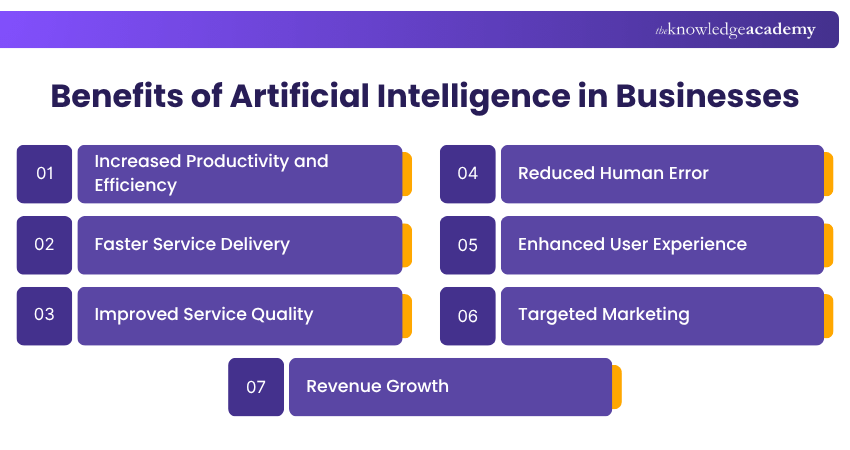
1) Increased Productivity and Efficiency: AI helps automate routine tasks and streamline business processes.
2) Faster Service Delivery: AI enables organisations to provide quicker and more responsive services.
3) Improved Service Quality: AI supports more consistent and accurate business operations.
4) Reduced Human Error: Automation can minimise errors in repetitive and data-driven tasks.
5) Enhanced User Experience: Personalisation helps businesses deliver more relevant customer experiences.
6) Targeted Marketing: AI enables companies to tailor marketing based on customer preferences and behaviour.
7) Revenue Growth: Improved efficiency, personalisation, and customer targeting can support higher revenue.
Trainer’s Insight
A useful way to judge an AI initiative is to compare the quality of the outcome before and after implementation, not just the amount of automation introduced.
Challenges of Artificial Intelligence in Business
Despite its potential, adopting artificial intelligence can introduce several practical, technical, and organisational challenges that businesses need to manage carefully. Below is a list of challenges that occur while using AI in business:
1) Implementation Costs: AI systems can require investment in computing infrastructure, software, integration, data management, and skilled professionals. These costs can create challenges for smaller businesses with limited resources.
2) Data Quality and Availability: AI systems depend heavily on reliable and relevant data. Isolated, incomplete, or poor-quality data can reduce the accuracy and effectiveness of AI-generated insights and decisions.
3) Trust and Human Oversight: Trust is another challenge when adopting artificial intelligence in business. While AI can automate many tasks and processes, human judgement, expertise and oversight remain important, particularly when AI supports complex or high-impact decisions.
4) AI Skills Gap: Companies need employees with appropriate AI and data skills to use these technologies effectively. A shortage of expertise can make AI adoption more difficult, requiring organisations to invest time and resources in employee training and upskilling.
5) Security and Data Privacy: AI systems often process large volumes of data, which can create additional security and privacy risks. Organisations must protect sensitive information from unauthorised access, data breaches, and misuse while implementing suitable security controls.
6) Regulatory Compliance: Businesses using AI must comply with relevant laws and regulations. Where AI processes personal data in the UK, requirements under the UK GDPR and Data Protection Act 2018 can apply to the training, testing and deployment of AI systems
7) Bias and Fairness: AI systems can produce biased or unfair outcomes when their data, design, or deployment contains underlying biases. Businesses therefore need to assess AI systems for fairness and take appropriate steps to reduce discriminatory or prejudiced outcomes.
Pro Tip
Create a simple AI governance checklist that covers ownership, approval, monitoring, escalation, and review. This helps teams manage AI consistently as its use expands across the business.
AI in business is not a finish line but an ongoing process of testing, learning, and refining. The organisations that gain the most from it are often those that stay curious, question results, and keep improving how people and technology work together.
Build smarter DevOps workflows with the Artificial Intelligence (AI) For DevOps Training – Register now!

Nilotpal Sarmah is a Senior Content Writer with 11+ years of overall experience spanning engineering, operations and content development. His technical knowledge and extensive writing experience enable him to simplify specialised topics across IT and Tech, Business Skills, Project Management, Health and Safety, and ISO and Compliance.
View Detail

 If you wish to make any changes to your course, please


