




We may not have the course you’re looking for. If you enquire or give us a call on 01344203999 and speak to our training experts, we may still be able to help with your training requirements.
SAFe vs Agile: Key Differences and When to Use Each
ByNilotpal SarmahLast updated on: 18 September 2026
Explore the key differences between SAFe and Agile, including their purpose, structure, scale and approach to coordination. This blog also explains when additional scaling structures may be useful for your organisation.
Zoom in, and you see an Agile team delivering in short cycles. Zoom out, and you might see dozens of Agile teams trying to deliver one connected solution.
The principles have not disappeared, but the coordination challenge has changed.
That is the key to understanding SAFe vs Agile. Agile provides the values and principles for adaptive delivery, while SAFe introduces additional structures for applying Lean and Agile practices at scale. Let’s explore how they compare and when additional scaling structures may be useful.
What is Agile?
Agile is an approach to Software Development that emphasises adaptability, collaboration, customer involvement and incremental delivery. Rather than relying on one long sequence of fixed stages, Agile encourages teams to deliver value frequently, gather feedback and adapt as requirements evolve.
The Agile Manifesto, created in 2001, established four core values:
1) People and collaboration over rigid processes and tools
2) Working software over extensive documentation
3) Customer partnership over contract discussions
4) Adapting to change over strictly following a plan
These values are supported by 12 principles that emphasise frequent delivery, collaboration, sustainable development, technical excellence, simplicity and regular reflection.
Core Characteristics of Agile
Agile working commonly involves:
1) Iterative Delivery: Work is divided into smaller increments instead of delivering everything at the end.
2) Adaptability: Teams can respond to changing requirements and feedback throughout development.
3) Customer Collaboration: Regular feedback helps teams ensure that what they build continues to address customer needs.
4) Team Collaboration: Cross-functional teams communicate closely and take greater ownership of their work.
5) Continuous Improvement: Teams regularly review their performance and identify ways to improve.

What is SAFe (Scaled Agile Framework)?
The Scaled Agile Framework (SAFe) is designed to help organisations apply Lean and Agile practices across multiple teams and broader organisational structures.
Rather than replacing Agile, SAFe builds on Agile and Lean principles by adding structures for coordinating teams, aligning work with business priorities and delivering value at scale.
A key concept in SAFe is the Agile Release Train (ART), a long-lived team of Agile teams and other stakeholders that work together to develop and deliver solutions incrementally.
Core Characteristics of SAFe
SAFe places emphasis on:
1) Aligning Multiple Agile teams: Bringing multiple Agile teams together around shared objectives creates better coordination while allowing teams to focus on their individual responsibilities.
2) Connecting Strategy with Execution: Turning strategic priorities into actionable work helps ensure that day-to-day delivery contributes to broader business goals
3) Coordinating Dependencies: Identifying cross-team dependencies early enables teams to address conflicts, sequence work effectively, and reduce delivery delays.
4) Delivering Value through Agile Release Trains: Through Agile Release Trains (ARTs), multiple teams plan and deliver together around shared goals and value streams.
5) Lean Portfolio Management: Lean Portfolio Management helps align strategy, funding and execution across the portfolio.
6) Built-in Quality: SAFe emphasises quality throughout development rather than relying on checks at the end.
7) Continuous Learning and Improvement: Regular reflection, feedback, and learning encourage teams to refine their practices and improve future outcomes.

Agile → Principles for working and delivering adaptivelySAFe → A framework for coordinating Lean-Agile delivery at scale
SAFe vs Agile: Key Differences
Although SAFe builds on Agile principles, Agile and SAFe are not interchangeable.
1) Purpose
Agile provides values and principles that support adaptive, collaborative and customer-focused delivery.
SAFe provides a structured framework for applying Lean-Agile practices across multiple teams and broader organisational levels.
2) Scale
Agile principles can be applied across different organisational contexts, while many Agile methods and frameworks focus primarily on team-level delivery.
SAFe explicitly addresses coordination across multiple Agile teams and organisational levels.
3) Structure
Agile does not prescribe a specific organisational structure. Teams can select practices and frameworks suited to their context.
SAFe provides defined concepts, roles, events and structures to coordinate work across teams and value streams.
4) Planning
Agile encourages iterative planning, frequent feedback and adaptation as needs change.
SAFe combines team-level iteration with broader planning and alignment across multiple teams.
5) Coordination
Agile teams may coordinate relatively independently when cross-team dependencies are limited.
SAFe provides mechanisms for synchronising multiple teams where dependencies and coordination needs are greater.
6) Governance and Strategy
Agile principles focus on adaptive delivery, collaboration, customer value and continuous improvement rather than prescribing enterprise governance structures.
SAFe extends these ideas into areas such as Lean Portfolio Management, strategic alignment, portfolio funding and broader organisational coordination.
Benefits and Limitations of Agile and SAFe
Both approaches offer valuable capabilities, but their suitability depends heavily on organisational context.
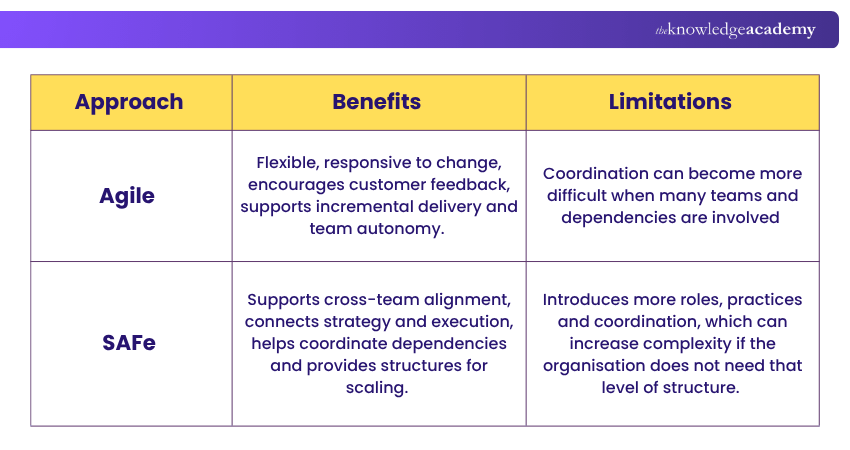
Neither approach is suitable for every organisational context.
A small product team may not need extensive scaling structures, while a large organisation with multiple interconnected teams may benefit from greater coordination and alignment.
SAFe vs Agile: Which Should You Choose?
The choice is not simply SAFe or Agile because SAFe itself incorporates Agile principles. The key consideration is how much structure your organisation needs to apply Agile effectively.
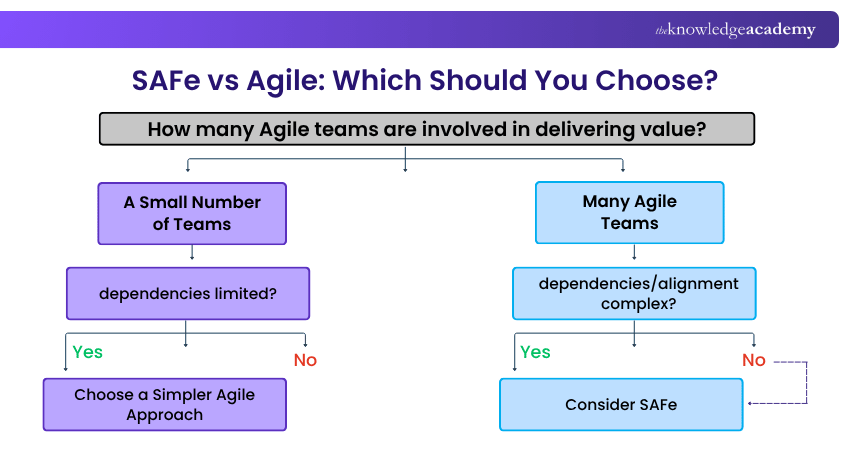
How much structure does your organisation need to apply Agile effectively?
Use these questions as a quick decision guide:
Choose a simpler Agile approach when:
1) A small number of teams are involved
2) Teams operate with limited dependencies
3) Cross-team coordination is relatively straightforward
4) Teams can adapt effectively without extensive scaling structures
Consider SAFe when:
1) Many Agile teams contribute to shared solutions
2) Cross-team dependencies are significant
3) Greater strategic alignment across teams is needed
4) Portfolio-level coordination is required
5) Large-scale planning and governance need greater structure
The goal is to use enough structure to support coordination without adding unnecessary complexity.
Align strategy with investment decisions through the Lean Portfolio Management SAFe® Course — Sign up today and maximise value across your portfolio!

Nilotpal Sarmah is a Senior Content Writer with 11+ years of overall experience spanning engineering, operations and content development. His technical knowledge and extensive writing experience enable him to simplify specialised topics across IT and Tech, Business Skills, Project Management, Health and Safety, and ISO and Compliance.
View Detail

 If you wish to make any changes to your course, please


